Skip to content
Fence Staining & Sealing in Overland Park, KS — One Even Tone, Corner to Corner

Fence Staining & Sealing in Overland Park, KS — One Even Tone, Corner to Corner

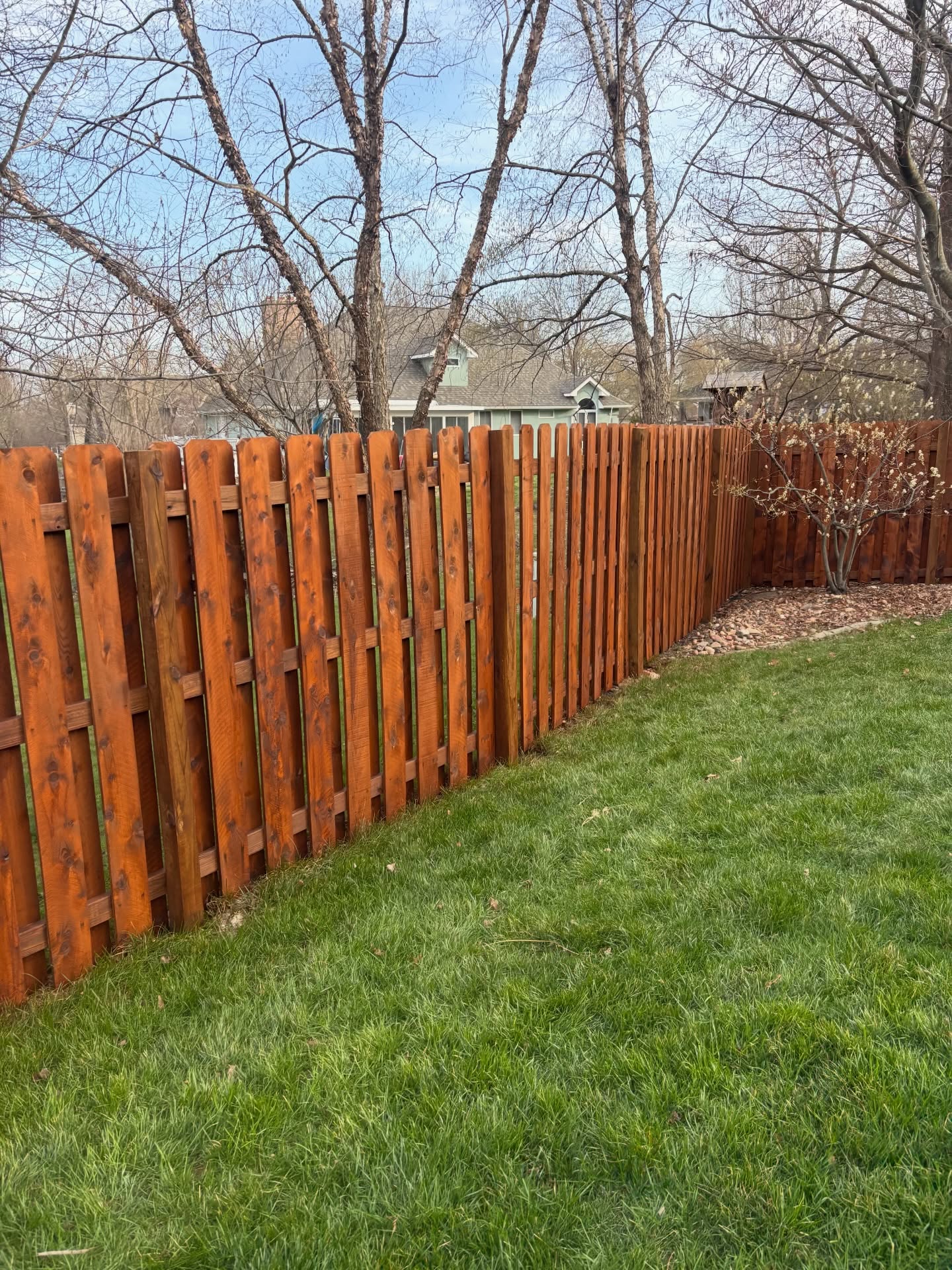
On an Overland Park lot the fence is often the longest thing you see from the street — so the hard part of staining it isn't the color, it's holding that one color the whole way down a 300-foot run. RKC Wood Care Pros washes and brightens a run to a single baseline, then spray-and-back-brushes penetrating semi-transparent stain at a steady rate so no section goes heavier than the next. We help you pick a tone that fits your wood and your exposure — deeper pigments for the high-sun west and south faces — and prove it on a hidden test square first. Grayed north-side cedar restored, new south-side runs coated on time, every date on your record. 400+ fences across the metro since 2021. Call (913) 286-1091 for a free walk and quote.

★★★★★
4.9
from 85 reviews
Licensed
& Insured · KS + MO
400+
fences installed
A+ BBB Rated Kansas City Fence Contractor Even-Tone Finishing · Spray + Back-Brush 2-Year Cedar / 3-Year PT Cycle
View stain options in our catalog ↓

WHY OVERLAND PARK HOMEOWNERS STAIN WITH RKC

A Long Run That Reads as One Deliberate Finish

On the big perimeters common in Overland Park, a good stain job is invisible in the best way — you can't tell where the crew started or stopped, and no section is heavier or lighter than the next. Most calls here come down to evenness: a run that's gone blotchy as the sun-hit faces bleached first, a patched section in the wrong color, or a grayed older fence that's the one tired thing on an otherwise sharp property. Every one is a uniformity problem before it's a color problem.

1

One even tone down the whole run

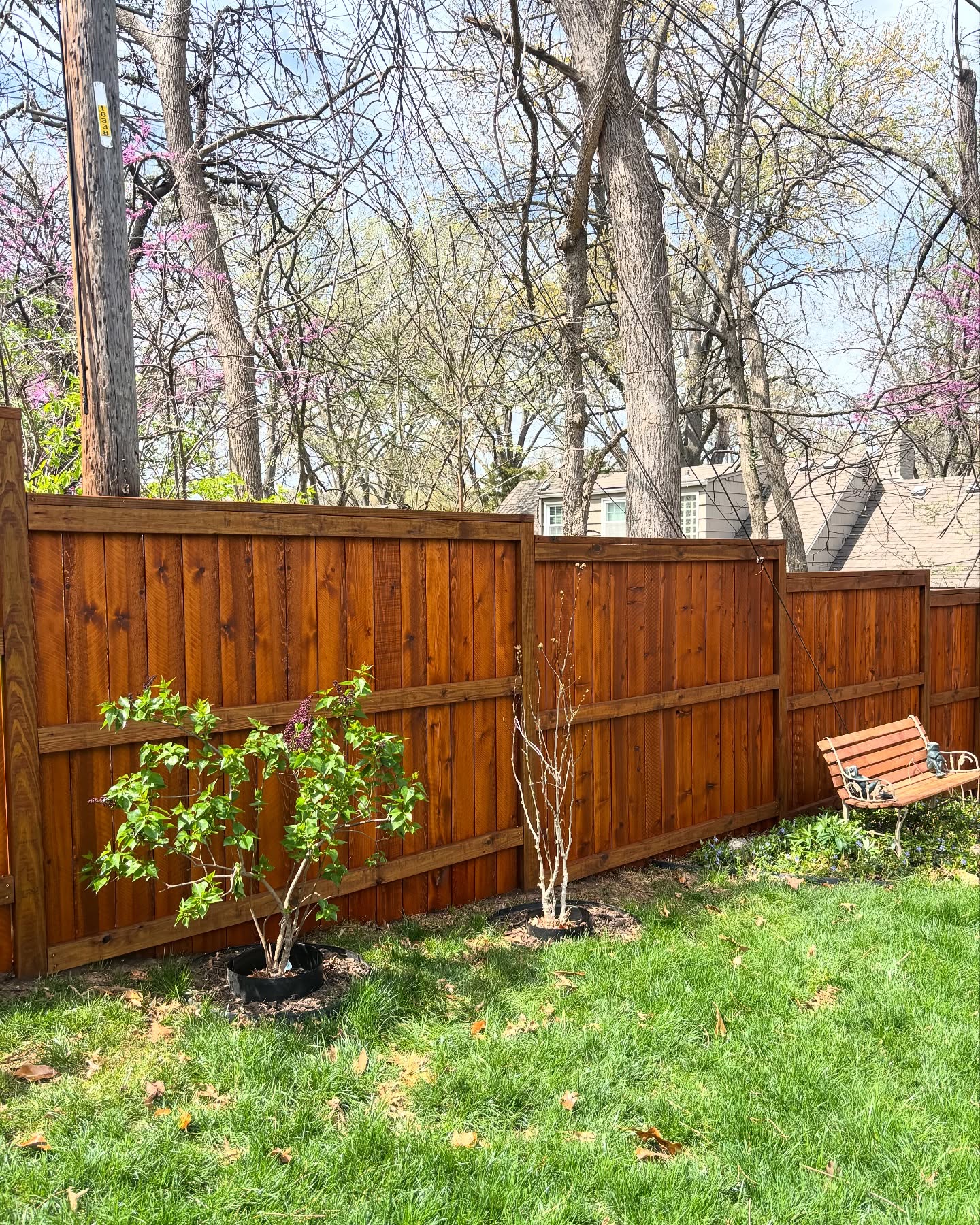
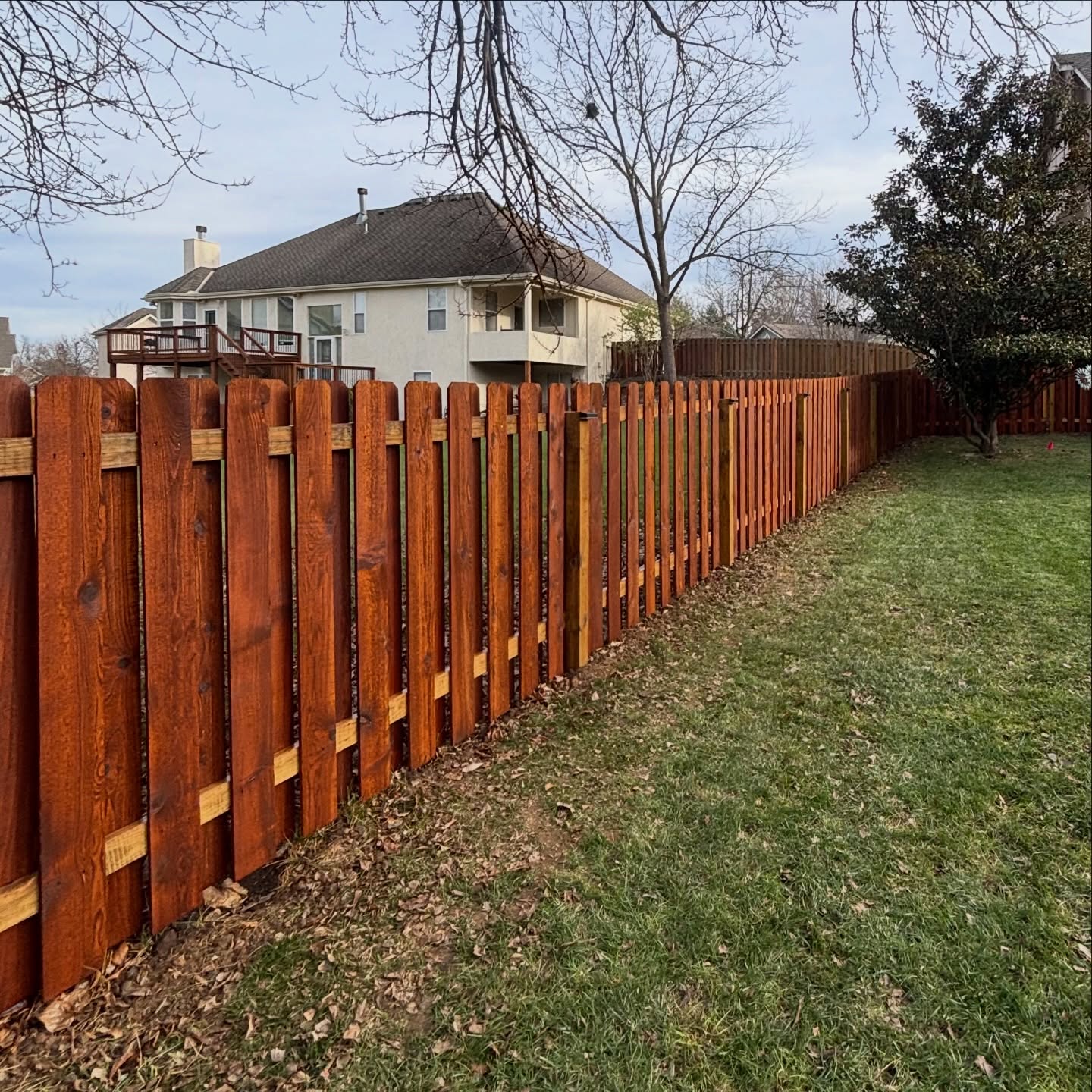
The tell of a professionally stained Overland Park fence is that you can't see where the crew started or stopped — one continuous tone corner to corner. That comes from washing and brightening the run to a common baseline, then spray-and-back-brushing at a steady rate so no section goes heavier than the next. On the long perimeters common here, evenness is the whole game, and it's the thing a rushed one-person crew can't fake.
2

The one thing on the property that isn't sharp

On a well-kept Overland Park lot, a grayed-out fence is usually the single tired element dragging down an otherwise sharp yard — and the first thing a buyer's eye lands on. A fresh, even coat pulls the fence back in line with the house and the landscaping. It's low money against what it does for how the whole property reads from the curb, which is why so many of our stain calls come right before a listing.

3

North side or south side, handled

Overland Park splits by age: the established neighborhoods north of 135th carry a lot of mature cedar ready for restoration, while the newer builds to the south are hitting their first-coat and early re-coat windows. We work both ends the same way — read the wood, match the tone, get it on the schedule — whether your fence is fifteen years old or fifteen months.

4

Still even at year five

Year five is where an Overland Park run either still reads like one fence or starts going patchy. Holding it comes down to penetrating semi-transparent product (fades, doesn't peel), the deeper pigments on the high-sun faces, and a 2-year cadence that re-levels the tone before the sun can split it. The fences we keep on schedule still look like a single, deliberate finish years on.

OVERLAND PARK LOCAL CONDITIONS

Why Fence Staining in Overland Park Is About Evenness

Three local factors shape stain work in Overland Park: the length of the runs, the split between an older north and a newer south, and the high sun that decides the tone. This is a market where a grayed run in an established north neighborhood needs a full restoration in the same week a young south-side fence wants its first careful coat. Same crew, same standard on both: read the wood, level the surface, hold one tone the whole way.

1

Long, visible runs make evenness the job

Overland Park lots tend toward bigger perimeters and long streetfront runs, which shifts the hard part of a stain job from 'what color' to 'the same color, the whole way.' A short side-yard fence forgives a little unevenness; a 300-foot run past the sidewalk shows every heavy lap and thin spot. So we wash and brighten to one baseline and apply at a controlled, steady rate — holding a single tone over a long line is the actual craft here, not the stain in the can.

2

A city split by fence age

Overland Park is really two staining markets. North of about 135th, the established neighborhoods hold decades of mature cedar — much of it in restoration territory, grayed and ready for a brighten-and-recoat. To the south, the newer subdivisions cycle through first coats and early re-stains, where matching a young street's tone is what matters. The first thing we settle at the estimate is which of those your fence is, because the scope and the tone decision follow from it.

3

High-sun faces decide the tone

The west- and south-facing sides of an Overland Park fence take the season's hardest UV and bleach first, which is why tone isn't only a looks call. Deeper, higher-pigment stains — mission brown, dark walnut — carry more UV block and hold color noticeably longer on those exposed runs, while a sheltered north face wears a lighter tone fine. We'll often spec a run to its exposure, and we always prove the color on a hidden test square before committing it, since weathered wood pulls every tone darker than the card.

Overland Park neighborhoods we've stained and restored fences across span both sides of town — the established streets around Nall Hills and Santa Fe up north, and the newer builds down toward Blue Valley, Wolf Creek, and the 151st Street corridor. Cedar privacy, treated pine, board-on-board shadow box, and mixed runs. Same read, same wash-and-brighten to a baseline, same steady spray-and-back-brush on each. And a fence built by someone else takes a coat just the same — good wood, level prep, and a penetrating tone don't care whose name was on the install.

CHOOSING A TONE

The Overland Park Stain-Tone Guide — How Each One Reads and Ages

Tone isn't only a looks decision — the pigment that gives a stain its color is the same pigment that blocks UV, so the tone you pick partly decides how long the coat lasts. Here's how the tone families we run in Overland Park read on the street, which wood they suit, and how each one ages — the trade-off between the look you want and the protection a high-sun run needs. We prove the final pick on a hidden test square before the whole fence is committed.

Tone family Reads like on the street Best on How it ages When OP owners pick it
Natural / clear-toned The raw cedar look, lightest of all New cedar Fades fastest — the shortest re-coat interval Owners who want protection without adding color
Honey gold / harvest Warm, bright amber New or lightly weathered Fades gracefully and forgivingly The classic bright, traditional JoCo look
Cedar-tone / redwood Medium warm red-brown New or weathered The safe all-rounder; hides minor variation Matching an existing neighborhood tone
Mission brown / chestnut Mid-dark neutral brown New or weathered Long — most UV pigment of the mid tones High-sun west and south runs, resale-neutral
Dark walnut / espresso Deep, rich brown Weathered (hides age best) Longest-lasting UV block, darkest Premium curb appeal on capped cedar
Mahogany / red-brown Warm red depth New or weathered Rich, but reads redder in full sun Statement runs and dark-trim homes

The pattern down the table: lighter reads more natural but re-coats sooner; darker carries more pigment and holds longer on high-sun faces. Most Overland Park runs land in the mission-brown-to-dark-walnut middle for exactly that reason. Want to see two tones side by side on your own wood? A free staining walk brings the sample squares, or start with a new Overland Park wood fence from the same crew that will finish it.

STAIN SERVICES

First Coats, Re-Stains & Gray-Fence Restoration — Every Overland Park Scenario

Which scope your Overland Park fence needs follows from the read — new wood waiting on its first coat, cedar due to be re-leveled to one tone, treated pine on the 3-year clock, or a grayed run that needs bringing back. Here are the four scopes we run across Overland Park, what each fits, and real per-foot pricing. Product lines and tones are swappable within a scope; the wash-and-brighten to a baseline, the spray-and-back-brush, and the in-house crew never change.

New-Install First-Coat Stain by RKC Wood Care Pros in Overland Park, KS

New-Install First-Coat Stain

The starter coat on every RKC Overland Park install

The coat that locks in the tone before the sun gets to it. New cedar sits about a month so its moisture falls and the finish keys into the grain; treated pine waits closer to three for its treatment to cure. We settle the color during install week so it's already loaded, and on many Overland Park cedar packages this starter coat is folded into the install — one to raise with Josh at the estimate. Semi-transparent, sprayed and brushed to one even tone across the whole new run.

  • Price: $3–6 / LF · typically $450–900 per 150 LF
  • Typical use: New cedar in the south-OP subdivisions, first protective coat after any RKC install, setting the tone from day one
Existing Cedar Re-Stain by RKC Wood Care Pros in Overland Park, KS

Existing Cedar Re-Stain

The 2-year cycle · the everyday OP call

The coat that pulls a run back to one tone. Caught on cycle it's a wash to clear oxidation and mildew, a metered dry window, then penetrating semi-transparent worked into the grain the length of the fence. We pull your color off the record and match it exactly, or re-level a run that's drifted — a bleached west face, a mismatched patched section — to a single finish again. The next date lands on the invoice before we leave.

  • Price: $4–8 / LF · typically $600–1,200 per 150 LF
  • Typical use: Established north-OP cedar, tone refreshes, re-leveling a run that's gone patchy or been touched up in the wrong color
Pressure-Treated Pine Re-Stain by RKC Wood Care Pros in Overland Park, KS

Pressure-Treated Pine Re-Stain

90-day first coat, 3-year cycle after

Pine keeps its own calendar. The factory treatment has to cure before a finish will grip — 90 days on a first coat — and it wants an oil-based semi-transparent afterward, which sinks into the dense treated grain a water-based product just sits on. We brighten any green or blackened boards first so the tone lands even across the run. You'll see this most on the longer perimeter runs and value builds around Overland Park.

  • Price: $3–7 / LF · typically $450–1,050 per 150 LF
  • Typical use: Treated-pine privacy and perimeter runs, larger lots, budget installs inherited from other contractors
Gray-Fence Restoration by RKC Wood Care Pros in Overland Park, KS

Gray-Fence Restoration

Bringing weathered north-OP runs back

The call we get most from the established side of town. A gray fence usually isn't spent — the silver is a shallow weathered layer over sound wood, uneven because the sun-hit faces went first. We strip any failed film, brighten the whole run to a common baseline, wash, dry it hard, meter it, then lay one full penetrating coat so it reads as a single fence again. Where a probe finds soft fiber we stop and put you on board replacement first — no finish over rot.

  • Price: $6–12 / LF · typically $900–1,800 per 150 LF
  • Typical use: Grayed mature cedar in the older neighborhoods, just-bought homes, runs that went patchy from uneven sun exposure
Semi-transparent penetrating cedar fence stain pricing — Overland Park, KS — RKC Wood Care Pros

OVERLAND PARK STAIN PRICING

What Fence Staining Costs in Overland Park

Price tracks how much prep it takes to get the run level — a fence caught on cycle costs a fraction of one that grayed unevenly and had to be brightened back — not the stain in the can. Every quote covers the wash, the metered dry window, penetrating semi-transparent stain, spray + back-brush by a two-person in-house crew, and a written re-coat date. The three configurations we quote most for Overland Park properties are below.

Cedar Re-Stain

$4–8 / LF

wash + penetrating stain

A full wash, a metered dry window, penetrating semi-transparent worked into both faces for one even tone, a walkthrough, and the 2-year date in writing. A common 150 LF Overland Park privacy run comes in around $600–1,200.

Pressure-Treated Re-Stain

$3–7 / LF

brighten + oil stain

Wash, a brightener on any discolored boards, an oil-based semi-transparent that grips the treated grain, and the 3-year date on file. Figure $450–1,050 for a 150 LF Overland Park pine run.

Gray-Fence Restoration

$6–12 / LF

strip · brighten · stain

Old failed finish off, the grayed and darkened boards brightened level, several wash passes, a moisture check, then one full penetrating coat. Priced from an on-site look at how uneven the run has gotten — a weathered 150 LF Overland Park fence usually $900–1,800.

Gray-fence restoration on unevenly weathered runs (strip + brighten to a baseline + multi-cycle wash + stain) is quoted after an on-site look at how far the tone has split — that read is what keeps you from paying restoration pricing on a fence that only needed a re-coat. Every Overland Park stain estimate is free, written, and itemized — call (913) 286-1091 or ask for an on-site walk. While we're there we can flag any Overland Park fence repair the wood needs before it's worth staining — one visit, same crew.

OUR STAIN PROCESS

How an Overland Park Stain Job Actually Runs

Four steps from the phone call to the final walk. Most Overland Park stain jobs span 2 to 4 days — but only one of them is stain day. The stain itself is usually a single day on site for a standard run. The rest of the clock is the read, the wash-brighten-dry-meter cycle that levels the surface, and the tone window before it. Here's what each step looks like on an Overland Park fence.

1

Measure the run and read where it stands

On an Overland Park property the fence is often the longest thing you see from the street, so the walk starts with two questions: how much of it is there, and how even is it right now. Josh or a lead tapes the footage, reads moisture with a meter, and maps where the run has drifted out of tone — a sun-bleached west face, a shaded damp corner, a section a prior owner touched up in the wrong color. That map is what an even finish is built from. The quote is free and itemized, with tone samples laid on a hidden board.

2

Level the surface before adding color

You can't lay an even topcoat over an uneven surface. We wash the whole run at low pressure to pull off oxidation, mildew, and loose old finish, then brighten the boards that have darkened or grayed so every one starts from the same place. Overland Park's clay and the shade on north-side lots make the drying stretch vary board to board, so we re-check with the meter and don't open a can until the wettest section reads ready.

3

Two-hand application for one continuous tone

The tool that ruins a long run is a lone sprayer — fast, but it lays color unevenly, heavy at the bottoms and thin up top. We pair a sprayer with a brusher working right behind it, driving the wet finish into the grain at a steady rate down the whole line. On a 300-foot Overland Park perimeter that's the difference between one continuous tone and a fence that looks like it was done in shifts.

4

Walk it together, then bank the date

The last step is your eyes on it with ours — we walk the full line for any board reading light or missed and touch it in before we call it done. Then the finish goes on record: date, product, exact color, footage, next coat due. Holding that record is why your re-coat reminder comes from us on time, and why the next coat matches this one exactly instead of guessing at a color years later.

RECENT OVERLAND PARK STAIN JOBS

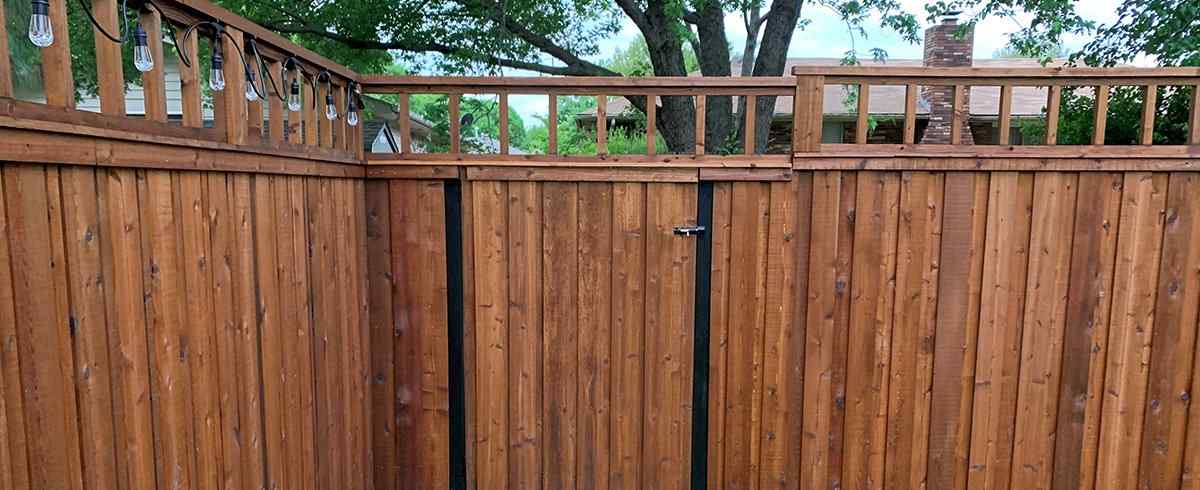
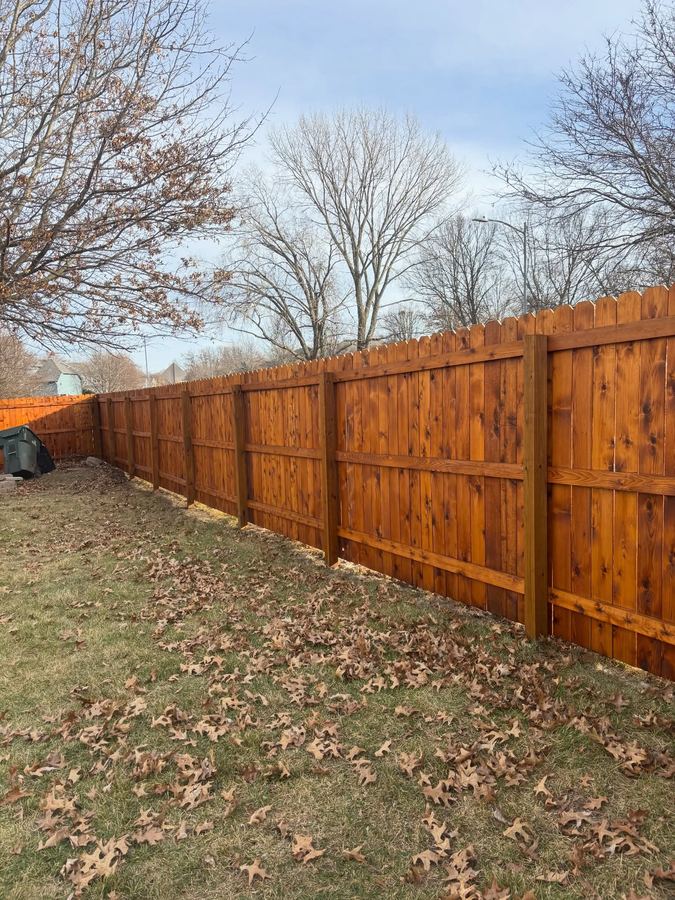
Cedar re-stain in mahogany red in Overland Park, KS by RKC Wood Care Pros
Cedar Re-Stain · Overland Park
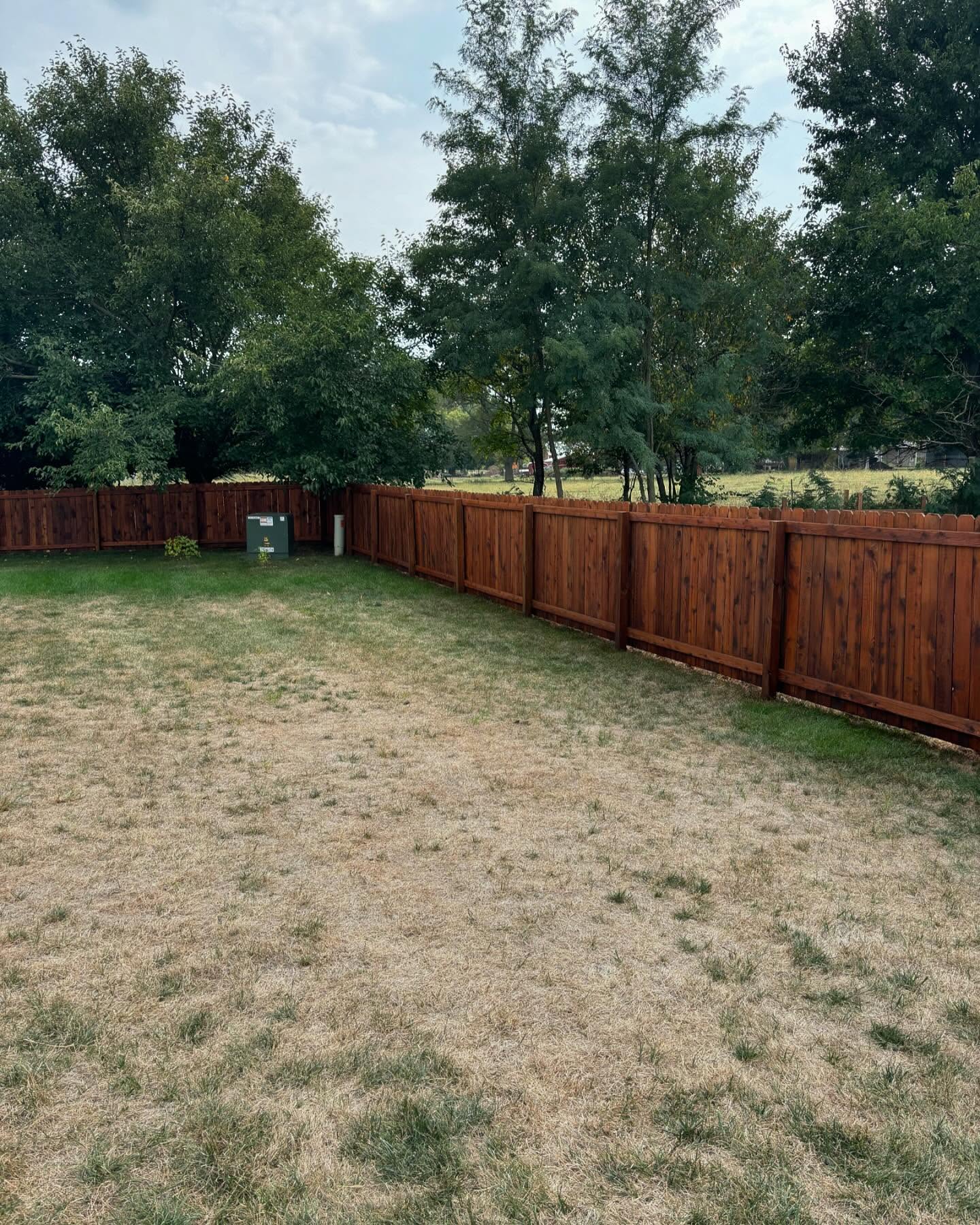
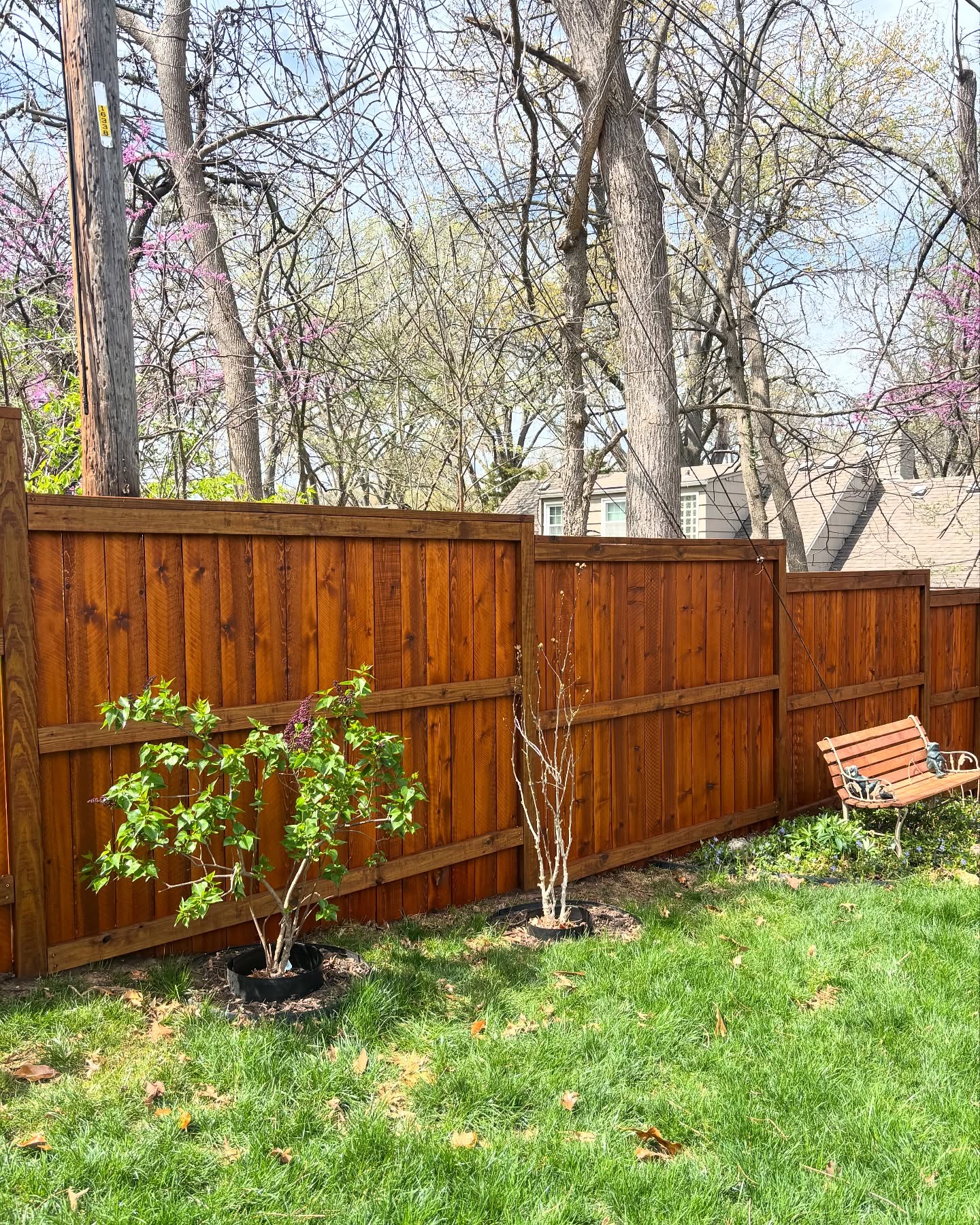
Completed cedar fence stain in Overland Park, KS
First Coat · Overland Park
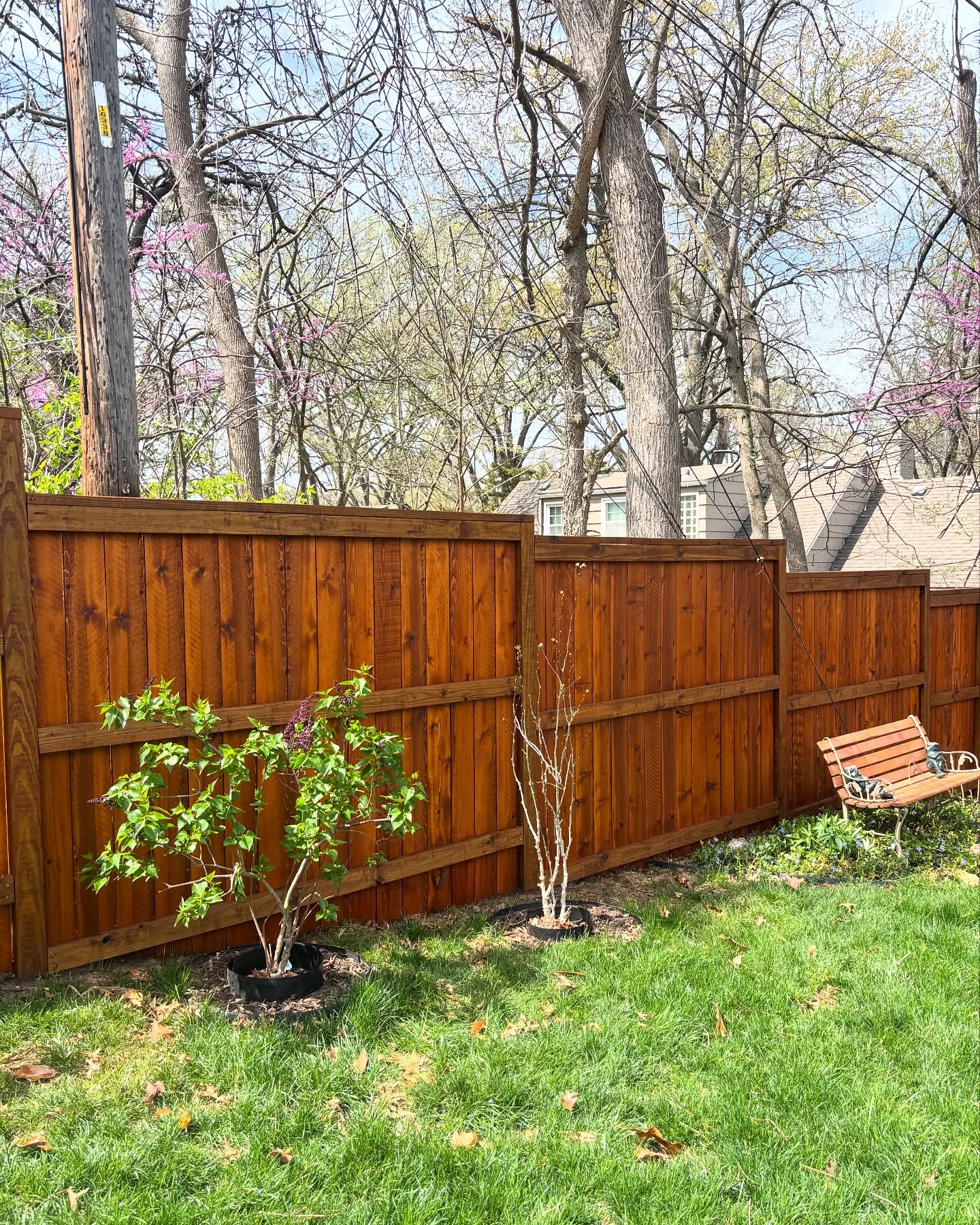
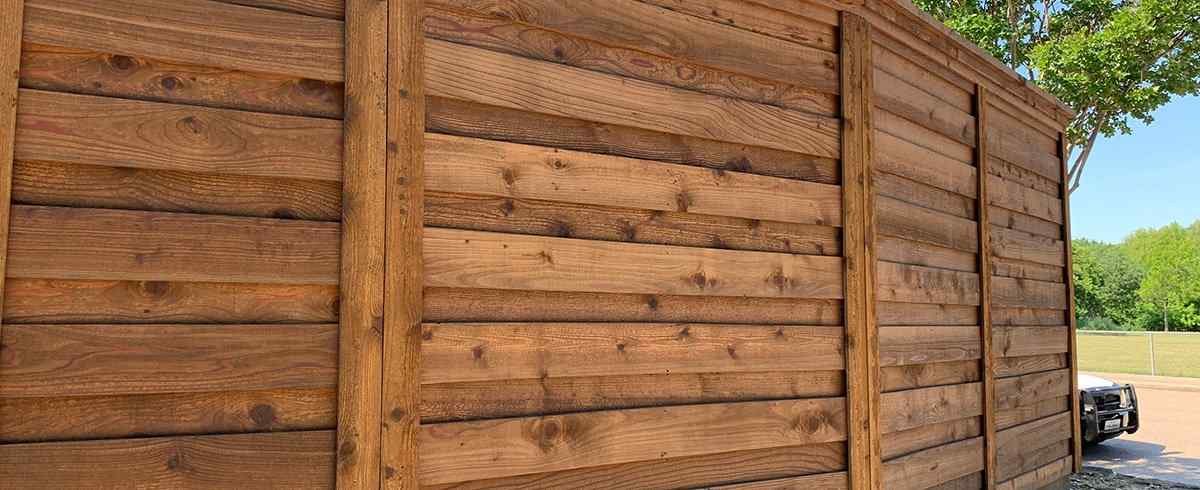
Pre-stained cedar in Overland Park, KS
PT Re-Stain · Overland Park
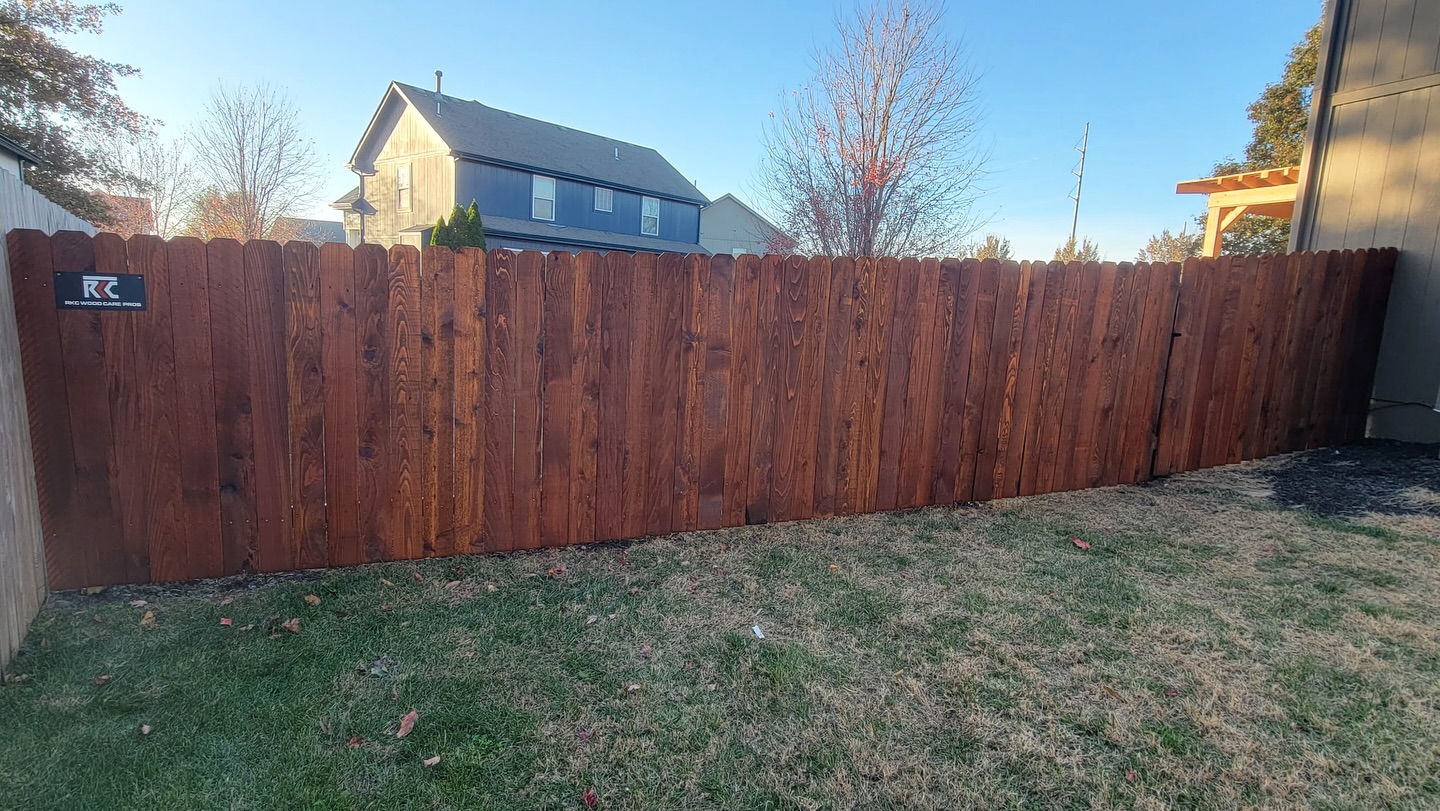
Gray-fence restoration to a dark finish in Overland Park, KS
Gray-Fence Restoration · Overland Park

REVIEWS

What Kansas City Homeowners Say About RKC

4.9 ★ · 85 Google reviews

Every review is on our Google Business Profile — read them there, unedited.

Read all 85 reviews on Google

OVERLAND PARK STAIN QUESTIONS

Stain Questions Overland Park Homeowners Ask Most

Fence staining in Overland Park comes down to three things: choosing a tone that both looks right and lasts, timing the coat to the wood, and the method that holds one tone across a long run. Below are the questions Overland Park homeowners actually ask on the stain estimate — grouped by topic, each answer specific to long runs, high sun, and a city split by fence age. If yours isn't here, call (913) 286-1091 and ask.

Overland Park, KS fence staining by RKC Wood Care Pros

Color & Tone

How do we choose the right tone for an Overland Park fence?
Start from the wood and the exposure, then the look you want. The tone guide above lays out how each family reads and ages; on a hard-sun west or south run we steer toward the deeper browns and walnuts that carry more pigment and hold color longer, while a sheltered north yard can take a lighter honey or natural. We always brush a sample on a hidden board and let you see it on your actual wood, in your own light, before the run is committed — a weathered board pulls every tone darker than the sample card.
Can you match the tone across a fence that's been patched?
Yes — in an established Overland Park neighborhood that's most of what a re-stain is. A prior owner's touch-up in the wrong color, a replaced section that never weathered in, a west face three shades lighter than the rest: we brighten the whole run to a common baseline first, then lay one tone over all of it so it reads as a single fence again. Matching an existing tone we didn't apply takes a test square, but we get close.
Should I go darker to make the fence last longer?
Darker tones do carry more pigment, and more pigment means a longer-lasting UV block — so on high-sun Overland Park runs a mission brown or dark walnut genuinely outlasts a pale natural. But it's a trade, not a free win: a dark fence reads bolder and runs warmer in July. We'll tell you where a deeper tone actually buys you time versus where it's purely a matter of taste.

Timing & Schedule

How often does an Overland Park fence need re-staining?
Cedar wants a fresh coat about every 2 years here, treated pine every 3. Overland Park's mix of open west-facing runs and 40-plus inches of annual rain works a finish harder than the 'every few years' guidance written for milder places — and a pale or clear finish burns off faster than a pigmented one. Push cedar much past two years and the even tone you paid for starts going blotchy as the high-sun sections bleach ahead of the rest. We date your next coat on the invoice.
When in the year do you schedule Overland Park stain work?
We run the bulk of it from late spring into early fall, when the dry windows are dependable and nights are warm enough to cure. Shaded north-side runs and anything near downspouts get extra drying time before we spray. If the meter reads damp we reschedule rather than trap moisture under the coat — and we'll take the warm, dry breaks in the shoulder months when they come.

Product & Application

What stains do you use on Overland Park fences?
We keep four penetrating semi-transparents on the shelf — Cabot Australian Timber Oil, Sikkens ProLuxe Cetol SRD, Ready Seal, and Benjamin Moore Arborcoat — and match the line to the wood and the tone you choose. On Overland Park's high-sun west and south runs we lean to the deeper, higher-pigment formulas that hold color longest; sheltered cedar takes a water-based semi-transparent fine.
Why semi-transparent instead of a solid stain or a clear sealer?
Think of it as three trade-offs. A solid stain gives the most color but films over the grain and eventually peels, which on a long visible run means scraping, not refreshing. A clear sealer keeps the grain but skips the pigment, so the wood grays anyway. Semi-transparent is the one that both shows the grain and carries real UV protection, and because it fades instead of peeling, the re-coat is a wash-and-recoat — a real difference when the fence is 300 feet of streetfront.
What is 'spray and back-brush,' and why insist on it?
It's how you get one tone across a big Overland Park run. A sprayer alone moves quickly but drops color unevenly; a brush alone is even but far too slow for a long perimeter and leaves lap lines. Running them together — spray, then immediately brush the wet stain into the grain — gives even penetration at speed. Every crew we send works in that pair; it isn't optional on a fence this visible.

OTHER OVERLAND PARK FENCE SERVICES

More Fence Services Available in Overland Park

Every service below stays in Overland Park — dedicated pages with local pricing, conditions, and recent project photos specific to your city. If you're also weighing a new install, a repair, a gate, or a specific material — here's where to go next.

Ready when you are

Get a free estimate — we usually respond the same day.

Call (913) 286-1091