Skip to content
Fence Staining & Sealing in Bonner Springs, KS — Method Matched to the Terrain

Fence Staining & Sealing in Bonner Springs, KS — Method Matched to the Terrain

Bonner Springs has some of the most irregular yards in the metro — steep slopes, stepped runs, limestone shelves, hard-to-reach hillside lines. You can't coat a fence like that the way you'd roll a flat suburban run, so here the application method is the whole job. RKC Wood Care Pros sprays to reach the hard runs, back-brushes every board to drive the finish into the grain, hand-brushes the gates and limestone-edge spots, and leapfrogs up the slope to keep a wet edge so no lap line shows. Mildew killed on the wooded faces, every coat logged. 4.9 stars from 85 Google reviews. Call (913) 286-1091 for a free walk and quote.

★★★★★
4.9
from 85 reviews
Licensed
& Insured · KS + MO
400+
fences installed
A+ BBB Rated Kansas City Fence Contractor Sprayed, Back-Brushed & Hand-Detailed 2-Year Cedar Cycle, Logged & Scheduled
View stain options in our catalog ↓

WHY BONNER SPRINGS HOMEOWNERS STAIN WITH RKC

The Method Matched to the Terrain

Bonner Springs is a topography-challenge town — steep slopes, limestone shelves, stepped and racked runs, hard-to-reach hillside lines. On terrain like that, how the finish goes on decides whether the coat lasts and reads even as much as what goes on. We spray to reach the hard runs, back-brush every board to drive the finish into the grain, hand-brush the gates and limestone-edge detail, and leapfrog up the slope to keep a wet edge. A penetrating finish that fades instead of peeling, applied to the standard the terrain demands, every coat logged so the next one matches.

1

Spray to reach the hard runs

On Bonner's steep, irregular lots the fence often runs up a slope or along a limestone-edged line a brush alone can't work. An airless sprayer moves the finish along those hard-to-reach runs, so the whole fence gets coated evenly — not just the easy flat sections a roller can handle. Reaching the hard terrain is the first thing the method has to do here.
2

Back-brush every board

Sprayed finish left to sit on the surface beads off and wears early. So a second hand back-brushes right behind the spray, driving it into the grain so it penetrates and bonds. It's the step spray-and-go crews skip, it's slower, and it's the whole reason our coats last — the difference between a fast coat that looks done for a season and one that actually holds on a hillside run.

3

A wet edge up the grade

When a fence steps up a slope, stopping and restarting leaves a lap line down the run. We work a two-person leapfrog — one sprays, one back-brushes, moving up the grade together — so we always overlap into still-wet finish and keep a wet edge. That's how a stepped hillside fence comes out one even tone from the bottom of the grade to the top.

4

Hand detail where it counts

The sprayer can't safely reach everything on an irregular lot, so we hand-brush the gates, post caps, tight corners, and the low runs against a wooded edge or a limestone outcrop. It's slow, precise work reserved for the detail and access-limited spots — the finishing touch that makes a coat look complete, not just covered.

BONNER SPRINGS LOCAL CONDITIONS

Why Staining in Bonner Springs Comes Down to Method

Three local factors shape stain work in Bonner Springs: the metro's most irregular terrain that dictates how the finish is applied, the stepped and racked runs that need a wet edge up the grade, and the wooded river-bottom damp that calls for back-brush and prep. This is a topography-challenge river town where a flat-yard method won't do. Same crew, same standard: plan the method for the terrain, spray to reach, back-brush to bond, hand-detail the tight spots, and log the schedule.

1

The most irregular terrain in the metro sets the method

Bonner Springs is a topography-challenge river town — steep slopes, limestone shelves inches down, mature timber, and some of the most irregular yards anywhere in the metro. You can't coat a fence like that the way you'd coat a flat suburban run, and that's the whole point here: the application method has to flex to the terrain. We spray to reach the long hillside lines a brush can't, back-brush every board to drive the finish in, and hand-brush the gates and the limestone-edge runs the sprayer can't safely reach. On a Bonner lot, how the finish goes on matters as much as what goes on.

2

Stepped and racked runs need a wet edge up the grade

Bonner's fences climb the hills — stepped down or racked to follow the grade — and coating a run that rises across a slope is its own skill. If you spray a section, stop, and come back, the edge sets and leaves a lap line down the graded run. So we work a two-person leapfrog: one sprays while the other back-brushes, moving up the slope together to always overlap into still-wet finish and keep a wet edge. It's why our stepped runs come out one even tone from the bottom of the grade to the top instead of showing the seams where a solo applicator would have had to stop and restart.

3

Wooded, river-bottom damp calls for back-brush and prep

The river-town setting and the mature timber shade Bonner's lots and hold humidity, so the wooded and low river-bottom faces grow mildew and stay damp. That shapes the method too: those faces get a mildew-kill and a hand-brushed detail pass, and every board gets back-brushed so the finish penetrates and sheds water rather than sitting on a damp surface where it would fail. We also meter carefully, because a shaded board on a humid hilltop lot can read dry on the surface while the core still holds water. The method answers the moisture as much as the terrain.

The Bonner Springs fences we've coated and brought back run across the steep, wooded hilltop lots and the river-bottom edges that give the town its topography-challenge character — cedar racked and stepped up the grade, runs along limestone-edged and timbered property lines, and gray, mildew-streaked fences ready for a brighten. Each one gets its terrain read and its method planned up front, the finish sprayed to reach and back-brushed to bond, the gates and detail hand-brushed, and the posts probed where slope and erosion have undermined them. A fence another company built on this terrain earns the identical method-driven treatment — an even coat has only ever cared how carefully it went on.

HOW THE FINISH GOES ON

The Application-Method Guide — Spray, Back-Brush & Hand Work

On Bonner's irregular terrain the biggest variable isn't the color or the product — it's how the finish is applied. Each method does a different job, and using the right one for the run is most of what makes a coat last and read even. Here's the method guide we work from on a hillside lot: each technique, what it does, where it's best used on a Bonner run, and the catch. The through-line — spray to reach, back-brush to bond, hand-detail the rest, and keep a wet edge up the grade.

Application method What it does Best on a Bonner run The catch
Airless spray Moves finish fast and reaches runs a brush can't — up a slope, over a limestone shelf, along a hard-to-access hillside line The long, stepped, hard-to-reach runs Bonner's irregular lots are full of Spray alone just lays finish on the surface; it must be back-brushed in, or it beads off and wears early
Back-brushing behind the spray A second hand works the sprayed finish into the grain before it sets, so it penetrates instead of sitting on top Every run — this is the non-negotiable step that makes a coat actually last on any terrain It's the step spray-and-go crews skip; it's slower, and it's the whole reason our coats hold
Hand brush Places finish precisely into detail the sprayer can't safely reach on an irregular lot Gates, post caps, tight corners, the low run against a wooded edge or a limestone outcrop Slow, so it's used for detail and access-limited spots, not a whole long run
Two-person leapfrog on a slope One sprays while the other back-brushes, moving up a stepped run together to keep a wet edge The racked and stepped runs that climb Bonner's steep hilltop lots Requires a crew that works in sync; a solo applicator leaves lap marks on a graded run
Keeping a wet edge Coating in a sequence that always overlaps into still-wet finish, so no lap line shows Long runs and slopes where stopping and restarting would leave a visible seam On a hot, windy, or steep run the edge sets fast — pace and crew size have to match the conditions
Spray-and-go (what we don't do) Sprays a fast coat and leaves it sitting on the surface, no back-brush, no detail work Nothing — it looks done for a season, then wears unevenly and fails early The common shortcut on a tricky lot; it's exactly why a lot of hillside coats don't last

The line that runs down the guide: on irregular terrain the method is the craft — spray reaches, back-brushing bonds, hand work details, and a wet edge keeps a graded run even end to end, while spray-and-go fails. Want us to plan the method for your lot? A free staining walk reads the terrain and lays out the approach, or start with a new Bonner Springs wood fence from the same crew that will spray and back-brush that first coat.

STAIN SERVICES

Coats for Every Grade — Every Bonner Springs Scenario

The scope your Bonner fence lands in comes straight out of the terrain read — a method-matched coat on a steep stepped run, a re-stain sprayed and back-brushed on its cycle, a cure-timed first coat, or a brighten-and-restore on a gray, mildew-streaked hilltop run. Below are the four we run across Bonner Springs, what each one suits, and honest per-foot numbers. Colors are yours to choose; what stays fixed is the method — spray to reach, back-brush to bond, hand-detail the tight spots, keep a wet edge up the grade, all by our own crew.

Hillside & Stepped-Run Coat by RKC Wood Care Pros in Bonner Springs, KS

Hillside & Stepped-Run Coat

The Bonner specialty · method matched to the terrain

Bonner Springs has some of the most challenging, irregular yards in the metro — steep slopes, stepped and racked runs, limestone shelves, and hillside lines a brush alone can't reach. Coating a fence like that is about method: we spray to reach the hard runs, back-brush every board to drive the finish in, and work a two-person leapfrog up the slope to keep a wet edge so no lap line shows on the graded run. It's slower and more skilled than a flat-yard coat, but it's the only way a stepped hillside fence comes out one even tone from the bottom of the grade to the top.

  • Price: $5–9 / LF · typically $750–1,350 per 150 LF
  • Typical use: Steep, stepped, and racked runs, hard-to-reach hillside lines, limestone-shelf lots
Cedar Re-Stain by RKC Wood Care Pros in Bonner Springs, KS

Cedar Re-Stain

The 2-year cycle · sprayed and back-brushed

A Bonner cedar fence wants a re-coat about every two years to keep reading like cedar instead of drifting to silver. However tricky the lot, the method is the same standard: a soft wash to lift oxidation and the river-town mildew, a meter check for the dry window, then the matched color sprayed and back-brushed into both faces so it penetrates rather than sits on top. On the shaded, wooded faces we kill the mildew first and hand-brush the detail. We log your product and color so the re-coat matches, and put the next date on the invoice.

  • Price: $4–8 / LF · typically $600–1,200 per 150 LF
  • Typical use: Cedar dog-ear, board-on-board, and shadowbox runs on their 2-year cycle
New-Cedar First Coat by RKC Wood Care Pros in Bonner Springs, KS

New-Cedar First Coat

Timed to the cure · sealed in the right method

New cedar on a Bonner lot needs about a month to cure before a penetrating finish keys into the grain instead of beading off. We time the first coat to that cure, then apply it the way the terrain calls for — sprayed and back-brushed up the slope, hand-brushed at the gates and the limestone-edge runs the sprayer can't reach. Getting the method right on the first coat means a new hillside fence starts life sealed evenly instead of thin where the terrain made it hard to reach. We log it so the re-coat matches. On our own installs it's often folded into the price.

  • Price: $3–6 / LF · typically $450–900 per 150 LF
  • Typical use: Fresh cedar on hillside and new-build lots, the opening coat after any RKC install
Gray-Fence Restoration by RKC Wood Care Pros in Bonner Springs, KS

Gray-Fence Restoration

Bringing a weathered hilltop run back

A Bonner cedar fence left unsealed goes gray and, on the wooded faces, mildew-streaked. That gray is usually a thin skin over sound wood. We strip any failed finish, kill the mildew, brighten to one tone with an oxalic treatment, wash and hard-dry, then re-coat with the same method-driven care — sprayed and back-brushed up the run, hand-detailed where the terrain limits access. Because Bonner's slopes and erosion wash can undermine a post and the limestone shelf sits inches down, we probe the posts first; there's no return on coating a run whose footing has moved on the hillside.

  • Price: $6–12 / LF · typically $900–1,800 per 150 LF
  • Typical use: Gray, mildew-streaked cedar on hilltop lots, homes just changed hands, fences never sealed
Cedar fence stain pricing by terrain and method — Bonner Springs, KS — RKC Wood Care Pros

BONNER SPRINGS STAIN PRICING

What Fence Staining Costs in Bonner Springs

What a Bonner job costs rides on the terrain and the method it demands — a re-coat on a flat or gently graded run is one number, a steep, stepped, hard-to-reach hillside run that needs slope work and hand detail runs a little more. Each quote folds in the terrain read, the wash and mildew kill, the metered dry window, the matched penetrating family sprayed and back-brushed with hand detail on the tight spots, the two-person slope work where the grade needs it, and a written next date. The three setups we price most often for Bonner homes are below.

Cedar Re-Stain

$4–8 / LF

wash + sprayed & back-brushed stain

The 2-year coat, sprayed and back-brushed into both faces with the mildew killed on the wooded sides, next date in writing. Most 150 LF Bonner cedar runs land at $600–1,200, flat or gently graded.

Hillside / Stepped-Run Coat

$5–9 / LF

method-matched slope work

The steep, stepped, hard-to-reach runs — spray to reach, back-brush to penetrate, leapfrog to keep a wet edge, hand-detail the limestone-edge spots. A 150 LF hillside run generally lands at $750–1,350.

Gray-Fence Restoration

$6–12 / LF

strip · brighten · re-coat

Failed finish stripped, mildew killed, brightened to one tone, washes, a slope-and-erosion post check, then a method-driven re-coat. A weathered 150 LF hilltop run is usually $900–1,800.

A hillside number comes only after an on-site look at the grade, the access, and whether the slope or erosion wash has undermined any posts — that check is what stops you paying slope-work rates on a flat run, or coating a fence whose footing has moved. Every Bonner Springs estimate is free, written, and itemized — call (913) 286-1091 or set up a walk. While the crew's on site they can flag any Bonner Springs fence repair — a slope-undermined or erosion-washed post — that should be handled before a coat protects the run — one trip, same hands.

OUR STAIN PROCESS

How a Bonner Springs Stain Job Comes Together

Four steps from the phone call to the final walk. Most Bonner stain jobs span 2 to 4 days — and planning the method for the terrain, done first, is what the whole coat is built around. The coat itself is usually a single day on site for a standard run, more on a big hillside lot. The rest of the clock is the terrain read, the wash-and-mildew-kill cycle, and the metered dry window the shaded lots complicate. Here's what each step looks like on a Bonner fence.

1

Walk it and plan the method for the terrain

Step one on a Bonner fence is a terrain read that decides how we'll apply the coat. Josh or a lead measures the footage, identifies the wood, takes a moisture reading, and walks the grade — where the run steps or racks up the slope, where the limestone shelf or a wooded edge limits sprayer access, where the river-bottom damp grows mildew. On any older fence we probe the posts the slope and erosion can undermine. Then we plan the method: spray lines for the long hillside runs, hand-brush for the detail and access-limited spots, a leapfrog up the grade to keep a wet edge. The estimate's free, itemized, and sampled on a hidden board.

2

Wash, kill mildew, and meter the dry window

Before any finish goes on, the wood has to be clean and dry — and on Bonner's shaded, humid lots that takes care. A run due on schedule gets a soft wash and a mildew-kill on the wooded and river-bottom faces; a weathered run takes an oxalic brightener to one tone; any failed film gets stripped. Then the meter goes on the wood, because a shaded board on a humid hilltop lot can read dry on the surface while the core still holds water, and a coat over damp wood fails no matter how well it's applied. We wait for a true dry reading through the board before the method work begins.

3

Spray to reach, back-brush to bond, detail by hand

Surface clean and dry, we coat it the way the terrain demands. The sprayer moves the finish along the long, stepped, hard-to-reach hillside runs; a second hand back-brushes right behind, driving it into the grain so it penetrates instead of beading off — the step that makes a coat last, and the one a spray-and-go crew skips. On the graded runs we leapfrog up the slope to keep a wet edge and avoid lap lines, and we hand-brush the gates, caps, and limestone-edge spots the sprayer can't safely reach. Deeper pigment goes on the exposed faces so the whole run ages even. The method is the craft here.

4

Walk it together, then log the finish

Last is your eyes alongside ours — a full pass up and down the grade, checking that the stepped runs read one tone, the hand-detailed spots match, and no lap line shows on the slope, any thin spot touched in before we sign off. Then the finish lands on your file: the date, the wood, the product, the exact color, the footage, and when the next coat is due — about two years. That record is why your re-coat matches and why the reminder comes from us. On a tricky hillside lot, a logged, method-driven coat is what keeps the whole irregular run reading even year after year.

RECENT BONNER SPRINGS STAIN JOBS

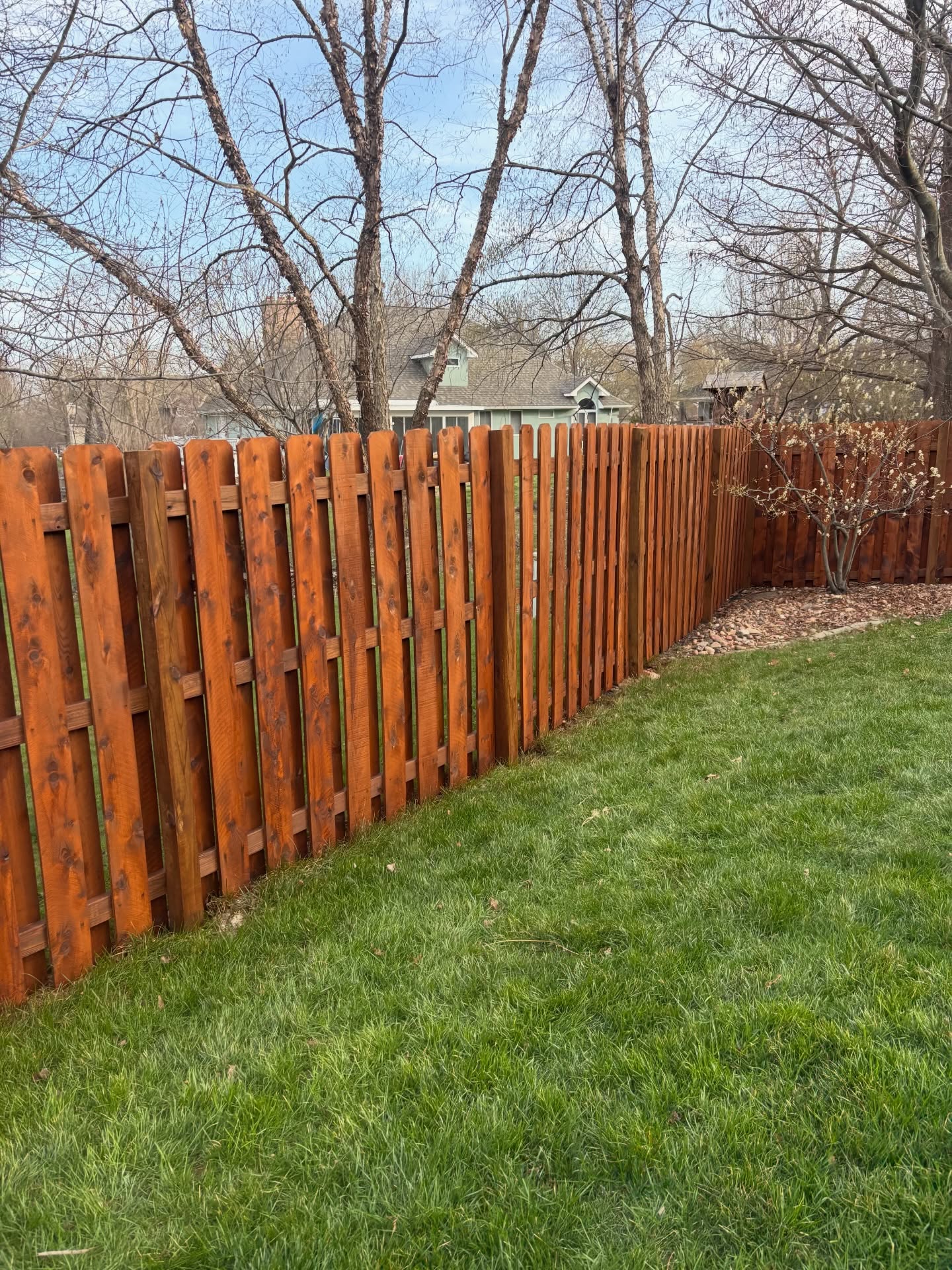
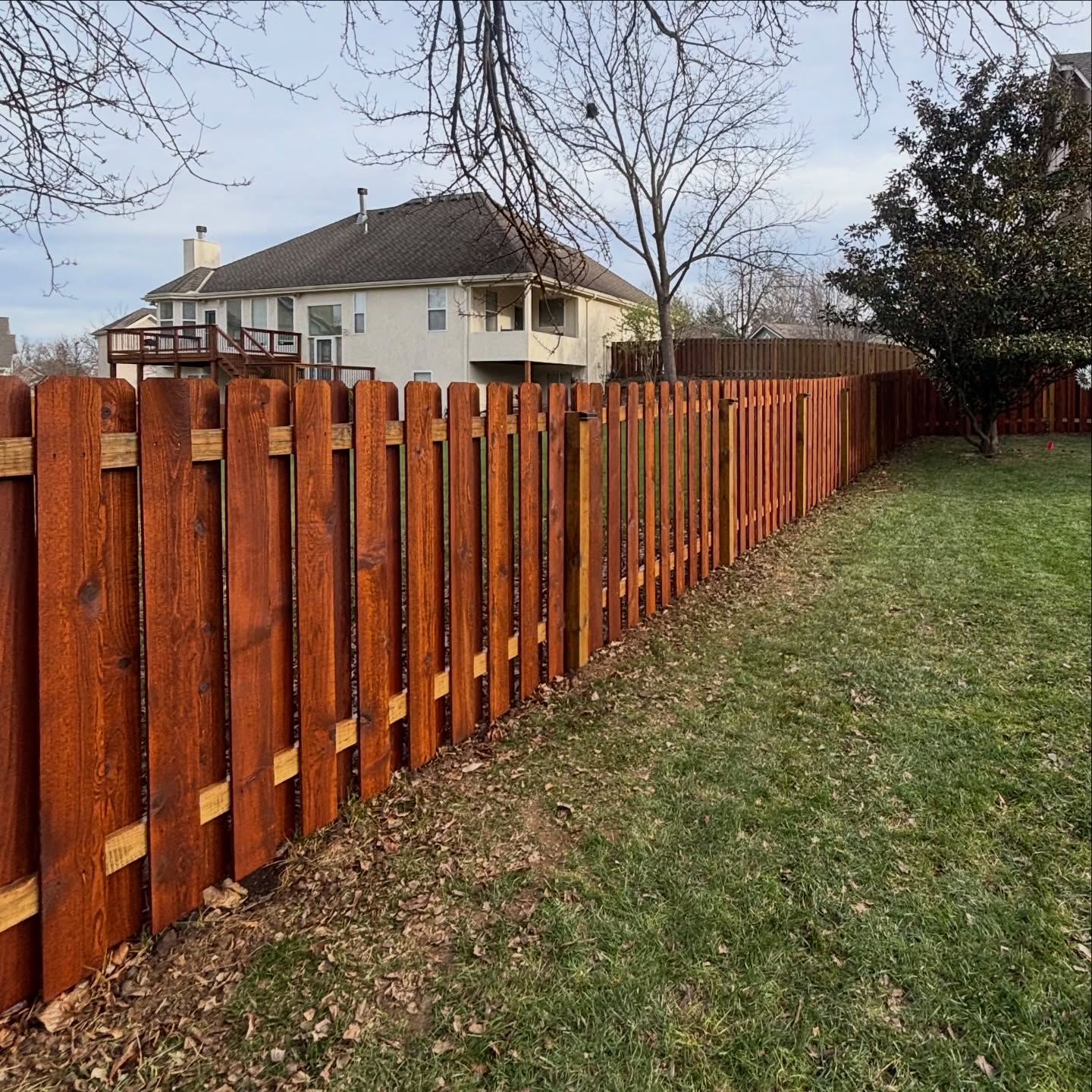
Walnut stain finish sprayed and back-brushed on a cedar fence in Bonner Springs, KS by RKC Wood Care Pros
Method-Matched Coat · Bonner
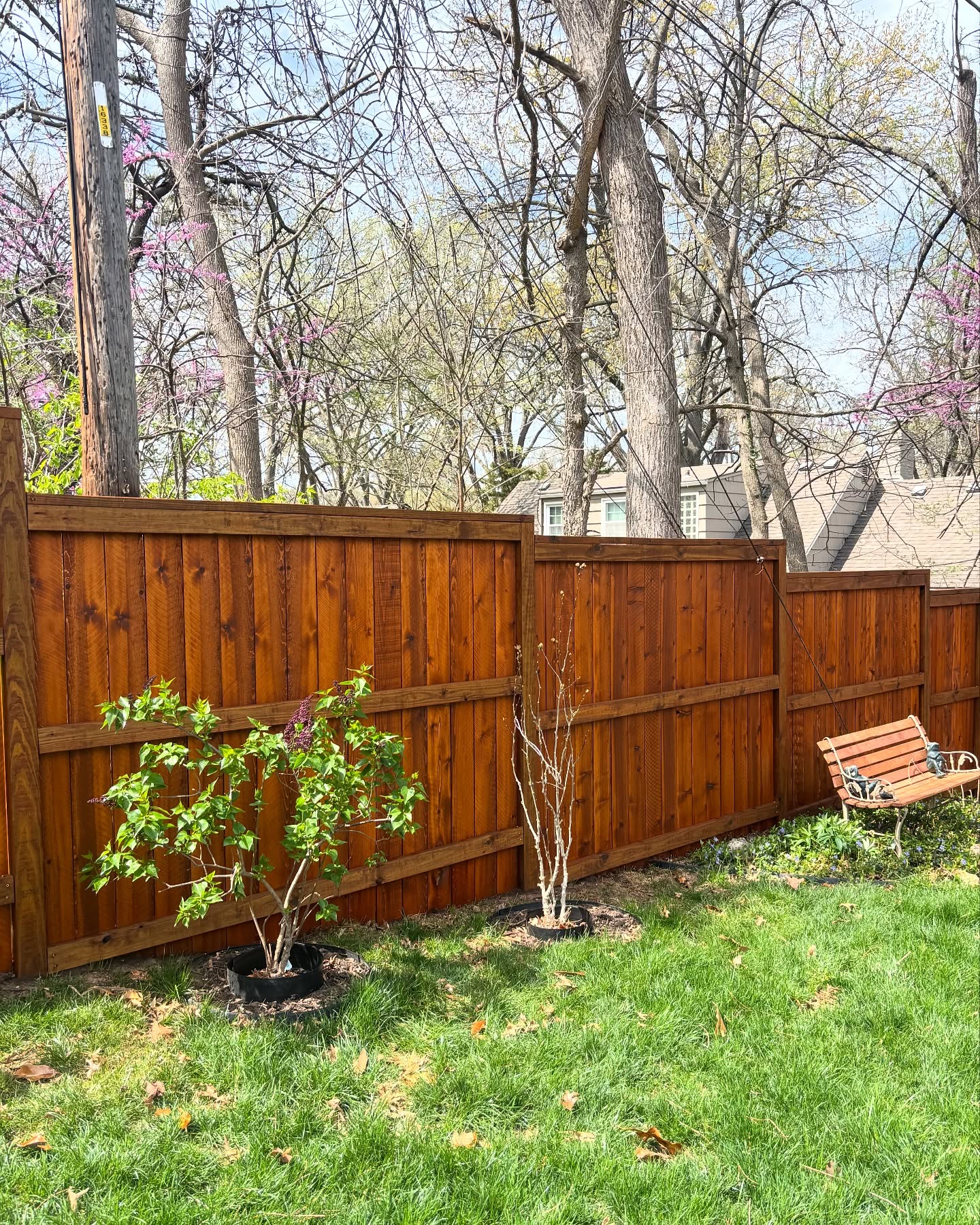
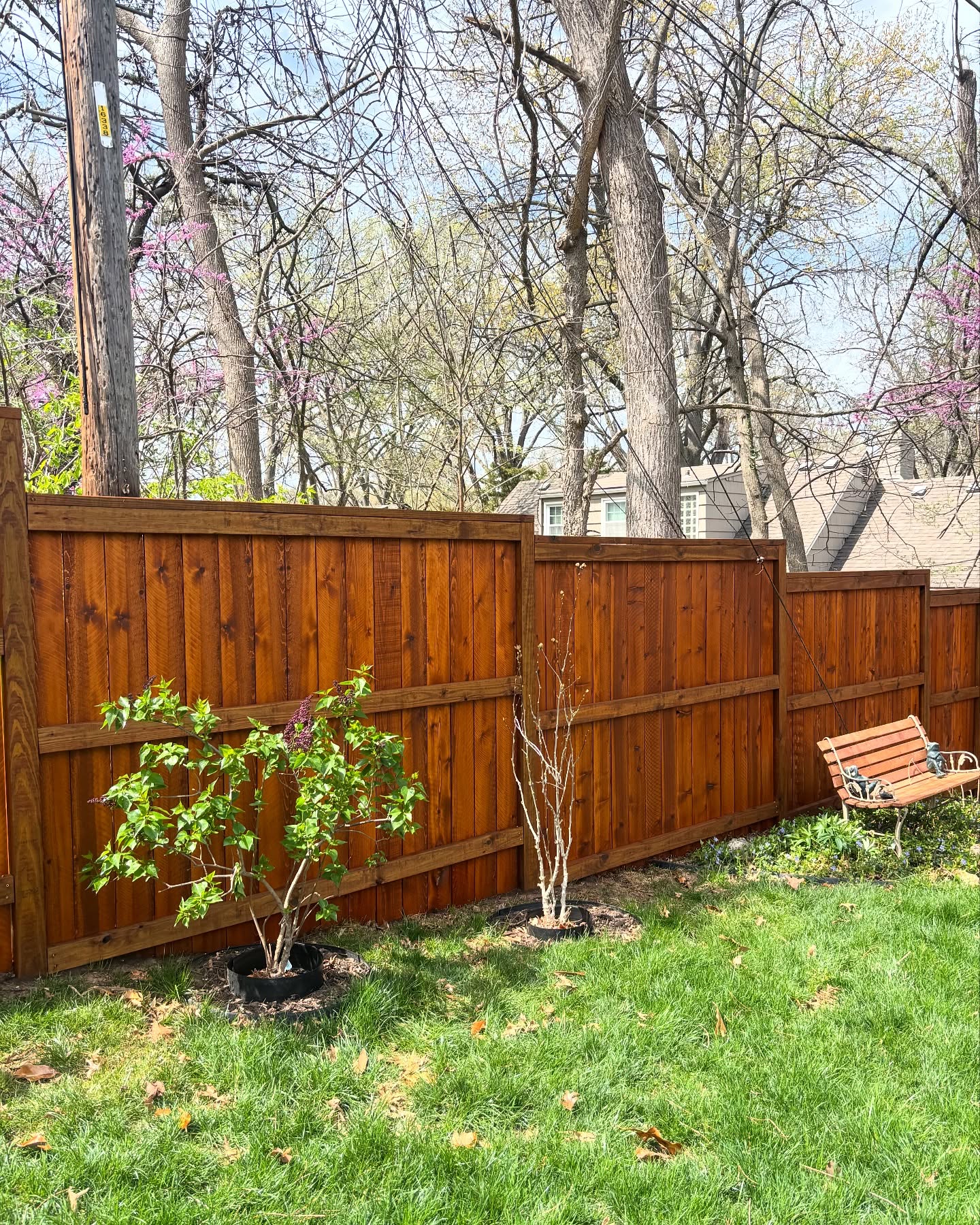
Golden honey stain on a cedar fence in Bonner Springs, KS
Cedar Re-Stain · Bonner
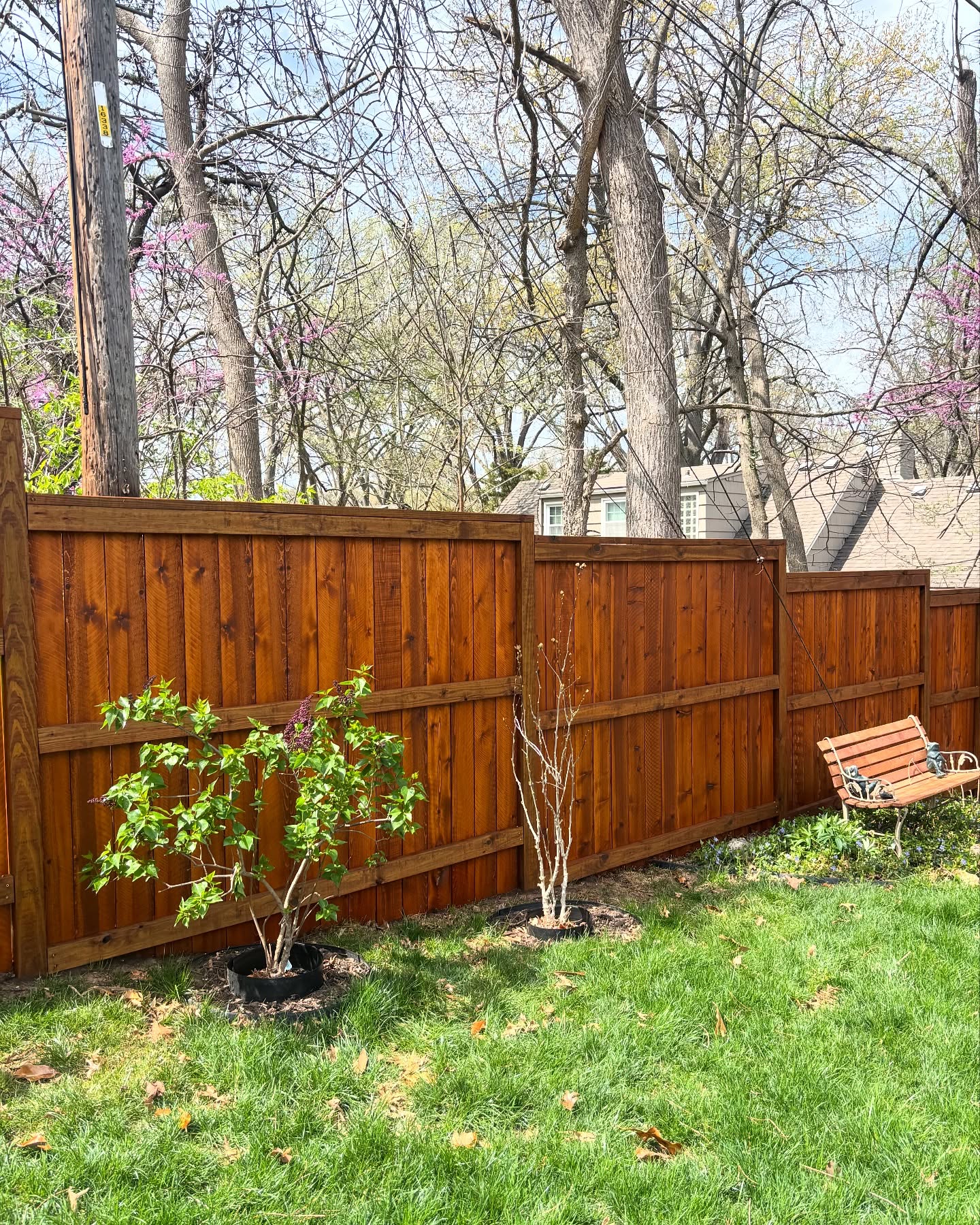
Fence staining in progress with spray and back-brush in Bonner Springs, KS
Spray & Back-Brush · Bonner
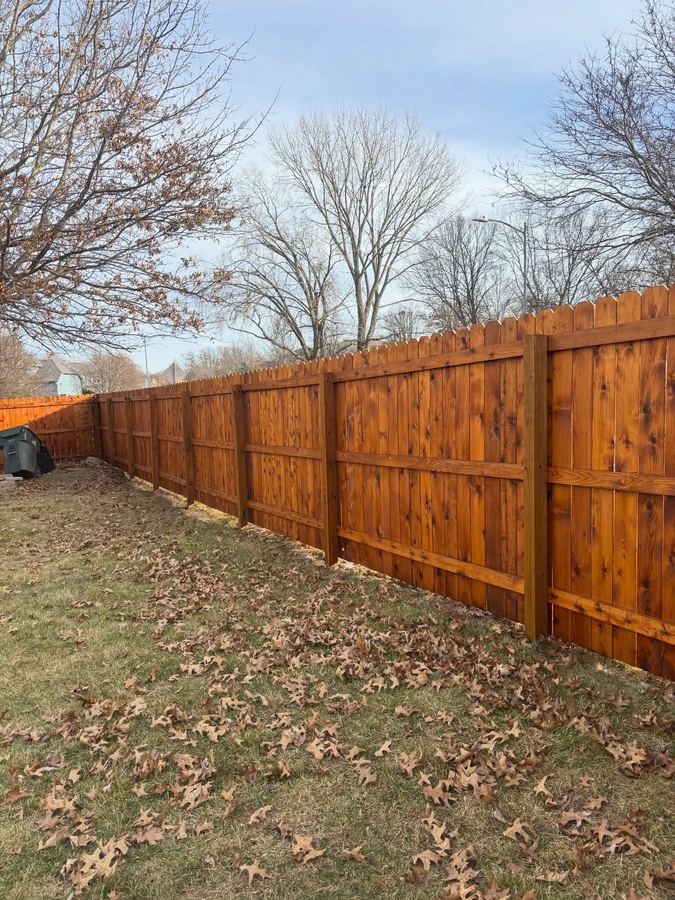
Cedar fence after a method-driven stain job on a hilltop lot in Bonner Springs, KS
Hilltop Run · Bonner

REVIEWS

What Kansas City Homeowners Say About RKC

4.9 ★ · 85 Google reviews

Every review is on our Google Business Profile — read them there, unedited.

Read all 85 reviews on Google

BONNER SPRINGS STAIN QUESTIONS

Stain Questions Bonner Springs Homeowners Ask Most

Three questions decide most Bonner stain jobs: why the application method matters so much on this terrain, how the wooded damp and steep grade are handled, and how to finish new or gray hillside cedar. These are the ones Bonner homeowners raise at the estimate — sorted by topic, each answer tied to the application-method guide, the terrain and moisture, and the re-coat schedule. Don't see yours? Call (913) 286-1091 and ask.

Bonner Springs, KS fence staining by RKC Wood Care Pros

How It's Applied

Why does the way a stain is applied matter so much on my Bonner lot?
Because the terrain here is unforgiving of a lazy method. Bonner has some of the most irregular yards in the metro — steep slopes, stepped runs, limestone shelves, hard-to-reach hillside lines — and you can't coat them the way you'd roll a flat suburban fence. We spray to reach the long runs a brush can't, back-brush every board to drive the finish into the grain, hand-brush the gates and access-limited spots, and leapfrog up the slope to keep a wet edge so no lap line shows. The application-method guide above lays out each technique and where it's used. On flat ground the method matters less; on a Bonner hillside it's most of what decides whether the coat lasts and looks even.
What's back-brushing, and why do you do it on every board?
Back-brushing is running a brush over finish right after it's sprayed on, to work it into the wood grain before it sets. It's the single most important step in making a coat last, and it's the one spray-and-go crews skip to save time. Sprayed finish that's left to sit on the surface just beads off and wears early; back-brushed finish penetrates the grain and bonds, so it fades slowly instead of failing. On a Bonner lot where we spray to reach the hard runs, back-brushing is what turns that fast coverage into a coat that actually holds. It's slower, and it's the whole reason our finishes outlast a quick spray job.
My fence steps up a hill — will the stain come out even?
Yes, if it's applied with a wet edge, and that's exactly how we work a graded run. When a fence steps or racks up a slope, spraying a section, stopping, and coming back later leaves a lap line where the edge set — a visible seam down the run. We avoid it with a two-person leapfrog: one sprays while the other back-brushes, and we move up the slope together so we're always overlapping into still-wet finish. That keeps a wet edge the whole climb, so a stepped hillside fence comes out one even tone from the bottom of the grade to the top. A solo applicator on a long graded run is where you see the seams; a synced crew is how you avoid them.

Terrain & Moisture

The wooded side of my fence grows mildew — how do you handle that?
With prep and method both. Bonner's mature timber and river-town humidity shade the wooded and river-bottom faces and hold moisture, so mildew and algae grow on them. We kill and wash that off first — stain over living green growth flakes in a season no matter how it's applied — then hand-brush the detail on those shaded faces and back-brush every board so the finish penetrates and sheds water instead of sitting on a damp surface. On heavily shaded runs a slightly deeper pigment resists the mildew's return better than a bare or clear coat. The method answers the damp: prep it off, drive the finish in, and keep it on schedule.
Can you even reach the fence run along my steep, wooded property line?
Usually yes — reaching the hard runs is exactly what the spray method is for. On a Bonner lot the fence often runs along a steep, wooded, or limestone-edged property line a brush alone can't work. An airless sprayer lets us move the finish along those hard-to-access lines, and we back-brush what we can reach and hand-brush the detail spots the sprayer can't safely cover. If a run is genuinely inaccessible from your side, we'll tell you at the walk and figure out the approach — but between the sprayer's reach and hand work on the tight spots, we can coat runs on terrain that a flat-yard crew would struggle with. That's what the method is built for here.

New Cedar & Schedule

I just had a new cedar fence built on my hillside lot — when should I stain it?
Give new cedar about 30 days to cure first, so a penetrating finish keys into the grain instead of beading off. Then it's a matter of method as much as timing: on a hillside lot we time the first coat to the cure, then apply it the way the terrain calls for — sprayed and back-brushed up the slope, hand-brushed at the gates and the limestone-edge runs. Getting the method right on the first coat means the fence starts life sealed evenly instead of thin where the terrain made it hard to reach. We log it so the re-coat matches. On our own installs the first coat is often folded into the price and applied to the same standard.
How often will a Bonner fence need re-staining?
About every two years for cedar, and the exposed, sun-facing runs favor the shorter end while the shaded, wooded faces hold a bit longer under the tree cover. Whatever the terrain, staying on schedule is what keeps the fence from drifting to gray and needing a full restoration — which is more work on an irregular hillside lot than on flat ground. We log your next date and remind you before it's due, so the fence gets re-coated while it's still holding color. On a tricky lot where the method work takes real skill, staying on the maintenance cycle is far easier than letting it lapse into a strip-and-restore.

OTHER BONNER SPRINGS FENCE SERVICES

More Fence Services Available in Bonner Springs

Each link below keeps you in Bonner Springs — its own page, with pricing, conditions, and recent job photos tied to this city rather than the metro at large. Weighing a fresh install, a repair, a gate, or one specific material alongside the staining? Here's where each of those picks up.

Ready when you are

Get a free estimate — we usually respond the same day.

Call (913) 286-1091