Skip to content
Fence Staining & Sealing in Lee's Summit, MO — Read the Fade Before You Replace

Fence Staining & Sealing in Lee's Summit, MO — Read the Fade Before You Replace

Lee's Summit has more aging cedar than almost any market we work, and most of it isn't as far gone as it looks — a silver-gray run is usually a thin oxidized layer over sound wood, not a fence you have to replace. RKC Wood Care Pros reads the fade first: still-brown gets an on-cycle re-coat, silvered wood gets brightened and restored, and only true rot is past a coat of stain. Semi-transparent penetrating stain, spray-and-back-brushed on both faces, with lakeside runs metered for the extra moisture near the water. Every date logged on your record. 400+ fences across the metro since 2021. Call (913) 286-1091 for a free walk and quote.

★★★★★
4.9
from 85 reviews
Licensed
& Insured · KS + MO
400+
fences installed
A+ BBB Rated Kansas City Fence Contractor Gray-Fence Restoration · Spray + Back-Brush 2-Year Cedar / 3-Year PT Cycle
View stain options in our catalog ↓

WHY LEE'S SUMMIT HOMEOWNERS STAIN WITH RKC

Getting the Most Out of the Cedar You Already Have

In a town this full of mature cedar, the money question usually isn't "what color" — it's "is this fence worth saving or is it done," and far more often than owners expect, it's worth saving. Most Lee's Summit stain calls come from a run that's drifted to silver, a lake-facing side that's fading ahead of the rest, or a fence someone inherited that looks a decade older than it is. Every one of those is a read-the-wood problem before it's a color problem.

1

A gray fence brought back instead of torn out

Most "done" fences aren't. Silvering is a shallow weathered skin, not structural failure — clear the old finish, brighten the gray out, let it dry hard, and one full penetrating coat can hand you another decade. This is the call we field most from folks who just closed on a Lee's Summit house nobody kept up. And when a run genuinely is finished — fiber gone soft under a probe — we tell you plainly and steer you to board replacement rather than paint over the problem.
2

A lake-facing side that stops fading first

Near Raintree Lake, Lakewood, and the Longview shoreline, the water-facing side of a fence takes reflected sun on top of direct sun and lightens ahead of the street side — you can watch one run go two-tone. We meter and prep those waterside boards for the extra moisture they hold, and stain both faces to equal coverage so the whole run ages as one fence, not a bright side and a shaded side.

3

A re-stain that matches the last one

The two-tone fence — one section darker, drip lines at the picket bottoms, brush marks in patches — is what you get when a different crew or a subbed-out stain company grabbed a different product and skipped the back-brush. We run two-person crews, log your exact product and color code on the record, and pull the same line off the shelf every re-coat. On a long neighborhood-visible run, that's the difference between a fence and a patchwork.

4

Wood that still looks right at year five

Year five is where Lee's Summit cedar splits into the runs that held and the ones that went rough. The difference is three things done right: spray-and-back-brush for deep, drip-free penetration; a semi-transparent product with no film to peel; and a 2-year cadence that stops oxidation before it starts. Every fence we've kept on the RKC schedule since 2021 still reads like good wood.

LEE'S SUMMIT LOCAL CONDITIONS

Why Fence Staining in Lee's Summit Is a Lake-Town Job

Three local factors shape stain work in Lee's Summit: the water that pushes the fade and stretches the dry window, the sheer depth of mature cedar, and the finish that survives both. This is a market where a lake-lot run near Raintree needs a careful restoration in the same week a 12-year subdivision fence wants a straightforward re-coat. Same crew, same rule on both: we read the wood and the water before we spray.

1

Water pushes the fade — and stretches the dry window

Lee's Summit is a lake town, and the water changes the math on both ends of a stain job. Near Raintree Lake, Lakewood, and the Longview shoreline, the water-facing side of a run takes reflected sun on top of direct sun and fades noticeably faster than the street side. At the same time, the higher ambient humidity off the water keeps the wood damp longer, so the dry window before we spray runs closer to 48 hours than 24. We meter waterside boards specifically — they read wet after the rest of the fence looks dry.

2

The metro's deepest stock of mature cedar

Between the big 1990s-2000s subdivisions and the lake communities, Lee's Summit has more aging cedar than almost anywhere we work — which means most of our calls here aren't first coats, they're triage on 6-to-15-year runs. That shapes the job: long footage to keep uniform, tones that have to match an existing neighborhood-visible run, and a fair number of fences people assume are past saving that a proper restoration brings back. Reading how far a fence has actually gone is half the estimate here.

3

The tone matters as much as the product here

We run semi-transparent penetrating stain on Lee's Summit cedar because it guards the wood from inside the grain and wears by fading, so a run never reaches the peel-and-scrape stage a solid film reaches. On the capped cedar common in this market, owners lean toward the deeper tones — dark walnut, mahogany, a rich saddle brown — which happen to carry more pigment and hold their UV block longer on those hard-hit lake-facing boards. And since a weathered board pulls stain darker than fresh wood, we prove every color on a hidden test square before the run is committed.

Lee's Summit neighborhoods we've stained and restored fences across include Raintree Lake, Lakewood, Winterset Park, the streets near Longview Lake, and the established subdivisions off Todd George Road — cedar privacy, treated pine, board-on-board shadow box, and mixed runs. Same fade read, same two-person spray-and-back-brush method, same 2-year cadence on each. And a fence built by someone else stains just the same — good wood, proper prep, and a penetrating coat don't care whose name was on the install.

READ THE FADE

What Your Lee's Summit Fence Is Telling You — and What It Actually Needs

Before you price a replacement, read the surface — most weathered fences fall into one of six states, and only the last one is genuinely past saving. This is the triage we run on every Lee's Summit fence at the estimate. It's the part that separates a cheap on-cycle re-coat from a full restoration — and, honestly, the times a coat of stain is the wrong answer entirely. We confirm the read board-by-board on the on-site walk.

What you see What's actually happening Scope Now or later Band
Still brown, just dulling The finish is thinning but the wood underneath is sound. On-cycle re-coat Now — the cheapest window there is $
Fading to tan or blonde The pigment's UV block is spent and surface oxidation is starting. Wash + re-coat Now — every month waiting adds prep $
Silver-gray, fairly even A thin oxidized layer over wood that's still good beneath it. Brighten + restore Still saveable — don't replace yet $$
Black spotting or streaks Mildew and tannin staining — common on shaded and lakeside runs, and it's not rot. Brighten + re-coat Now — it spreads across the run if left $$
Peeling or flaking film A solid or film-forming product failed and has to come off before anything new goes on. Strip + restore Needs full prep — the finish, not the wood, failed $$$
Soft, punky, crumbling boards That's true rot — past what any coat of stain can fix. Repair first Swap the bad boards before we stain the run repair quote

Bands are relative: $ ≈ an on-cycle cedar re-stain ($4–8/LF), $$ a brighten-and-restore, $$$ a full strip-and-refinish ($6–12/LF). The one row that isn't a stain job is rot — that's Lee's Summit fence repair first, then a coat. Not sure where your fence lands? A free staining walk settles it in ten minutes.

STAIN SERVICES

First Coats, Re-Stains & Gray-Fence Restoration — Every Lee's Summit Scenario

Which scope your Lee's Summit fence needs falls out of the fade read — new wood waiting on its first coat, cedar due for a re-stain, treated pine on the 3-year clock, or a silvered run that needs bringing back. Here are the four scopes we run across Lee's Summit, what each fits, and real per-foot pricing. Product lines and tones are swappable within a scope; the fade read, the spray-and-back-brush, and the in-house crew never change.

New-Install First-Coat Stain by RKC Wood Care Pros in Lee's Summit, MO

New-Install First-Coat Stain

The starter coat on every RKC Lee's Summit install

The coat that sets a new fence up to last. Fresh cedar needs about a month for its moisture to drop enough that the finish keys into the grain instead of sitting on top; treated pine wants roughly three for its treatment to cure. We settle the color during install week so it's already on the truck, and on a lot of Lee's Summit cedar packages this starter coat folds into the install price — worth raising with Josh at the estimate. Semi-transparent, sprayed and brushed into every picket, post, and rail.

  • Price: $3–6 / LF · typically $450–900 per 150 LF
  • Typical use: New cedar privacy off Raintree Lake, fresh builds around Lakewood, the first protective coat after any RKC install
Existing Cedar Re-Stain by RKC Wood Care Pros in Lee's Summit, MO

Existing Cedar Re-Stain

The 2-year cycle · the bread-and-butter LS call

Lee's Summit has more mature cedar than almost any market we work, so this is the call we run most. Caught on cycle it's straightforward: a low-pressure wash lifts oxidation and mildew, a 24-to-48-hour dry window, then semi-transparent penetrating stain sprayed and back-brushed into the grain. We pull your exact product and color off the record and match it board-for-board, or shift you to a richer tone if you're ready. The next date goes on the invoice before we pack up.

  • Price: $4–8 / LF · typically $600–1,200 per 150 LF
  • Typical use: The metro's biggest stock of 6-to-12-year cedar runs, tone refreshes, homeowners staying ahead of the gray
Pressure-Treated Pine Re-Stain by RKC Wood Care Pros in Lee's Summit, MO

Pressure-Treated Pine Re-Stain

90-day first coat, 3-year cycle after

Pine plays by a different clock. Its factory treatment has to fully cure before a finish will grab — that's the 90-day wait on a first coat — and from there it prefers an oil-based semi-transparent, which sinks into the dense treated grain where a water-based product just sits. We hit any dull-green or blackened boards with a brightener first so the tone lands even across the run. Most of this work shows up on the longer perimeters and the value builds on the older side of town.

  • Price: $3–7 / LF · typically $450–1,050 per 150 LF
  • Typical use: Treated-pine privacy and perimeter runs, bigger lots, budget installs inherited from other contractors
Gray-Fence Restoration by RKC Wood Care Pros in Lee's Summit, MO

Gray-Fence Restoration

Bringing silvered, weathered runs back

A silver-gray fence reads as finished; on most Lee's Summit lots it isn't. The gray is a shallow oxidized skin over wood that's still solid — and on shaded and waterside runs there's usually black mildew and tannin bleed that looks far worse than the damage actually is. Our restoration lifts all of that: failed film off, a brightener to neutralize the gray and the black and warm the tone back toward cedar, a hard dry, a meter check, then a full penetrating coat. Only where a probe finds soft, spongy fiber do we stop and put you on board replacement first — no finish over rot.

  • Price: $6–12 / LF · typically $900–1,800 per 150 LF
  • Typical use: Weathered cedar and PT gone gray, just-bought homes, shaded and waterside runs headed for the dumpster too early
Semi-transparent penetrating cedar fence stain pricing — Lee's Summit, MO — RKC Wood Care Pros

LEE'S SUMMIT STAIN PRICING

What Fence Staining Costs in Lee's Summit

Price tracks how far the fence has gone, not the stain itself — a run caught on cycle costs a fraction of one that grayed out and had to be stripped. Every quote covers the wash, the dry window, semi-transparent penetrating stain, spray + back-brush by a two-person in-house crew, and a written re-coat date. The three configurations we quote most for Lee's Summit properties are below.

Cedar Re-Stain

$4–8 / LF

wash + penetrating stain

Gentle wash, a dry window read on the meter, penetrating semi-transparent stain worked into both faces, a final walk, and your next date in writing. A neighborhood-standard 150 LF Lee's Summit privacy run lands around $600–1,200.

Pressure-Treated Re-Stain

$3–7 / LF

brighten + oil stain

Wash, a brightener pass on any green or blackened boards, oil-based semi-transparent driven into the treated grain, and the 3-year date logged. A 150 LF Lee's Summit pine run runs about $450–1,050.

Gray-Fence Restoration

$6–12 / LF

strip · brighten · stain

Failed film stripped, the silvered and mildewed layer brightened back, several wash passes, a moisture check, then a full penetrating coat. Priced only after we read how far gone the run is on site — a weathered 150 LF Lee's Summit fence typically $900–1,800.

Gray-fence restoration on weathered runs (strip + brighten + multi-cycle wash + stain) is quoted after an on-site read of how far the fence has gone — that read is what keeps you from paying strip pricing on a fence that only needed a re-coat. Every Lee's Summit stain estimate is free, written, and itemized — call (913) 286-1091 or ask for an on-site walk. While we're there we can flag any Lee's Summit fence repair the wood needs before it's worth staining — one visit, same crew.

OUR STAIN PROCESS

How a Lee's Summit Stain Job Actually Runs

Four steps from the phone call to the final walk. Most Lee's Summit stain jobs span 2 to 4 days — but only one of them is stain day. The stain itself is usually a single day on site for a standard privacy run. The rest of the clock is the read, the wash-dry-meter cycle, and the color window before it — a little longer near the lakes, where the wood holds moisture. Here's what each step looks like on a Lee's Summit fence.

1

Grade the fade before anything else

In a market this full of aging cedar, the estimate opens with a diagnosis, not a tape measure. Josh or a crew lead grades each run against the six fade states — brown, silvering, black-spotted, peeling, or genuinely rotted — because that single call is the whole gap between a light re-coat and a strip-and-restore. Footage and a moisture reading come next; near the water the number on the meter overrules the calendar. You get a free itemized quote and a color square on a hidden board so the tone is settled before we start.

2

The prep the wood earns

No two Lee's Summit fences earn the same prep. A sound run needs only a gentle wash to clear oxidation and mildew; a silvered or mildew-blackened one — the norm on shaded and waterside lots — earns a brightener pass to reset the color before stain touches it. We keep the washer dialed low so the surface cleans without the grain tearing up, then let the wood dry to spec, which by the lakes can mean a full extra day. Stain waits until the meter agrees, every time.

3

One sprayer, one brush, no gaps

Covering a long lake-lot perimeter is a two-person job. One works an airless gun for reach and speed; the other stays a step behind with a brush, pressing the wet finish into the grain before it can set. Drop the brush and you get glossy pools at the base of every picket and starved end grain up top; drop the sprayer and a big run drags on for days and streaks. Both at once, wet-into-wet, is how we bring 400 feet in uniform in a single day.

4

Sign-off, then the reminder that matters

We don't pack up until we've walked the whole run with you and hit anything thin — the undersides, the caps, the shaded corners that get skipped. Then your fence goes in the book: date, product, color, footage, next coat due. Because that record lives with us, the nudge to re-coat comes from our side, on schedule — the follow-up that quietly disappears the day a builder farms its staining out to a third party.

RECENT LEE'S SUMMIT STAIN JOBS

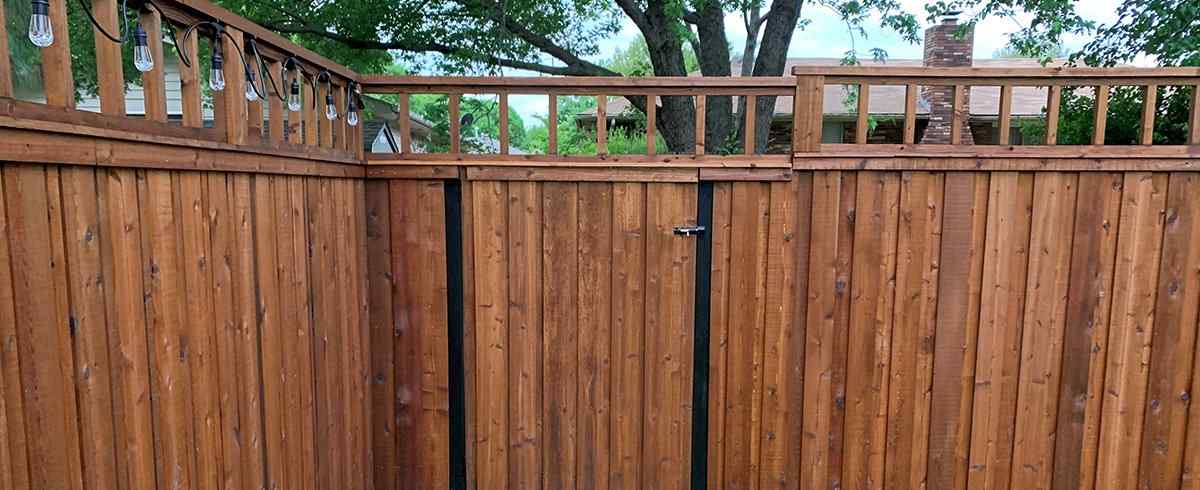
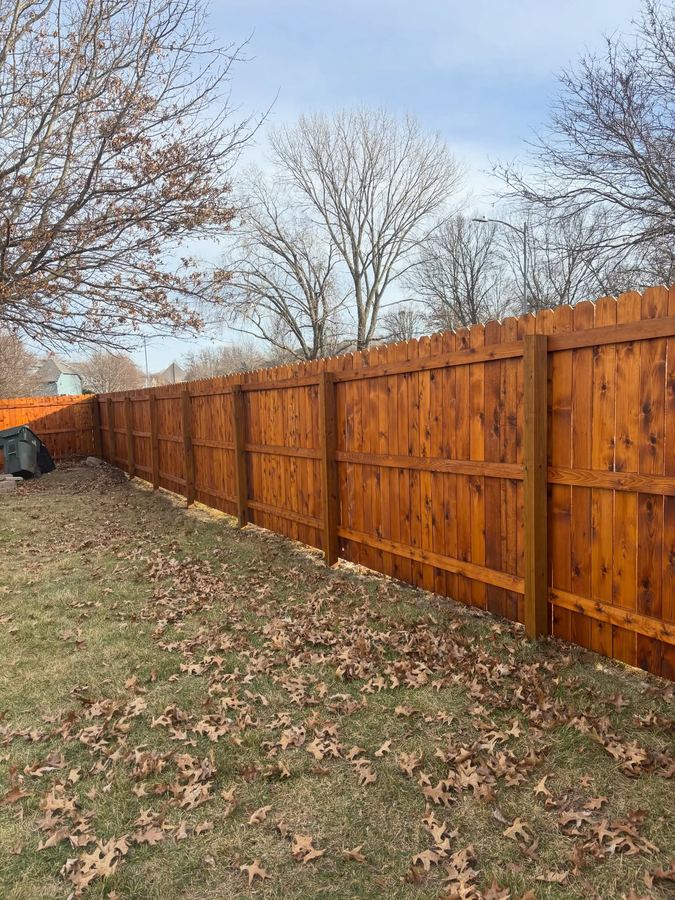
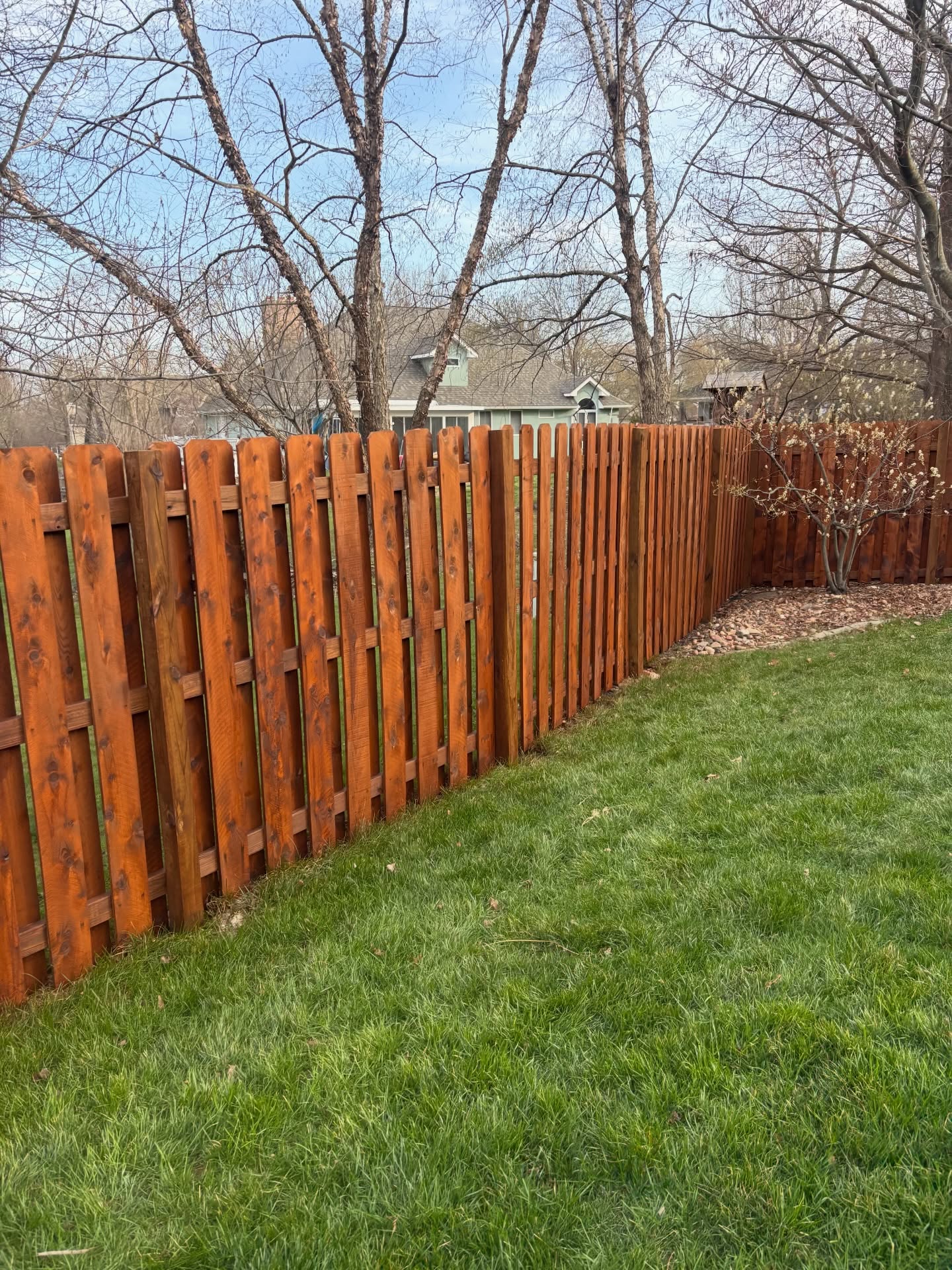
Cedar re-stain in Lee's Summit, MO by RKC Wood Care Pros
Cedar Re-Stain · Lee's Summit
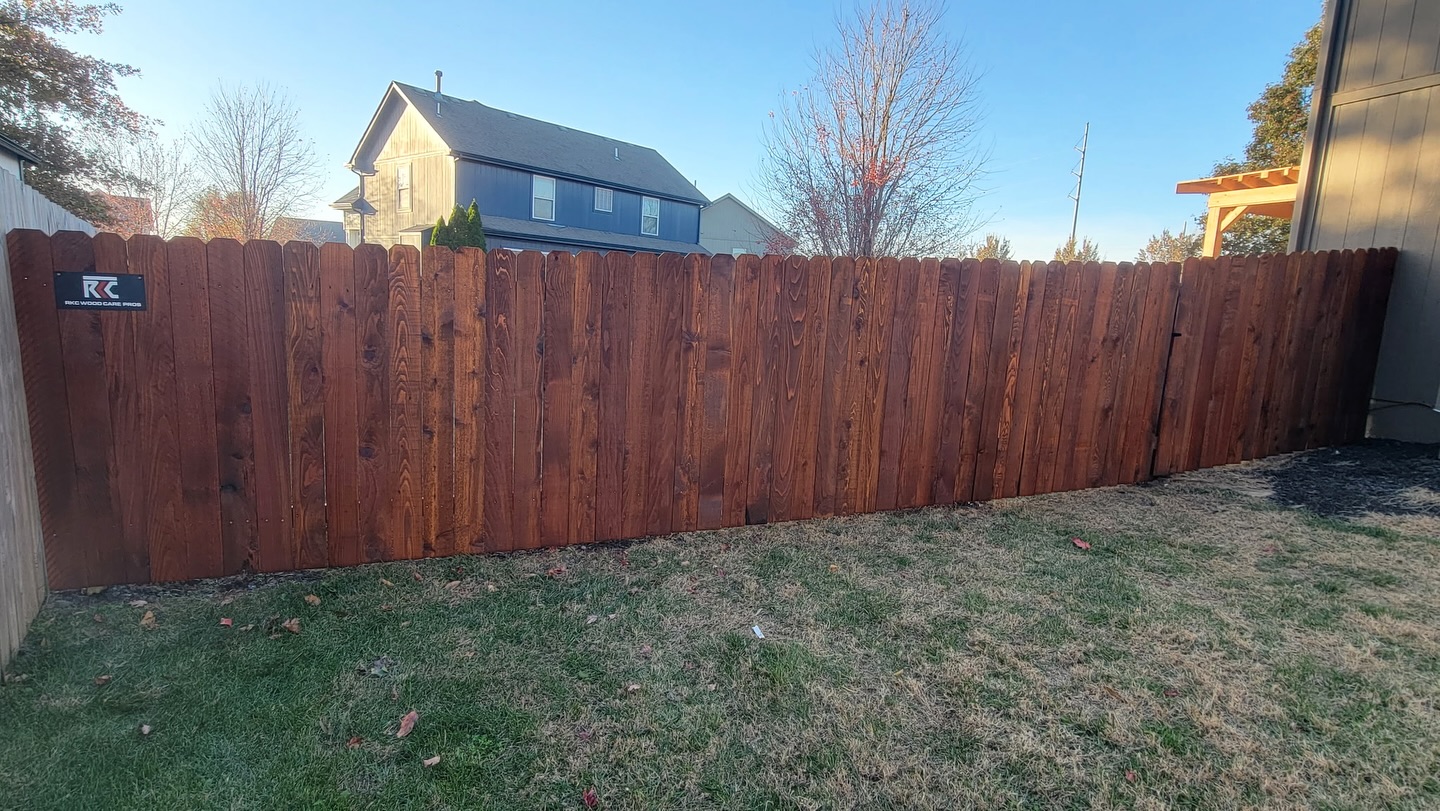
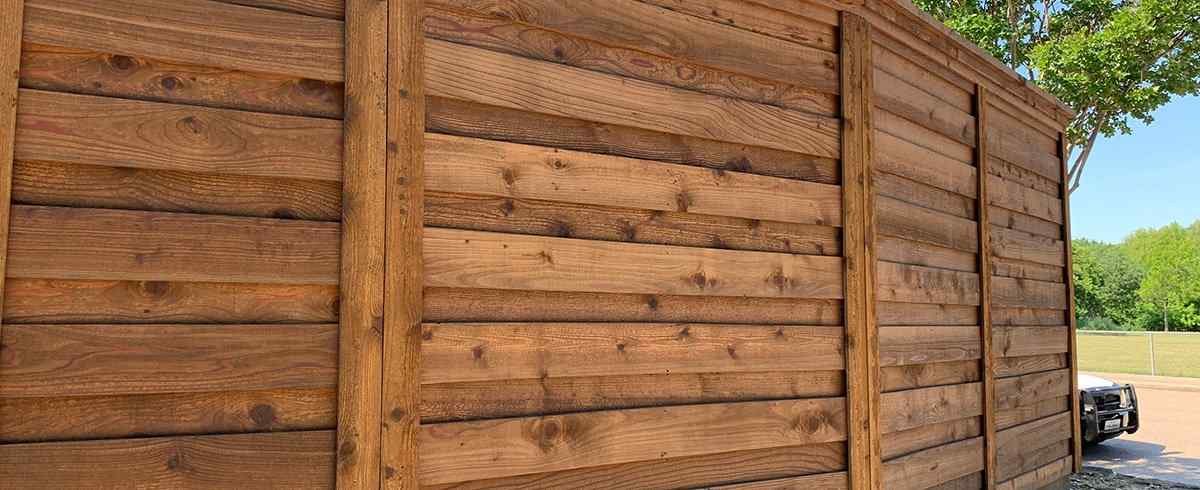
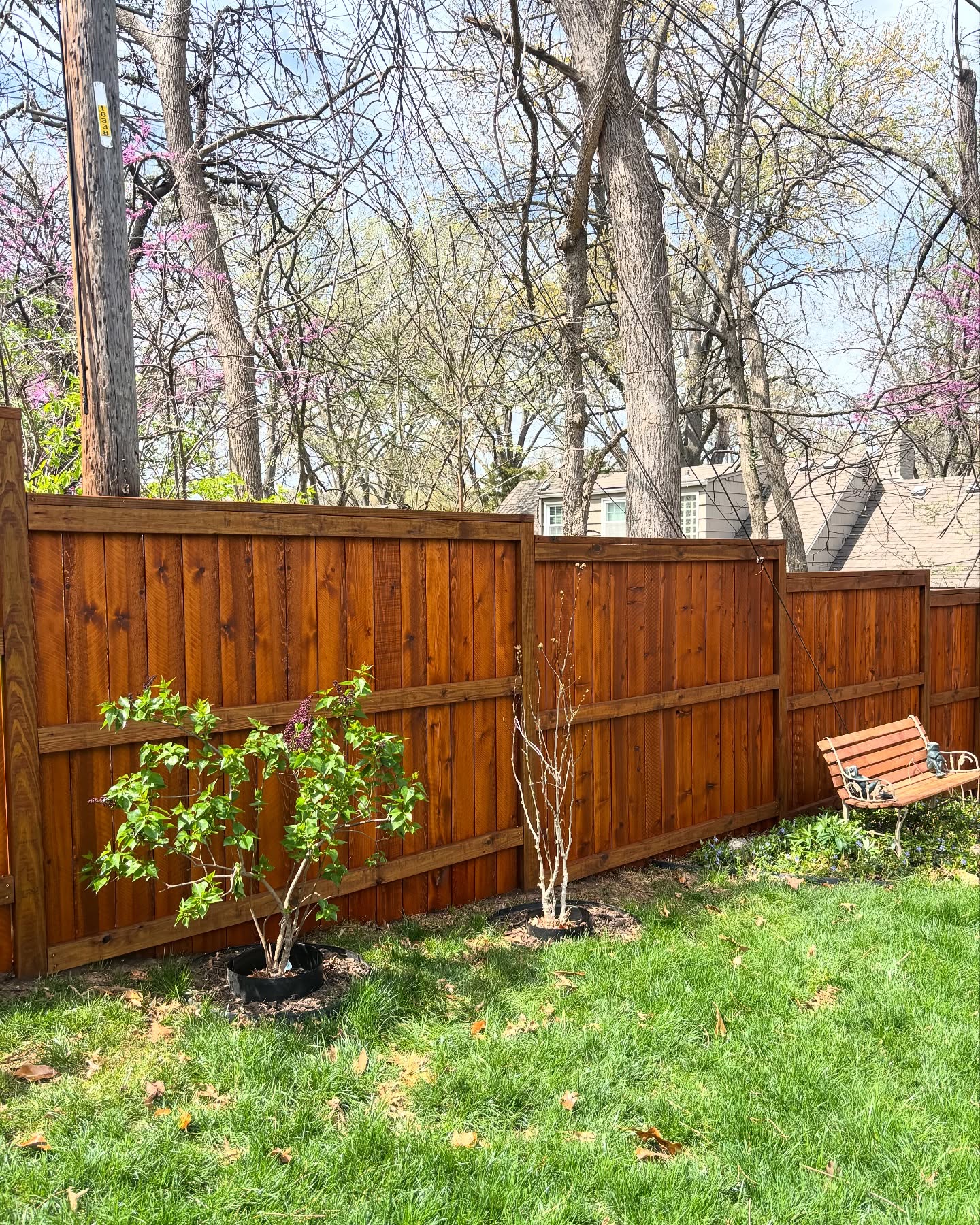
Freshly stained cedar fence in Lee's Summit, MO
First Coat · Lee's Summit
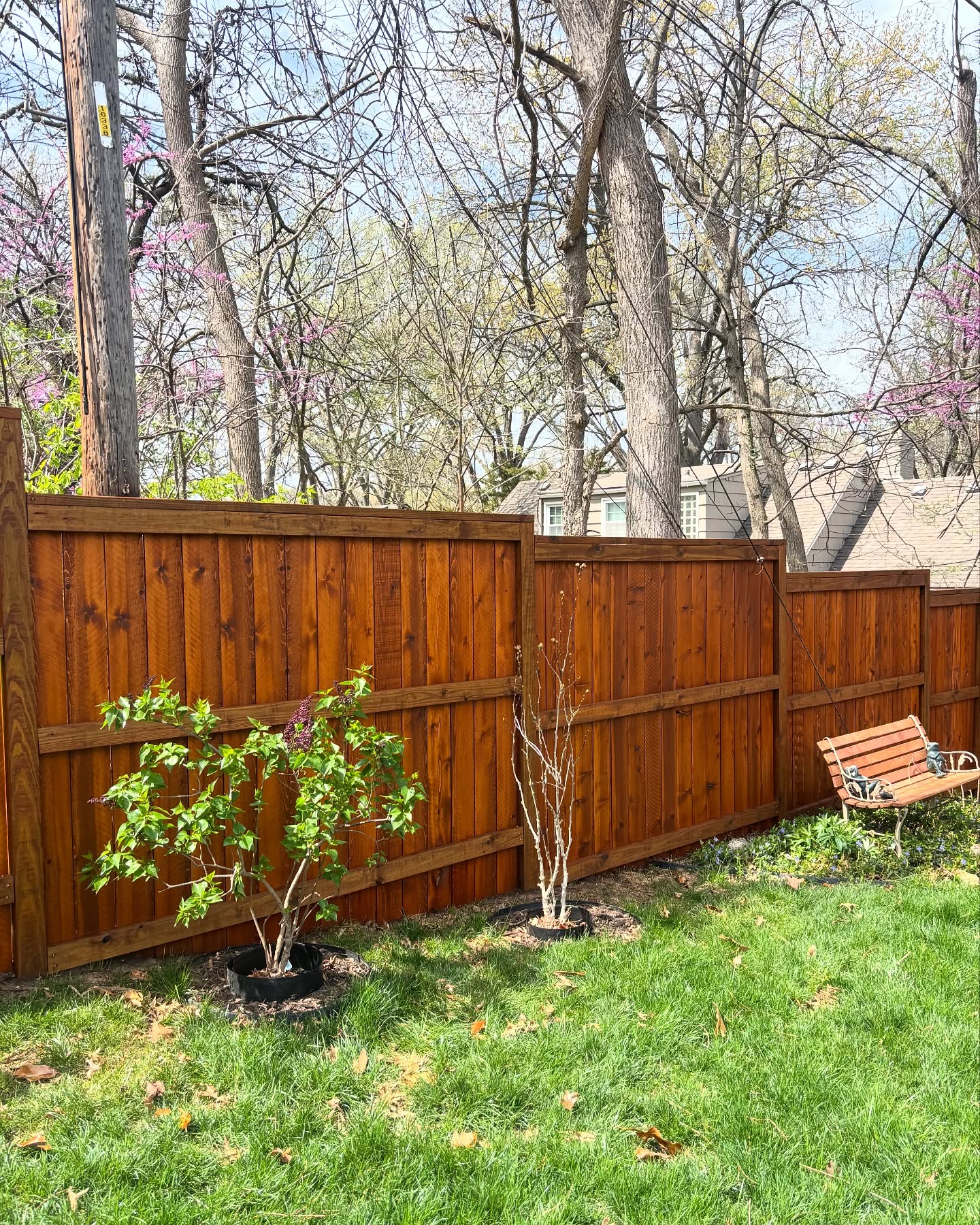
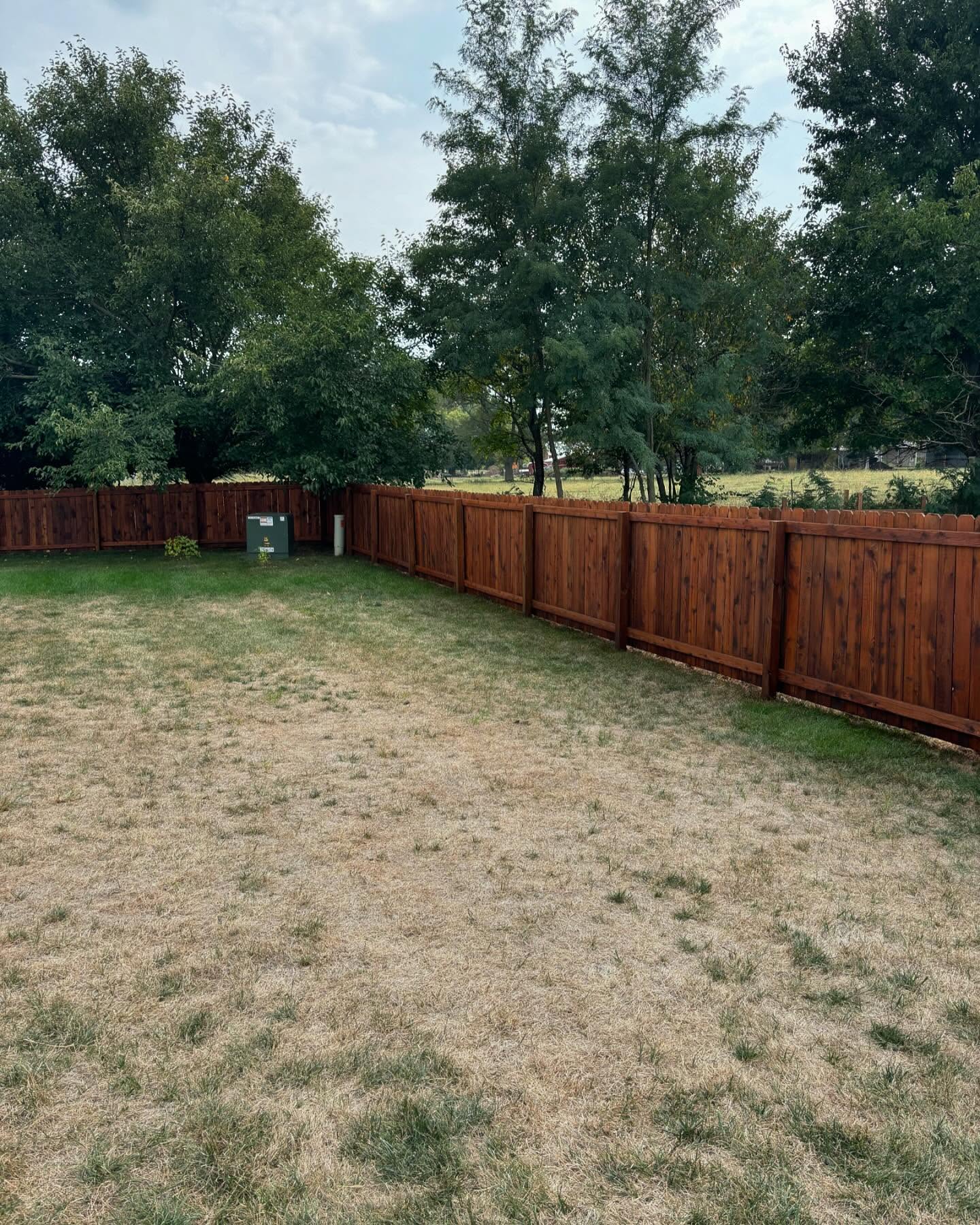
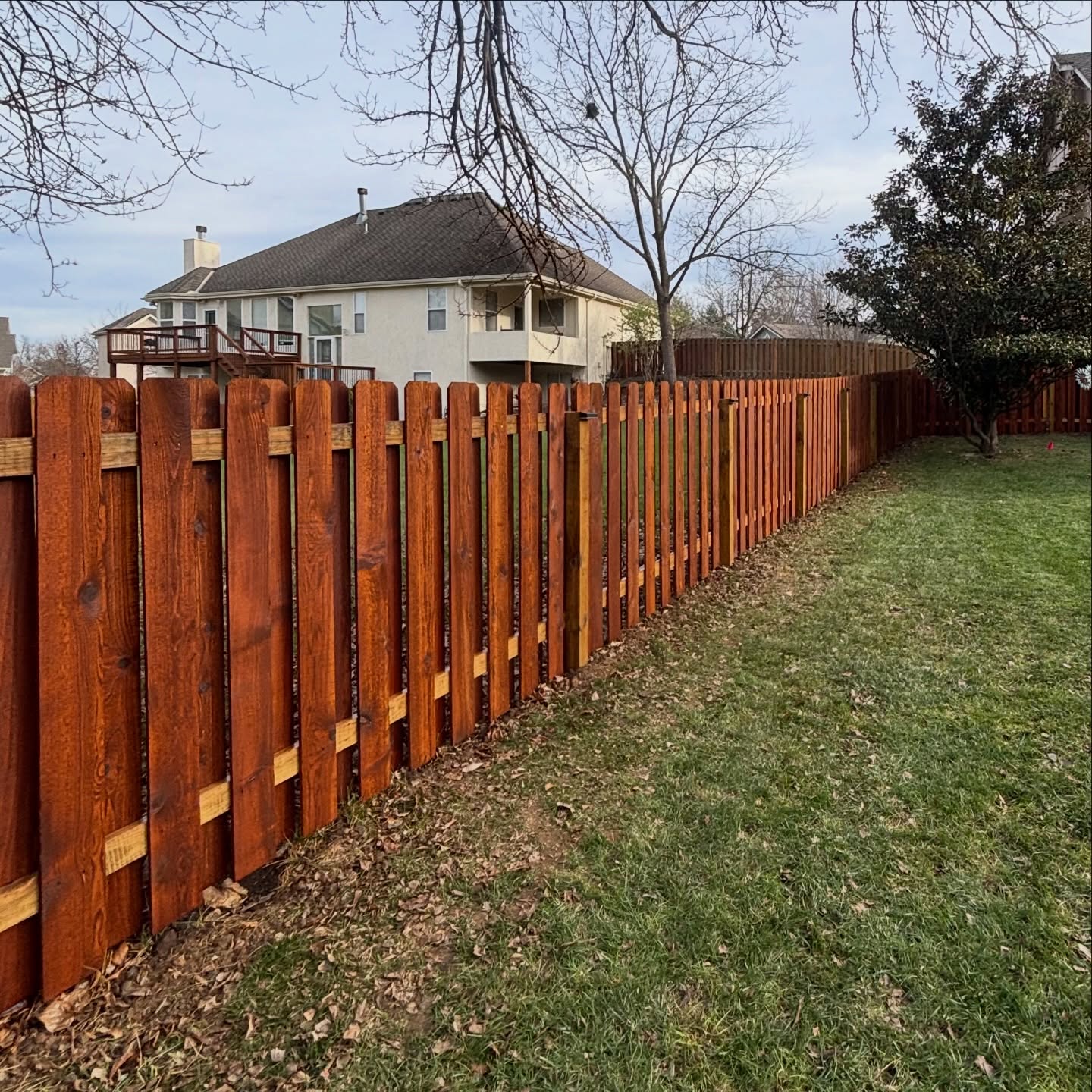
Pre-stained cedar in Lee's Summit, MO
PT Re-Stain · Lee's Summit
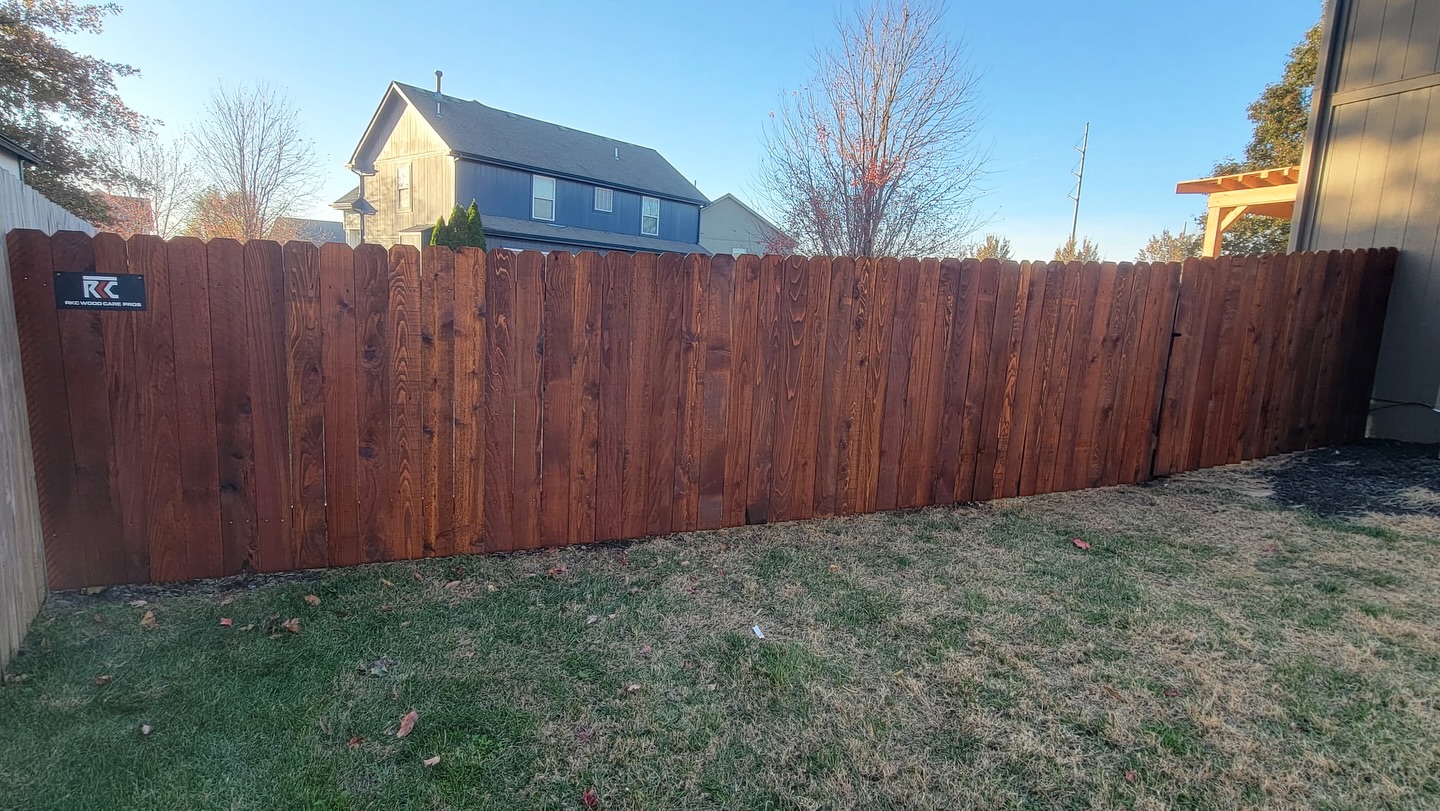
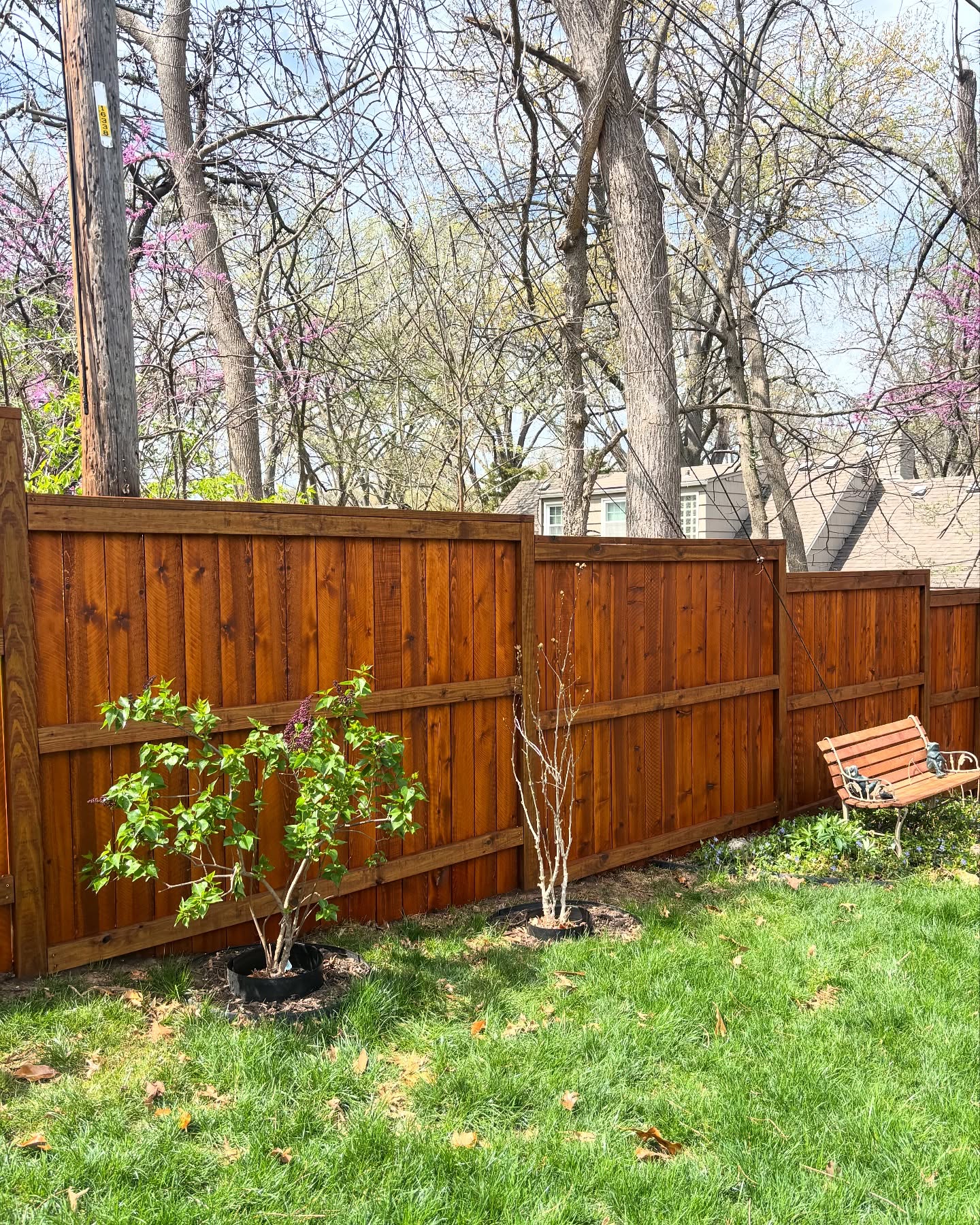
Gray-fence restoration and dark stain finish in Lee's Summit, MO
Gray-Fence Restoration · Lee's Summit

REVIEWS

What Kansas City Homeowners Say About RKC

4.9 ★ · 85 Google reviews

Every review is on our Google Business Profile — read them there, unedited.

Read all 85 reviews on Google

LEE'S SUMMIT STAIN QUESTIONS

Stain Questions Lee's Summit Homeowners Ask Most

Fence staining in Lee's Summit comes down to three things: whether the fence is worth saving, timing the coat to the wood and the water, and the product and method that make it last. Below are the questions Lee's Summit homeowners actually ask on the stain estimate — grouped by topic, each answer specific to how cedar behaves in a lake town. If yours isn't here, call (913) 286-1091 and ask.

Lee's Summit, MO fence staining by RKC Wood Care Pros

Is My Fence Worth Staining?

My Lee's Summit cedar fence has gone gray — is it too late to stain it?
Rarely. That gray is almost always a shallow weathered skin over wood that's still solid. A brightener pass neutralizes the oxidation and warms the tone back toward cedar; strip off any old failed film first, dry it hard, and a full penetrating coat resets the whole run. Plenty of the fences owners here have already priced a replacement on had years left in them. The only true stop is rot — if a probe sinks into soft, spongy fiber, that board needs swapping before any coat, and we'll say so on the walk instead of selling you stain over a bad fence.
How can I tell whether my fence needs a re-coat or a full restoration?
It's mostly a read of the surface. Still brown and just dulling, or fading toward tan, means the wood is fine and you're due for an on-cycle wash-and-re-coat — the cheapest window there is. Even silver-gray usually just needs brightening and restoring. Black spotting and streaks are mildew and tannin, not rot, and brighten out. Peeling or flaking means a film-forming product failed and has to be stripped first. Only soft, punky boards are actually past staining. The triage table above walks through each one; we confirm it on the on-site read.
Do you stain fences RKC didn't build?
All the time. In a town with this much older cedar, most of our refinishing is on fences someone else installed — homes bought with a weathered run out back, or owners whose builder never did staining and pointed them at an outside crew that's long gone. We treat them exactly like our own: grade the fade, price the prep it actually needs, and see it through start to finish.

Timing & Schedule

How often does a fence in Lee's Summit really need re-staining?
Plan on a 2-year cycle for cedar and 3 for treated pine — and if you back to water, keep an eye on the lake-facing side, which burns through a coat faster under reflected sun. The 'every 3 to 5 years' figure you'll read online is written for drier, milder places; between our rainfall, the freeze-thaw count, and lakeside humidity, a finish here works harder than that. Stretch cedar to the four-year mark and an easy re-coat quietly becomes a full restoration. We pin the date to your specific fence and write it on the invoice.
When in the year do you schedule Lee's Summit stain work?
The heart of the season is late April into October — reliable dry stretches, overnight temps warm enough to cure, and steady sun to set the coat. Lake-adjacent jobs get a little more dry time built in, since that wood carries moisture longer than an identical-looking street-side run. When the meter comes back high we move the date instead of burning your money on damp boards. We'll also take the warm spells in March and November when the forecast lines up.
Do you keep track of when I'm due for the next coat?
We do. When the job wraps, the date, product, color code, and footage go straight onto your file. As the 2-year cedar or 3-year pine mark comes up, the reminder comes from us — nothing for you to track. That's a thread that only exists because the same company installs and stains; hand the staining to an outside contractor and the record, and the call, never happen.

Product & Application

What stains do you use on Lee's Summit fences?
Semi-transparent penetrating products — Cabot Australian Timber Oil, Sikkens ProLuxe Cetol SRD, Ready Seal, and Benjamin Moore Arborcoat. We pick the line by wood type and exposure: oil-based holds up best on treated pine and on hard-hit lake-facing cedar, water-based semi-transparents suit most sheltered cedar. All of them protect by penetrating and fading rather than filming and peeling.
Why semi-transparent instead of a solid stain or a clear sealer?
A solid stain hides the grain behind a film — it shows well the first year, then chips and lifts once freeze-thaw and lake-town sun work under it, and the only remedy is scraping. A clear sealer carries no pigment, so it does nothing to stop the graying. Semi-transparent sits between them on purpose: pigment enough to shield the wood from UV, body thin enough to sink in and leave the grain visible, and a wear pattern that fades instead of flaking. On boards already taking extra sun off the water, a finish you refresh with a wash beats one you have to strip.
What is 'spray and back-brush,' and why insist on it?
They cover different weaknesses. A sprayer moves fast and reaches the whole board but pools at the picket bottoms and starves the end grain up top; a brush is thorough but slow and leaves lap marks on a long run. Pairing them — sprayer first, a brusher a beat behind pushing the wet stain into the grain — cancels both faults, and it's what lets us bring a 400-foot lake-lot perimeter in evenly in a day. Every RKC Lee's Summit crew works in that pair; there's no solo-sprayer version of the job.

OTHER LEE'S SUMMIT FENCE SERVICES

More Fence Services Available in Lee's Summit

Every service below stays in Lee's Summit — dedicated pages with local pricing, conditions, and recent project photos specific to your city. If you're also weighing a new install, a repair, a gate, or a specific material — here's where to go next.

Ready when you are

Get a free estimate — we usually respond the same day.

Call (913) 286-1091