Skip to content
Gate Installation in Gardner, KS — Walk, Drive, Double & Sliding Gates

Gate Installation in Gardner, KS — Walk, Drive, Double & Sliding Gates

In Gardner the gate usually goes in with the first fence — a new-subdivision backyard getting its door for the first time, on a flat former-farmland lot with no mature trees to slow the Kansas wind. We spec the gate right alongside the run so cedar, vinyl, or picket, it matches the fence board for board — built on a welded frame with a 36-inch hinge post set past the graded fill and into settled subsoil.

★★★★★
4.9
from 85 reviews
Licensed
& Insured · KS + MO
400+
fences installed
A+ BBB Rated 400+ Fences Installed Since 2021 Welded Gate Frames · Galvanized Hardware Free On-Site Estimates
See gate styles in our catalog ↓

WHY GARDNER FAMILIES ADD A GATE

The First Fence in a New Backyard Needs a Door That Works

Gardner is the metro's new-family market — young households fencing a wide-open backyard for the very first time, and the gate is what turns that fenced rectangle into a yard they actually live in. Almost nobody calls us saying "I need a latch." They say the mower won't fit through, the dog keeps slipping the gap, or the trailer has nowhere to back in. The gate is the instrument; what you feel every day is everything on the other side of it. Here's what a new Gardner backyard gets out of one built right.

1

The new backyard finally has a door

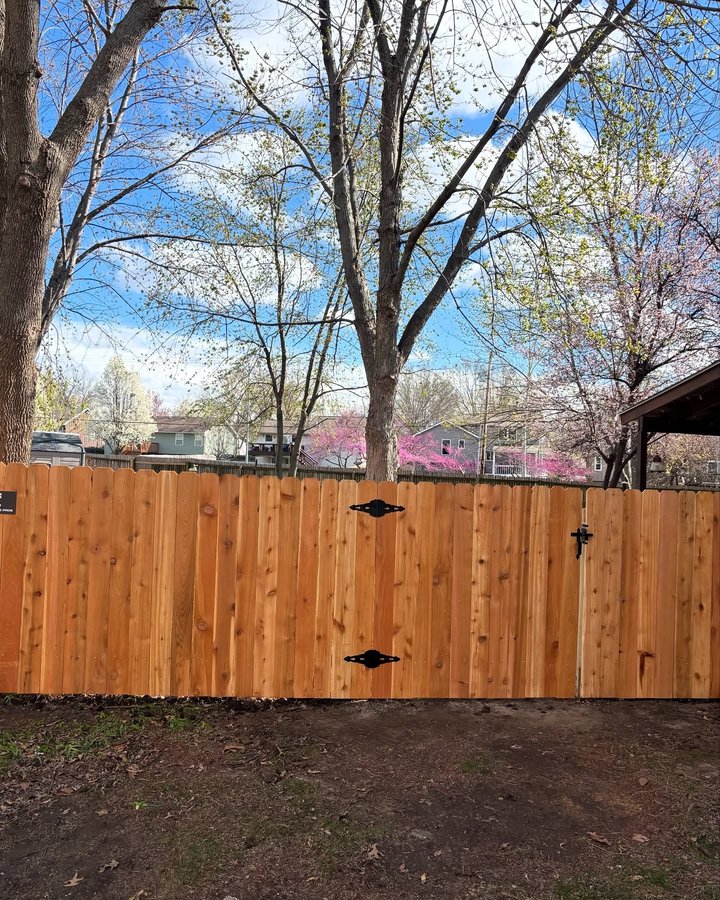
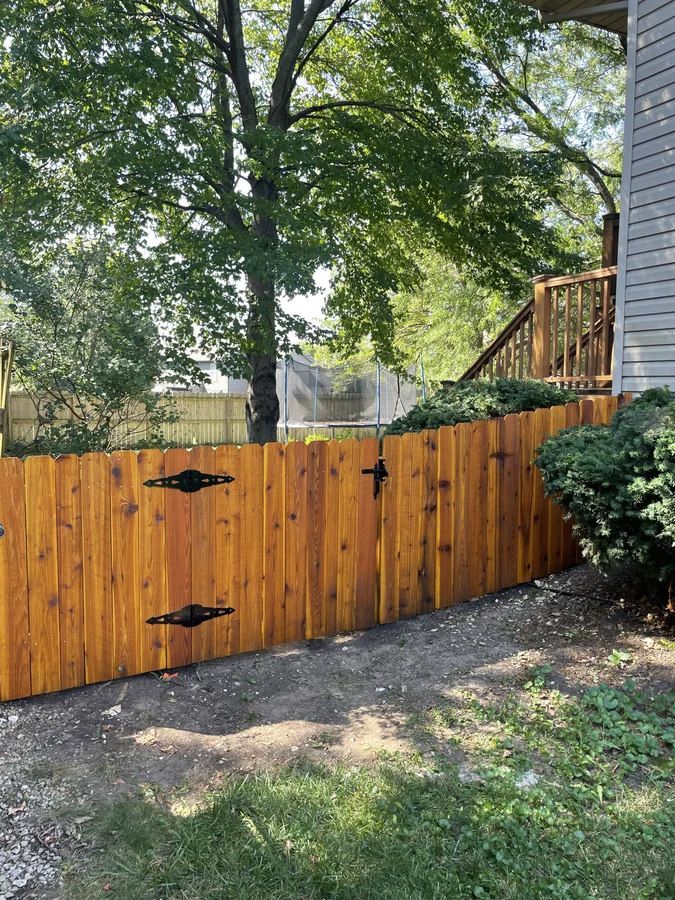
When the sod goes down, the fence goes up — and the gate is what turns a fenced rectangle into a yard you actually use. Cart the mower through, wheel the trash to the curb, let the kids run out back without a gap they can slip through. On a first fence we spec the gate right alongside the run so it goes in the same week, not as a maybe-later.
2

A walk gate the dog can't beat

A self-closing spring and proper hinge tension mean the walk gate latches itself behind you every time. The dog stays in, you stop jogging back to double-check the catch. It's a five-dollar spring and a careful hinge set, and it's the difference between a gate that manages the dog and one you never think about — which on a Gardner lot full of young families is the whole job.

3

Clear width for whatever's parked in the side yard

The boat, the camper, the utility trailer, the contractor's truck next spring. A double-drive gate opens 14 to 20 feet clean, built to the actual lot instead of a standard doorway. Two leaves meet at a center drop rod, each hinge post buried 36 inches, each leaf braced corner to corner — because the quarter-acre flat lots out here are exactly where those trailers live.

4

A gate that still lines up in the Kansas wind

On an open, treeless lot the gate takes gusts head-on for years before the landscaping ever catches up. A welded frame, a diagonal brace, galvanized hinges rated over the load, and a post sunk past the graded fill keep the leaf plumb and the latch aligned. Not sagging at the second hinge after one summer — square at year five, square at year ten.

LOCAL CONDITIONS FOR GATES

Why a Gate on a New Gardner Lot Is Built Differently

A gate is the highest-stress piece of any fence — and a fresh Gardner subdivision hands it two problems an older lot doesn't have. The ground is graded former farmland that hasn't settled, and the yard has no mature trees yet to break the wind. Add the freeze-thaw swing every KC winter and three decisions end up separating a gate that still swings true in year ten from one that's dragging by year two.

1

On a two-year-old lot, the 36-inch post matters even more

A new Gardner subdivision is built on graded former farmland — the top foot or two of a fresh backyard is disturbed fill that hasn't finished settling. Set a gate post shallow into that loose ground and the drought-cycle swell of the clay underneath walks it out of plumb inside a season, gate and all. We drop every hinge post 36 inches into wet-poured concrete, below the frost line and down into the undisturbed subsoil the fill was pushed over. That's the single line between a gate that still latches in year ten and one that drags by year two.

2

No mature trees yet — so the gate takes the full gust

The thing people underestimate about a new Gardner backyard is how open it is. The landscaping is sticks in the ground; there won't be a windbreak for a decade, and Gardner is flat enough that a Kansas gust arrives at full speed. A wide drive gate is a sail in that wind. So the leaf gets a diagonal cross-brace corner to corner, anything past 14 feet goes double-drive to cut the lever arm in half, and the hinge post is sized up a gauge. The gate is braced for the yard it lives in now, not the sheltered one it'll be in fifteen years from now.

3

Welded corners and hinges sized over the load — not a bolt-together kit

The trap for a value-minded first-fence buyer is the bolted big-box gate with zinc-plated hardware. It looks fine on install day, then every joint works loose, the frame racks out of square, and the latch quits lining up by the second summer. We weld every corner of the frame instead, and we rate the hinges above the leaf's actual weight with margin to spare — hot-dip galvanized so KC humidity can't rust them thin. It costs a little more up front and saves the sag call later. Bolted gates are what we get called out to replace.

We've hung gates on the new streets of Waverly Hills, Stone Creek, Willow Chase, Copper Creek, and Kill Creek Station, and reset older ones on the DIY runs over by the Johnson County Fairgrounds. Same 36-inch posts, same welded frames, whether it's a first fence off 175th or a replacement near US-56.

SPEC IT WITH THE FENCE

Match Your First Gate to Your First Fence

Because a Gardner gate almost always goes in with a new fence, the real question isn't "what gate" — it's "what material, for what it costs you to own." Find the row that sounds like your household and budget. The gate is built to match the run you pick, so cedar, vinyl, picket, or pine, the leaf reads as part of the fence and holds up on a flat, wind-exposed lot.

Your Gardner setup The material call How the gate is built & what it costs to own
Brand-new backyard, dog and kids, first-fence budget in mind 6-ft cedar dog-ear + a matching cedar walk gate Welded frame clad in cedar, self-latching hardware, first stain coat at 30 days included; plan on a re-stain roughly every two years to hold the color.
Busy family that wants to never think about it again White or tan vinyl privacy + a reinforced vinyl gate Aluminum-insert-stiffened vinyl leaf over a welded internal frame — no stain schedule, wipes clean, and it's the low-maintenance look that's taken a real foothold in Gardner's newer streets.
Front-yard or open look, want it low and friendly 4- to 5-ft picket + a picket walk gate Cedar or vinyl picket on a light welded frame with strap hinges and a gravity latch — the shorter, more decorative front-yard style you see far more of here than in the pricier suburbs.
Older non-HOA pocket near the fairgrounds, cost comes first Pressure-treated pine, gate to match PT frame and panels with galvanized hardware — the lowest install cost of anything we build; it trades a little more upkeep down the road for the smallest number today.
Pond, common-area, or view lot in a newer subdivision Black powder-coated ornamental steel or aluminum A welded, maintenance-free panel with a gate cut to match the run; self-latching where it wraps a pool, and the finish the newer Gardner developments lean toward for open sightlines.
Wide flat drive that has to fit the boat or camper Double-drive, cedar or iron Two braced leaves meeting at a center drop rod, both hinge posts 36 inches deep — the clear-width answer for the quarter-acre lots where the trailer lives in the side yard.

None of this is a catalog you pick from cold. On the estimate visit Josh reads the run first — the board, the height, the color you're leaning toward — and the gate follows from there. Match it at the fence and you get one continuous line with a door in it, not a fence with a gate bolted on as an afterthought.

GATE TYPES

Walk, Single-Drive, Double & Slide — the Four We Build in Gardner

Which one you need comes down to what has to pass through it and what the driveway will physically allow. These are the four gate types we install across Gardner, with real pricing on each. Material — cedar, vinyl, picket, ornamental — swaps inside any of them to match your fence; the welded frame and the 36-inch post stay the same no matter what you clad it in.

Walk Gate install by RKC Wood Care Pros in Gardner, KS

Walk Gate — 3–4 ft wide

The first gate most new Gardner backyards get

The side-yard door into a brand-new backyard — sized for the mower, the trash cart, or a toddler on your hip. On a first fence we build it to match whatever the run is: a cedar leaf clad over a welded square-tube frame, a reinforced vinyl leaf for the low-upkeep households, or a shorter picket panel out front. Self-latching hardware goes on the moment a dog is involved, which in Gardner is most of the time.

  • Price: $300–600 (cedar) · $400–800 (vinyl)
  • Typical use: Side-yard entry into a new-subdivision backyard, dog-and-kids households
Single-Drive Gate install by RKC Wood Care Pros in Gardner, KS

Single-Drive Gate — 10–14 ft wide

Fits the typical Gardner driveway between the pillars

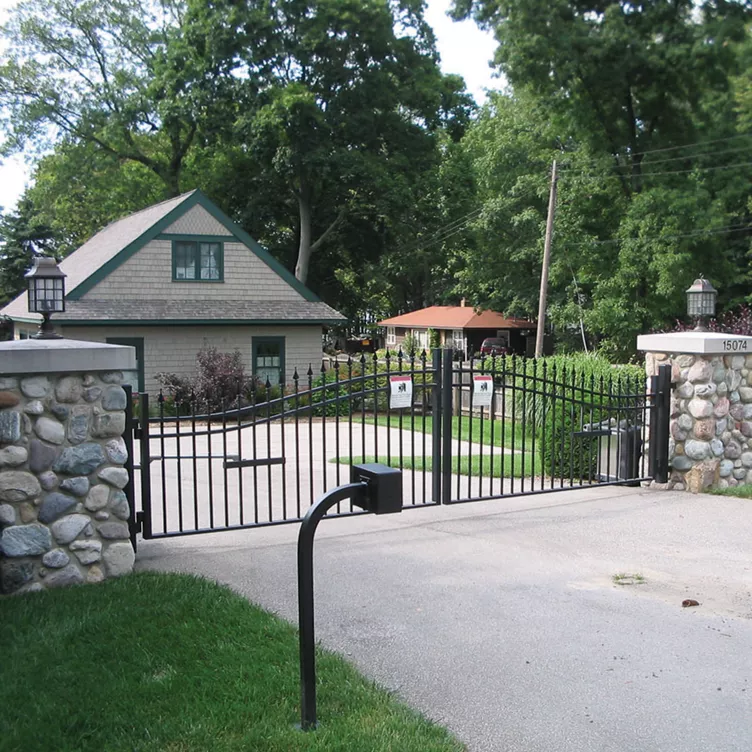
One leaf swinging off a single hinge post — the workhorse on a flat Gardner lot where the driveway runs straight off a level street. Welded frame, a diagonal brace running from the bottom hinge corner up to the latch corner, and ball-bearing or J-bolt hinges spec'd over the leaf's real weight. The hinge post is sunk 36 inches into wet-poured concrete, down past the loose graded fill a new subdivision leaves behind and into the settled subsoil.

  • Price: $650–1,200 (cedar) · $900–1,800 (iron)
  • Typical use: Level residential driveways, single-vehicle entries in Waverly Hills and Stone Creek
Double-Drive Gate install by RKC Wood Care Pros in Gardner, KS

Double-Drive Gate — 14–20 ft wide

For the boat, the RV, and the wide flat lots

Two leaves meeting at a center drop rod, each swinging from its own post. Splitting the opening halves the lever arm every hinge carries — which is the whole point on a treeless Gardner lot where nothing slows the wind before it hits the gate. Common where a family parks a boat or camper on a quarter-acre and needs the clear width to back it in. Both posts go 36 inches down, both leaves carry their own brace.

  • Price: +30–50% over single-drive
  • Typical use: Boat/RV and trailer clearance on the larger flat lots north and west of town
Sliding Gate install by RKC Wood Care Pros in Gardner, KS

Sliding Gate — 10–20 ft travel

When there's no room for a leaf to swing

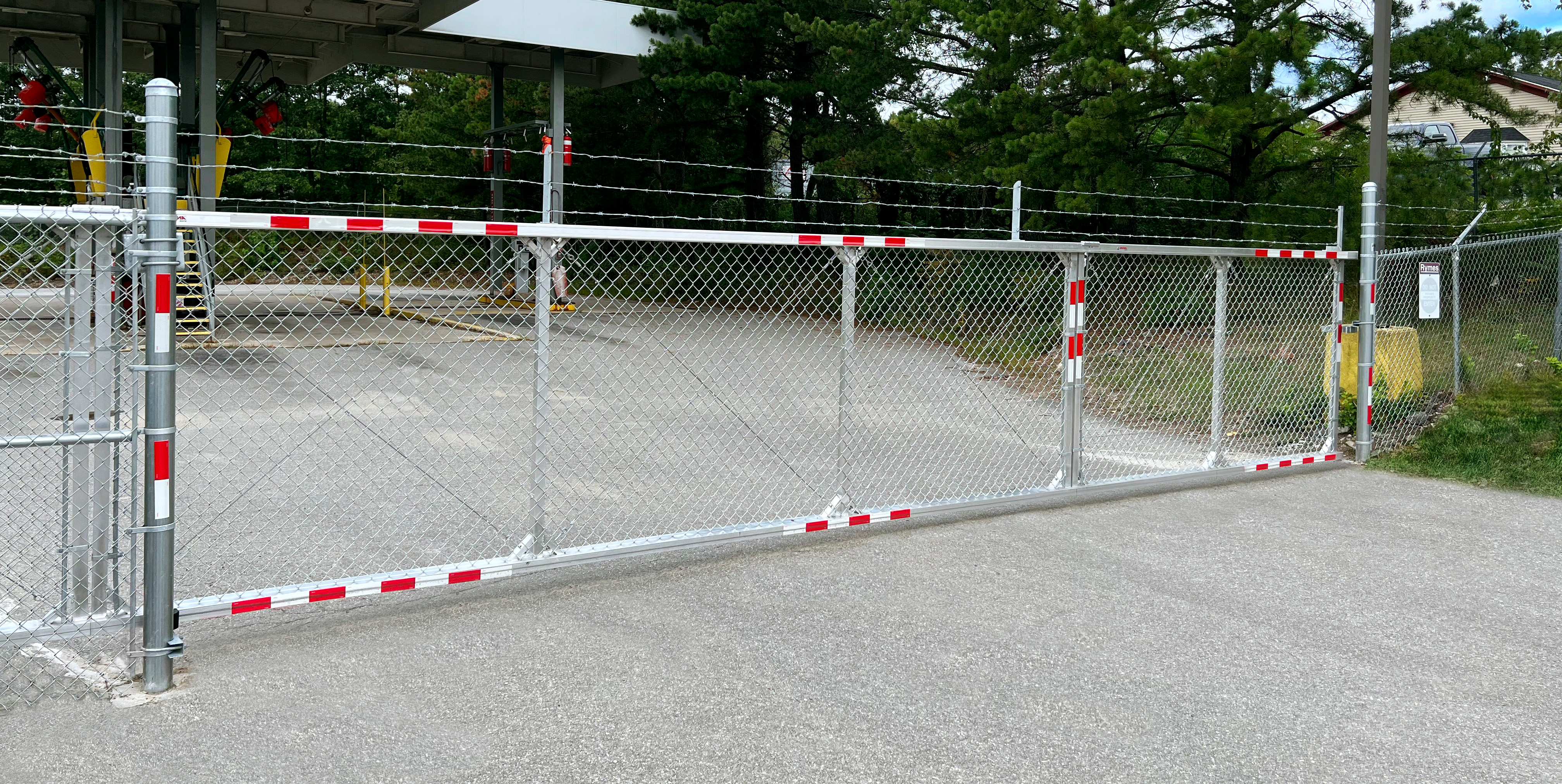
A cantilever slide rides rollers to the side and needs zero arc to open — the answer when a fence line sits tight to the driveway edge or a wall boxes in the approach. We install these most on the commercial and light-industrial sites growing up around New Century AirCenter and the Edgerton intermodal corridor, but they solve the odd residential lot where a swing gate would foul the parking pad too.

  • Price: +$400–900 over swing-gate pricing
  • Typical use: Tight residential lots, commercial yards along the I-35 / US-56 corridor
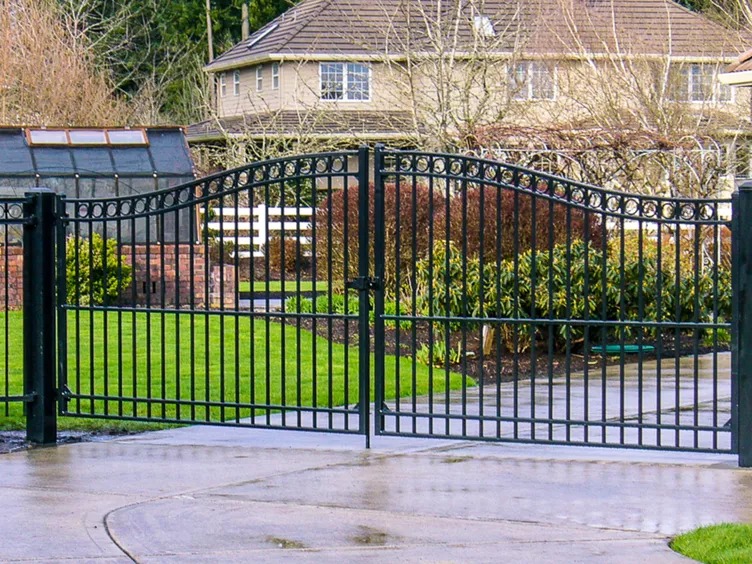
Ornamental iron spear-top double drive gate cost — Gardner, KS — RKC Wood Care Pros

GARDNER GATE PRICING

What a Gate Costs in Gardner

Price tracks gate type, material, and size — and the cheapest way to get one is to bundle it with the fence while we're already on the lot. Every quote covers the welded frame, the heavy-duty galvanized hardware, and a 36-inch hinge post in wet-poured concrete. These are the three configurations Gardner homeowners ask for most.

Walk Gate

$300–800

installed

Cedar, vinyl, picket, or pressure-treated to match your fence run. Welded frame, self-latching hardware when a dog or pool is behind it.

Single-Drive Gate

$650–1,800

installed

Cedar $650–1,200 · Ornamental iron $900–1,800. Welded frame, corner-to-corner brace, ball-bearing hinges, 36-inch post.

Double-Drive / Custom

+30–50%

over single-drive

Wide boat-and-RV openings, matched finials, or a cantilever slide for a tight lot — measured and quoted on site.

Adding the gate to a new fence install is the best value — the posts and the crew are already there. Every Gardner gate estimate is free, written, and itemized down to the hinge and post depth. Call (913) 286-1091 or request an on-site walkthrough, or compare the full gate-type range at the metro Kansas City gate installation hub.

OUR PROCESS

From the Call to the First Swing — Four Steps in Gardner

Most Gardner gate projects run one to three weeks start to finish, and the install itself is the short part. Walk gates are often a single day on site, drive gates one to two; the rest of the timeline is concrete cure and any custom fabrication. Here's exactly what each step looks like — including the part where we match the gate to your fence before anything gets built.

1

On-site measurement on your actual lot

Josh walks the property, tapes the real opening — almost never the number the homeowner had in their head — and confirms gate type, swing direction, and how the driveway meets the street. On a new-construction lot he also reads what the ground is: how far down the graded fill goes before it hits settled subsoil, because that's what the hinge post has to reach. You get a free, itemized written estimate the same week that names the frame material, the hinge, and the post depth.

2

Match the gate to the fence and the budget

Because a Gardner gate is usually going in with a first fence, this is where we settle the material call together — cedar for the look, vinyl for set-and-forget, picket out front, pressure-treated to hold the cost down. We pin the leaf to the same board, cap, and color as the run so the gate reads as part of the fence instead of an add-on, and we lock the hardware: strap or ball-bearing hinges, latch style, and whether a self-close spring goes on for the dog.

3

Install — posts first, welded frame second, hinges dialed on site

Hinge posts go in on day one, 36 inches into wet-poured concrete, and cure overnight before they carry any weight. The welded frame and panels hang on day two once the footings have set. The hinges get mounted and tuned right there against the real ground, not pre-set at a shop, so the leaf swings true to the slope it actually sits on and meets the latch square. Most walk gates wrap in a single day; drive gates usually run two.

4

Load-test, walkthrough, and a free 30-day settle check

Before final payment we cycle the gate open and shut ten times and watch every hinge take the load — any drag, scrape, or missed catch gets corrected on the spot. New footings settle a hair in the first month, so we come back at 30 days to realign the latch and take out any hinge drift for free. And we show you the one quarter-turn hinge adjustment you can do yourself later. Most Gardner homeowners never need it, but you'll have it.

RECENT GARDNER GATE INSTALLS

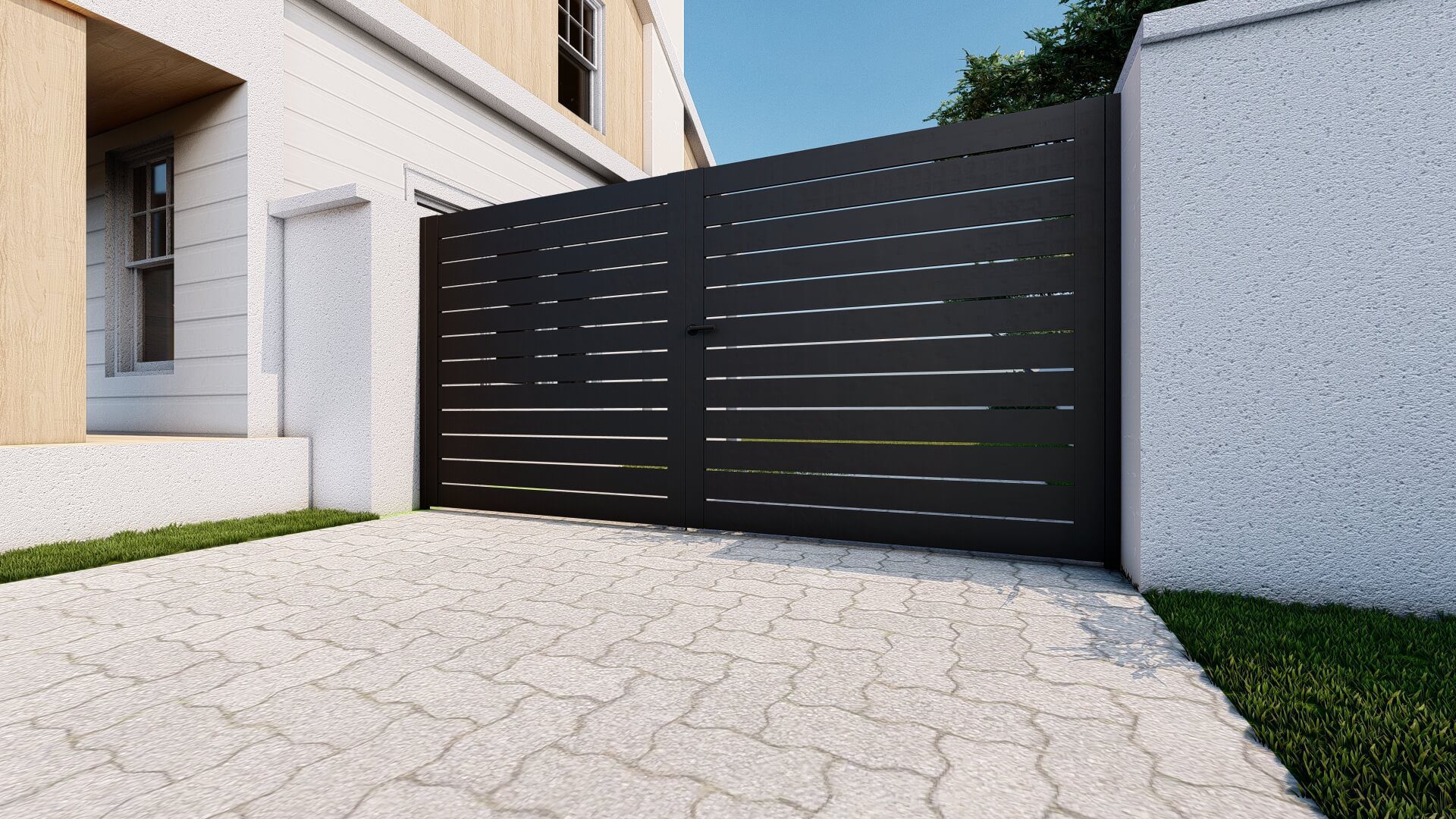
Horizontal-slat entry gate install in Gardner, KS by RKC Wood Care Pros
Horizontal-Slat Entry Gate · Gardner
Cedar privacy fence double-drive gate install in Gardner, KS by RKC Wood Care Pros
Cedar Double-Drive Gate · Gardner
Cantilever slide gate install in Gardner, KS by RKC Wood Care Pros
Cantilever Slide Gate · Gardner
Cedar privacy fence with walk gate install in Gardner, KS by RKC Wood Care Pros
Privacy Fence Walk Gate · Gardner

REVIEWS

What Kansas City Homeowners Say About RKC

4.9 ★ · 85 Google reviews

Every review is on our Google Business Profile — read them there, unedited.

Read all 85 reviews on Google

GARDNER GATE QUESTIONS

Gate Questions Gardner Homeowners Ask Most

A Gardner gate really comes down to three things: type and sizing, building it for a flat wind-exposed new lot, and the pricing and hardware. These are the questions homeowners actually raise on the estimate visit, grouped by topic. If yours isn't here, call (913) 286-1091 and ask Josh directly.

Cedar single-drive gate install in Gardner, KS by RKC Wood Care Pros

Gate Types & Sizing

What gate width fits a typical Gardner driveway?
Most Gardner drives measure 10 to 14 feet between the pillars, and 12 feet is the sweet spot for a single-leaf swing gate on a welded, braced frame. Past 14 feet we steer you to a double-drive — two shorter leaves meeting in the middle — because a lone 16-foot leaf hangs too much lever arm on the hinges and catches the open prairie wind like a sail. Walk gates sit apart from all of that at 3.5 to 4 feet, enough for a mower or a wheelbarrow on a single pair of strap hinges.
For a new Gardner backyard, is cedar or vinyl the better gate?
It comes down to how you want to spend your time. Cedar gives you the warm natural look for the lowest up-front number, but it wants a re-stain about every two years to keep its color. Vinyl costs a bit more to install and never needs staining — you hose it off — which is why so many busy Gardner families in the newer subdivisions land there. Either way the gate is built to match the fence line exactly; we settle the call on the estimate visit once we see the run and hear how much upkeep you're up for.
Swing gate or sliding gate for my lot?
A swing gate pivots on one post (single-drive) or two (double-drive) and just needs room to arc open — simpler hardware, lower cost, and the default on Gardner's flat, straight-off-the-street driveways. A cantilever slide rolls to the side and needs zero swing room, which earns its keep when the fence line hugs the driveway edge or a wall boxes in the approach. Slide hardware runs $400 to $900 over a comparable swing gate, so on most residential lots here swing wins unless the geometry forces the slide.
Can I add a gate to a fence that's already up?
Depends entirely on the post it would hang from. If that post is set 36 inches deep in concrete and dead plumb, we can often hang a new leaf off it. If it's shallow, surface-mounted, or already leaning — common on older DIY runs around the fairgrounds side of town — it comes out and a proper 36-inch concrete post goes in, because a gate is only ever as straight as the post carrying it. We check depth and plumb on the estimate before we quote it.

Building for Gardner's Conditions

Why do gates lean so fast on brand-new Gardner lots?
Two reasons stack up out here. First, a new subdivision is graded former farmland, so the top foot or two of your backyard is loose fill that hasn't settled — a shallow post has nothing solid to hold. Second, Gardner is flat and wide open with no mature trees yet, so the wind hits a gate at full force and works a weak post loose a little more with every gust. Sink the post 36 inches into concrete, past the fill and below the frost line, and both problems go away.
How deep do the posts go, and why 36 inches?
Every gate hinge post we set in Gardner goes 36 inches into wet-poured concrete. That depth clears the Kansas City frost line, so the freeze-thaw cycle can't heave it, and it reaches through the disturbed grading fill of a new lot into the settled subsoil underneath. A gate post carries far more than a fence post — the full weight of the leaf plus the leverage of every open and close — so it's the one spot where cutting depth to save an hour guarantees a sag call down the road.
How long will a cedar or vinyl gate actually last here?
A cedar drive gate on a welded frame with ball-bearing hinges and a 36-inch post runs 15 to 20 years in Gardner's climate; the wood holds 15 to 25 with a steady two-year stain habit, and the steel frame outlives all of it. A reinforced vinyl gate goes 25 to 30 with essentially no maintenance. The things that kill a gate early — a heaved shallow post or a stripped bargain hinge — are exactly the two we engineer out.

Pricing, Hardware & Timeline

Why does a welded frame cost more than a bolted one?
A welded frame takes more shop time — every corner is cut, fit, tacked, and run with a full finish weld — and that's exactly why it stays square for the life of the gate. A bolted frame flexes at each joint, works loose, and racks out of true within a couple of seasons until the latch quits catching. Welding adds roughly 15 to 25% to the frame and erases the year-five sag repair. Every gate we build in Gardner is welded at every corner; bolt-together gates are what we get called back to replace.
What does a gate cost if I add it to a new fence install?
Bundling the gate with the fence is the cheapest way to get it, because we're already on site with the posts and the crew. Walk gates land at $300 to $800 depending on material, single-drive gates at $650 to $1,800 between cedar and ornamental iron, and double-drives run 30 to 50% over a single-drive for the extra leaf and hardware. Every estimate is free, itemized, and spells out the frame material, hinge, and post depth — no verbal numbers, nothing figured out on install day.
What's the warranty, and what's the 30-day check?
The hinges, latches, and drop rods carry their manufacturer warranty — typically 10 years on ball-bearing hinges and 5 to 10 on straps and latches — and the welded frame is covered by our own workmanship warranty: if it racks, sags at the latch corner, or a weld lets go under normal use, we come back and set it right. On top of that, every install includes a free 30-day return once the footings have fully settled, to realign the latch and take out any hinge drift.

OTHER GARDNER FENCE SERVICES

More Fence Services Available in Gardner

Every service below stays in Gardner — its own page with local pricing, real project photos, and the same crew. Since a gate usually rides in with a first fence out here, most people land here to pick the fence itself — cedar, vinyl, or a full privacy run — or to keep an older one going with repair and staining.

Ready when you are

Get a free estimate — we usually respond the same day.

Call (913) 286-1091