Skip to content
Gate Installation in Pleasant Hill, MO — Gates for the Historic Center, the Lake Lots & the Acreage Edge

Gate Installation in Pleasant Hill, MO — Gates for the Historic Center, the Lake Lots & the Acreage Edge

Pleasant Hill runs from a white-picket Historic Center to sprawling 1-to-2-acre lots on the edge of town — and the gate has to fit wherever yours sits. RKC Wood Care Pros builds walk, single-drive, farm-style double-drive, and cantilever slide gates across Pleasant Hill — self-closing for pet containment on the acreage, welded steel frames, and hinge posts set 36 inches deep against the settling ground near Pleasant Hill Lake and the wind on the open eastern outskirts. We're A+ BBB rated with 4.9 stars from 85 Google reviews, and Josh handles every estimate visit personally. Call (913) 286-1091 for a free on-site walkthrough.

★★★★★
4.9
from 85 reviews
Licensed
& Insured · KS + MO
400+
fences installed
A+ BBB Rated 400+ Fences Installed Since 2021 Welded Gate Frames · Galvanized Hardware Free On-Site Estimates
See gate styles in our catalog ↓

WHY PLEASANT HILL FAMILIES INSTALL NEW GATES

What a New Gate Actually Changes Out Here

Most people fence a Pleasant Hill lot for the room and the dog — and the gate is what turns that room into something you don't have to manage. Families come out here from Lee's Summit for an acre or two of space, and pet containment is the driver behind most of the fences we build. But a gate here isn't one thing: it's a self-closing walk gate on the acreage, a trailer-wide farm double-drive at the mouth of the drive, or a formal picket leaf near the depot. Here's what each one actually changes about living on the property.

1

Room the dog can't leave

Most people fence a Pleasant Hill lot for one reason: the acre or two of room they came out here for, and a dog to fill it. A gate that closes itself, latches above a nose, and leaves no gap at the bottom is what turns that room into containment you don't have to think about. It's the detail the older walk gates out here are missing — and the reason a new one feels solved instead of babysat.
2

A property entrance, not a driveway gap

Out where a drive meets a county blacktop, the gate marks the property. A trailer-wide double-drive on braced posts, a clean center drop rod, and pickets or rails that line up flush read as an entrance instead of a hole in the fence. We build it to your opening and your fence line — cedar or vinyl in the subdivisions, pressure-treated pine and farm-style width on the working acreage.

3

One line, from the picket to the pasture

Pleasant Hill runs the whole spread — white picket downtown, cedar privacy in the new subdivisions, split rail and wire on the edge. A gate's job is to belong to whichever line it lands in. We match it: era-matched pickets near the depot, a privacy leaf that continues the cedar run, a farm gate that ties into an existing rail or wire line clean instead of clashing with it.

4

Still latching after the ground has moved

Gates fail here two ways — a post settling in the rolling lake-hill ground, or a leaf racking under the wind on the open eastern edge. We beat both at the build: 36-inch concrete footings deep enough to hold in ground that shifts, welded frames that can't rack, and hot-dip galvanized hardware sized 50% over the leaf. The latch still lines up in year five, and in year ten.

GROUND, WIND & WIDTH

What Pleasant Hill's Ground and Wind Mean for Your Gate

A gate is the highest-stress component of any fence — every cycle pulls on the hinge post, and out here the ground and the wind pull back. Two things break gates in Pleasant Hill: the rolling, wooded ground near the lake, where posts settle and gates start to drag, and the open eastern outskirts, where wind hits a leaf with nothing in front of it. Add the farm-style widths the acreage calls for, and three build decisions separate a gate that still swings square in year ten from one that sags at year two. Here's how we handle each.

1

Hinge posts set 36 inches against settling ground

The trouble with the rolling, wooded ground around Pleasant Hill Lake isn't frost so much as settling — a hinge post that stops short works loose and tips as the soil moves under it, and once it tips the latch quits lining up. So every gate and hinge post we set here goes a full 36 inches into wet-poured concrete, below the frost line and deep enough to lock into ground that isn't. On a wide farm-style leaf the post gets upsized and set deeper still, because a 16-foot gate leverages a footing a walk gate never touches.

2

Welded frames hold a farm-width leaf square

The wider the gate, the harder every joint works — and a lot of Pleasant Hill gates are wide, spanning a trailer opening on the acreage. A bolted frame has play in every corner, racks out of square inside two seasons, and drops the latch side. We weld every corner on a square-tube frame — cedar-clad for a wood look, powder-coated where it's steel — so a long leaf keeps its geometry instead of sagging into a parallelogram.

3

Windward bracing on the exposed eastern edge

Out on the open eastern outskirts, wind hits a fence line with nothing in front of it, and a solid gate leaf is the biggest sail on the property. We brace the leaf on the diagonal, add a drop rod and a hold-back so a gust can't slam or rack it, and size every hinge 50% over the gate's actual weight in hot-dip galvanized or stainless — never big-box zinc, which rusts out inside a couple of humid Missouri summers. The right build holds plumb through years of wind and daily swinging.

Pleasant Hill gates we've built run from the Historic Center near the depot and the Rock Island Trail out to Pleasant Meadows, Wyatt Ridge, Sunset Hills, Country Ridge, and the working acreage on the open eastern edge. Same engineering, same 36-inch posts, same welded frames — whether it's a white picket downtown or a farm-style double-drive off a county blacktop.

START WITH THE SETTING

Where Your Lot Sits on Pleasant Hill's Gradient Decides the Gate

Pleasant Hill is one town spread across a whole gradient — historic-corner picket, new-subdivision cedar, and split-rail acreage — and the gate that fits depends on where on it you are. Find the row that sounds like your property. The left column is the setting on the ground; the middle is the gate it calls for; the right is how we build it so it holds here. A downtown pedestrian gate and a trailer-wide farm double-drive are the same craft answering two very different lots.

The Pleasant Hill setting The gate it takes How we build it to last here
A 1-to-2-acre lot where the whole point is room for the dog Self-closing walk gate + a wide property gate Pet containment is the reason most people fence out here, so the walk gate is built to close itself — self-closing hinge, self-latching catch above nose height, a bottom gap tight enough a digger can't slip it. The wider drive gate gets the same treatment where the yard opens to the driveway.
A semi-rural drive meeting a county blacktop (Boardman Rd, M-7, M-58) Wide PT-pine or cedar farm-style double-drive The opening has to clear a trailer or a mower, so we split anything past 14 feet into two leaves on a center drop rod and hang them off a braced H-post. Where a split-rail or wire line already runs the property line, the drive gate ties into it instead of clashing with it.
A new outskirts subdivision lot (Pleasant Meadows, Wyatt Ridge, Sunset Hills) Cedar or no-stain vinyl privacy walk + single-drive These lots were graded and the fill hasn't fully settled, so the hinge footing is over-dug and set deeper than the run posts. Cedar for the warm private line, vinyl for the crowd that wants to skip the stain schedule — the frame and post engineering stay identical under either.
A corner lot near the Historic Center and the depot White picket or decorative-wood pedestrian, kept low and open Downtown the gate is a formal, era-matched piece — pickets spaced to the run, both faces finished for the neighbor across the way, ornamental iron where the block already runs it. Kept low and open so it reads with the depot-era houses instead of walling the corner off.
A wooded lot rolling down toward Pleasant Hill Lake Swing or cantilever set against settling ground The hilly, wooded ground around the lake is where posts settle and gates start to drag. The downhill hinge footing goes deeper, the leaf is racked to the actual grade so it clears the whole arc, and on a tight rising approach a cantilever rolls clear instead of scraping the slope.
An exposed lot on the open eastern outskirts A long run taking the full prairie wind The east edge of town catches wind with nothing to break it. The windward hinge post gets upsized and set deeper, the leaf carries a drop rod and a hold-back so a gust can't slam or rack it, and every hinge is sized 50% over the gate's weight so the load has somewhere to go.

This isn't a menu you order from cold. On the estimate visit Josh reads where the lot sits — downtown, subdivision, lakeside, or acreage — how the existing fence line wants the gate to meet it, and how the ground and wind will work it, and the build follows from that. Mention the Rock Island Trail or the Cass County Fair and he'll know exactly which end of town you're on.

GATE TYPES

Walk, Drive, Farm-Style & Cantilever — Every Gate for Your Pleasant Hill Property

The right gate depends on what your property is for — containing the dog, passing a trailer, or fronting a historic corner. Here are the four gate types we install across Pleasant Hill, what each one fits, and total install pricing. Cedar matches the privacy run in the newer subdivisions; pressure-treated pine handles the long farm runs on the acreage; a white picket or ornamental leaf suits the Historic Center. The welded frame and 36-inch post engineering stay the same under all of them.

Cedar walk gate install in Pleasant Hill, MO by RKC Wood Care Pros

Walk Gate — 3–4 ft wide

The gate that keeps the dog home

On the 1-to-2-acre lots families move out here from Lee's Summit to get, the walk gate does the real job: it keeps the dog on the property. So we hang it to swing shut on its own — a self-closing hinge, a self-latching catch above a nose, and a tight bottom gap a determined mutt can't wriggle under. Cedar to match the privacy run in the newer subdivisions; a white picket or decorative-wood leaf near the Historic Center depot where the block calls for it.

  • Price: $300–600 (cedar) · $450–850 (iron)
  • Typical use: Pet containment on acreage, side-yard entry, historic-district pedestrian gate
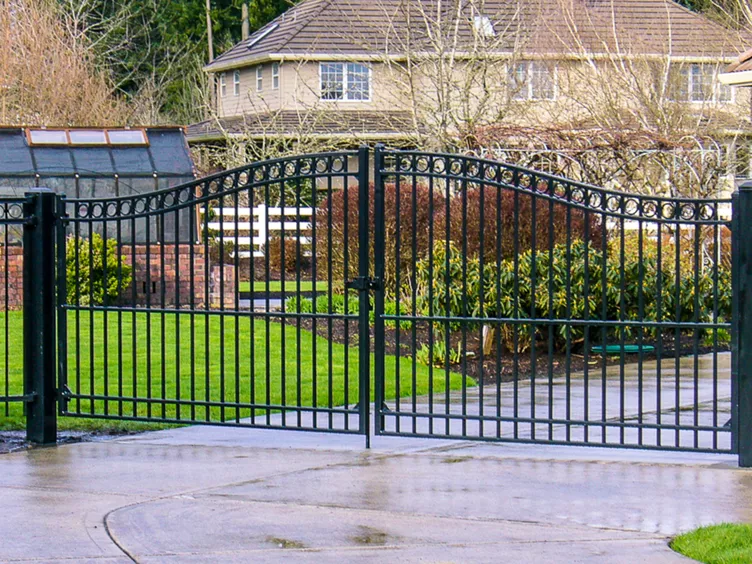
Aluminum single-drive residential gate install in Pleasant Hill, MO by RKC Wood Care Pros

Single-Drive Gate — 10–14 ft wide

The everyday property entrance

A single-leaf swing gate sized to the drive where it meets a Pleasant Hill blacktop — Boardman Road, M-7, a subdivision street. Welded frame, a diagonal cross-brace from bottom hinge to top latch, ball-bearing hinges sized over the leaf. The hinge post sets 36 inches in wet-poured concrete, because the ground rolls out here and a shallow post settles cockeyed within a season on the wooded lots near the lake.

  • Price: $650–1,200 (cedar) · $900–1,800 (aluminum)
  • Typical use: Standard drive, subdivision entry, cedar or low-maintenance aluminum
Farm-style double-drive gate with braced posts and center drop rod by RKC Wood Care Pros

Double-Drive / Farm-Style Gate — 14–20 ft wide

For the tractor, the trailer, the acreage

The signature Pleasant Hill gate. On a semi-rural lot the opening has to pass a mower, a trailer, a boat, sometimes a tractor — so two leaves meet at a center drop rod and each one's lever arm gets cut in half. Pressure-treated pine handles the long runs on the working acreage; cedar dresses the newer estate lots. Where the property already runs a split-rail or wire line, we hang the drive gate to tie into it clean instead of fighting it. Both posts at 36 inches, both leaves braced.

  • Price: $950–2,800 installed
  • Typical use: Semi-rural drives, trailer/boat/tractor clearance, split-rail or wire tie-in
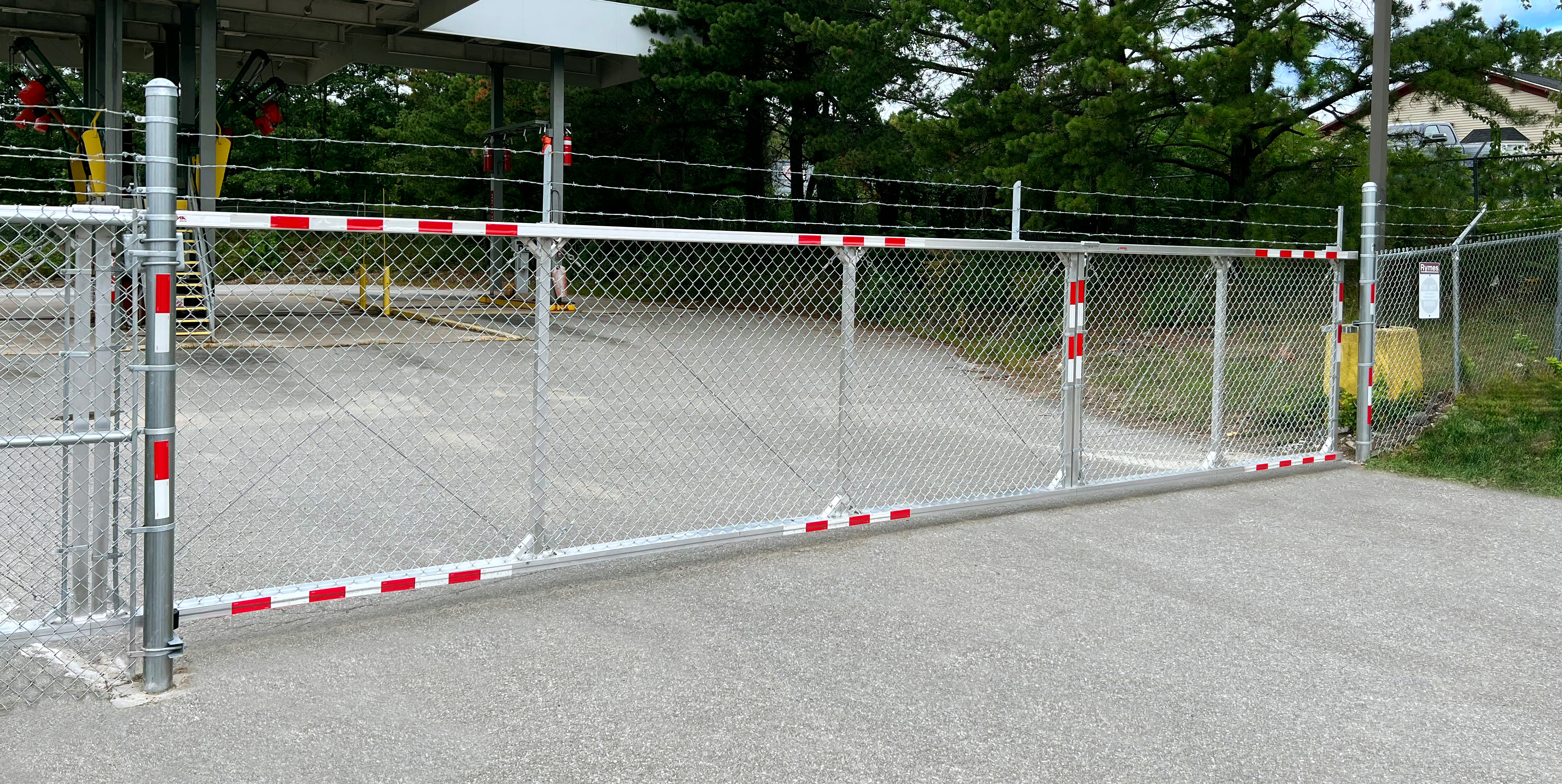
Chain-link cantilever slide gate install in Pleasant Hill, MO by RKC Wood Care Pros

Sliding / Cantilever Gate — 10–20 ft travel

For the drive that climbs off the road

When a drive rises off the county road toward the lake, or a wire line runs right up to the driveway edge with no room for a leaf to arc, a gate rolls sideways instead — a cantilever on rollers, no ground track to jam with gravel or leaves. Chain link fills the frame where the job is pet containment on a working lot; steel or aluminum where it fronts the road. Zero swing clearance, which is the whole point on the rolling ground east and south of town.

  • Price: $1,200–2,400 installed
  • Typical use: Rising lake-road drives, wire-line edges, chain-link pet containment
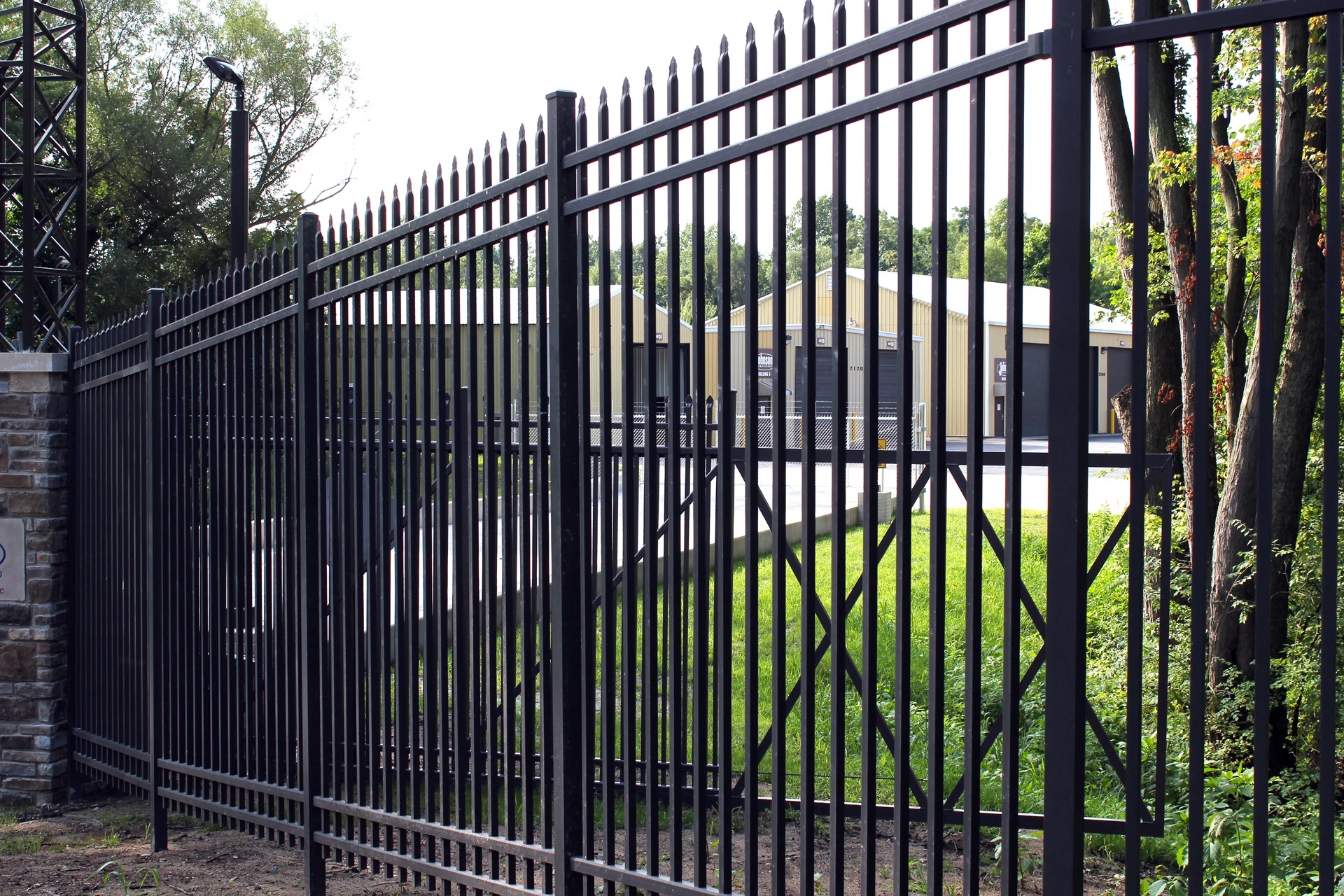
Ornamental steel security fence and gate in Pleasant Hill, MO by RKC Wood Care Pros

PLEASANT HILL GATE PRICING

What Gate Installation Costs in Pleasant Hill

Gate pricing in Pleasant Hill depends on gate type, material, and size — a walk gate and a trailer-wide farm double-drive are different jobs. Every quote includes welded steel frame construction, galvanized heavy-duty hardware, and a 36-inch hinge post set in wet-poured concrete. Below are the three configurations we quote most often for Pleasant Hill properties.

Wood Walk Gate

$300–600

installed

Cedar or pressure-treated pine. Welded frame, galvanized strap hinges, gravity or drop-rod latch. Total install $300–600.

Single-Drive Driveway Gate

$650–1,800

installed

Total install $650–1,200 wood, $900–1,800 ornamental iron. Welded frame, diagonal cross-brace, ball-bearing hinges, 36-inch hinge post.

Double-Drive & Cantilever

$950–2,800

installed

Total install $950–2,800 depending on width, material, and whether cantilever slide hardware is needed. Braced H-posts, center drop rod, and any split-rail or wire tie-in quoted on site.

Farm-style widths, split-rail or wire tie-ins, and cantilever slide hardware are quoted on site once we've measured the opening. For the full gate-type scope across the metro, see the Kansas City gate installation hub. Every Pleasant Hill gate estimate is free, written, and itemized — call (913) 286-1091 or request an on-site walkthrough.

OUR PROCESS

How a Gate Install in Pleasant Hill Actually Happens

Four steps from the phone call to the first swing. Most Pleasant Hill gate projects run 1 to 3 weeks start to finish. Install days themselves are short — walk gates are often a single day, drive and farm gates one to two. The longer stretch is fabrication lead time on the welded leaf, which we order once the opening is measured and any fence tie-in is settled. Here's what each step actually looks like on a gate install in Pleasant Hill.

1

On-site measurement and gate spec

Josh walks your Pleasant Hill property, measures the actual opening, and confirms gate type, swing direction, and clearance — and out here that means reading where the lot sits, from a historic-corner pedestrian gate to a trailer-wide farm double-drive. We settle hardware tier (strap vs. ball-bearing hinges, latch style, self-close for pet containment) and write up the estimate inside the week. Every quote lists hinge brand, post depth, and frame material. Timeline: estimate visit takes 30–45 minutes; written quote in 3–5 days.

2

Post sizing, swing, and any fence tie-in

A gate lives or dies at the hinge post, so before we build we measure the opening, the swing, and the grade, then size the hinge post to the gate's weight and width — a trailer-wide farm double-drive needs a bigger post set deeper than a walk gate does. We confirm the hardware rated above the gate weight, the swing direction, whether a drop rod or hold-back is needed for the wind, and how the gate meets the existing fence — cedar, vinyl, or a split-rail or wire line on the acreage — then set the posts 36 inches deep in concrete before the gate ever gets hung.

3

Install — hinge posts first, welded frame second

Hinge posts set on day one, 36 inches deep in wet-poured concrete, cured overnight. The welded frame and panels go up on day two once the footings have set. Hinges and latches mount on site — not pre-set at the shop — so the gate swings square against the actual ground slope. Timeline: walk gates 1 day on site, drive gates 2 days.

4

Walkthrough plus a 30-day adjustment visit

Before final payment we swing the gate open and closed ten times and watch every hinge under load. Any drag, any scrape, any latch miss gets adjusted on the spot. Because concrete footings settle slightly in the first month, we come back at 30 days for a free adjustment pass. Timeline: walkthrough on the last install day; 30-day visit takes 20–30 minutes.

RECENT PLEASANT HILL GATE INSTALLS

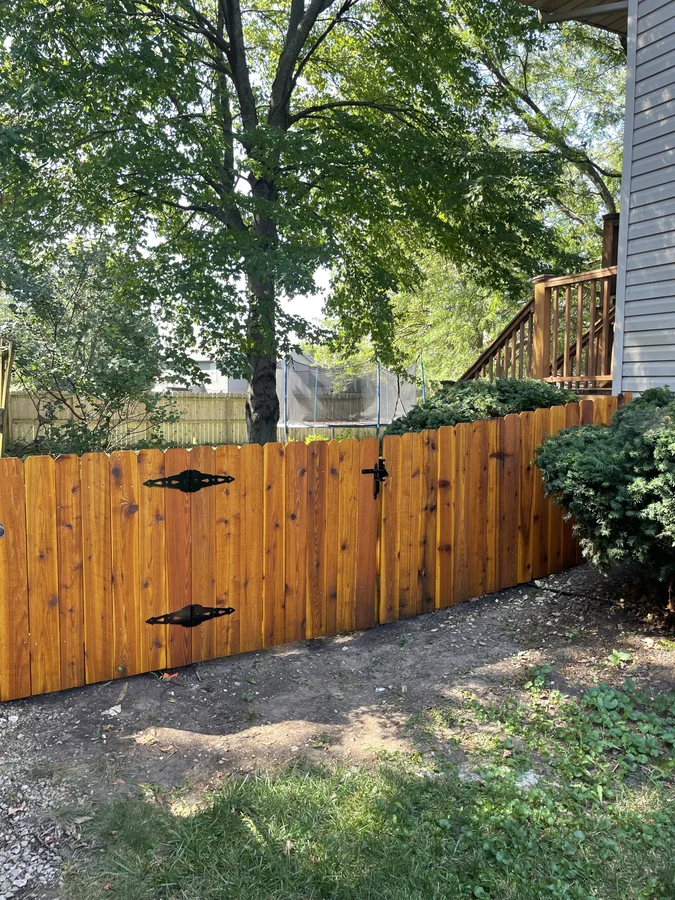
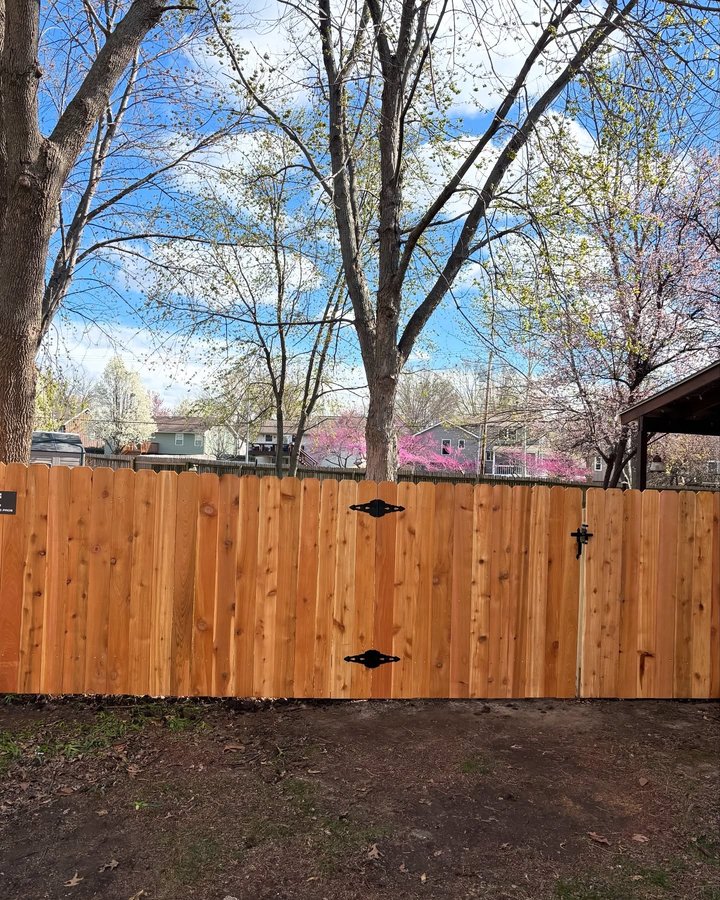
Cedar fence with matching gates installed in Pleasant Hill, MO by RKC Wood Care Pros
Cedar Fence & Matching Gates · Pleasant Hill
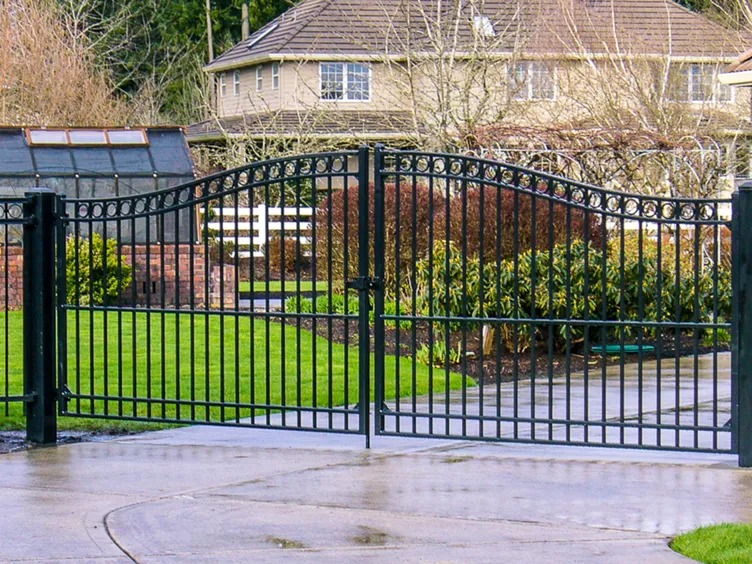
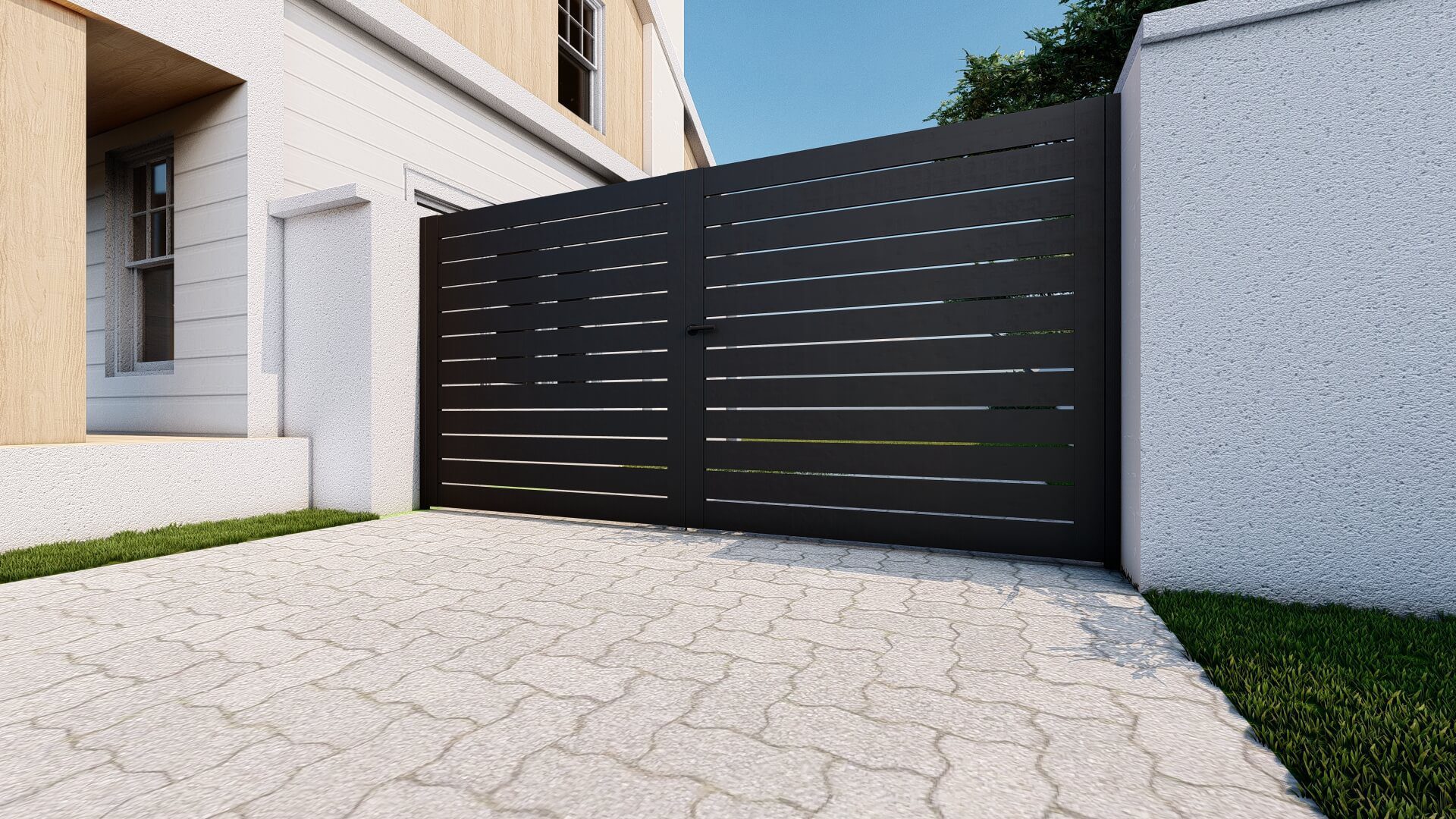
Aluminum residential driveway gate in Pleasant Hill, MO by RKC Wood Care Pros
Aluminum Drive Gate · Pleasant Hill
Chain-link cantilever slide gate in Pleasant Hill, MO by RKC Wood Care Pros
Chain-Link Cantilever · Pleasant Hill
Cedar walk gate install in Pleasant Hill, MO by RKC Wood Care Pros
Cedar Walk Gate · Pleasant Hill

REVIEWS

What Kansas City Homeowners Say About RKC

4.9 ★ · 85 Google reviews

Every review is on our Google Business Profile — read them there, unedited.

Read all 85 reviews on Google

PLEASANT HILL GATE QUESTIONS

Gate Questions Pleasant Hill Homeowners Ask Most

Gate installation in Pleasant Hill comes down to type and sizing, the ground you're setting into, and hardware spec. Below are the questions Pleasant Hill homeowners actually ask during the estimate — grouped by topic, each answer specific to the settling ground near the lake, the wind on the eastern edge, and how a gate is built to last here. If your question isn't here, call (913) 286-1091 and ask.

Cedar single-drive gate install in Pleasant Hill, MO by RKC Wood Care Pros

Gate Types & Sizing

What gate width do I need for a semi-rural Pleasant Hill drive?
In town most drives run 10 to 14 feet, and a single welded, cross-braced leaf covers that comfortably. Out on the acreage it's a different question — you're sizing for what comes through, not just the car. Once you factor a mower deck, a boat trailer, or a tractor, you're usually past 14 feet, and that's the line where we split it into a double-drive: two leaves meeting at a center drop rod, because a single 16-foot leaf hangs too much weight off one hinge and starts to droop. Walk gates land at 3.5 to 4 feet.
Can you hang a gate on my existing fence — even a split-rail or wire line?
Usually, yes, but the post decides it, not the panel. If the current hinge post was set a real 36 inches in concrete, it can carry a new leaf. A split-rail or wire farm line rarely has a post built for a swinging gate, so we set a proper braced hinge post at the opening and tie the gate into your existing run from there — you keep the rail or wire line you have and gain a gate that actually holds plumb. If an in-town post is shallow, surface-mounted, or already leaning, it comes out first. We check depth and plumb at the estimate.
How long does a cedar or pressure-treated farm gate last out here?
A cedar single-drive with a welded frame, ball-bearing hinges, and a 36-inch post runs 15 to 20 years in Pleasant Hill's climate — the cedar lasts 15 to 25 with a stain every couple of seasons, and the steel frame outlives the wood. On the working acreage, pressure-treated pine is the common call for the long runs: a little heavier and rougher than cedar, but it takes the weather and the wear on a rural lot and costs less per foot. Under either, the failure points are shallow posts and big-box zinc hinges — neither is how we build.
Swing gate or a cantilever slide for a lake-road drive?
If the drive climbs off the road or a fence line crowds the opening, lean toward a cantilever slide. A swing leaf needs clear, level ground to arc across, and on a rising approach near the lake it catches halfway open. A cantilever rolls sideways clear of the arc with no ground track to jam with gravel or leaves — which is why we run it on the sloped, wooded lots south and east of town. On a flat open drive a swing gate is simpler and cheaper; the grade is what makes the case for a slide, and it runs roughly $400 to $900 more than the same-size swing.

Pleasant Hill Conditions & Craft

How do you keep a gate plumb on the settling ground near the lake?
The rolling, wooded ground around Pleasant Hill Lake settles, and a hinge post that stops short works loose and tips as the soil moves — then the latch quits lining up. We set every gate post a full 36 inches in wet-poured concrete, below the frost line and deep enough to lock into ground that isn't standing still, and on the downhill side of a sloped lot the footing goes deeper still. On a wide farm leaf the post gets upsized too, because a 16-foot gate leverages a footing a walk gate never touches. Get the post right and the gate rides out the ground movement instead of chasing it.
Will a new gate actually keep the dog on the property?
That's the job we build it for, since pet containment is the main reason people fence acreage out here. The walk gate gets a self-closing hinge so it shuts behind you on its own, a self-latching catch set above nose height so a paw can't trip it, and a bottom gap tightened down so a digger can't slip under. On the wider yard-to-drive openings we do the same, and where the run is chain link we carry the mesh through the gate frame so there's no weak seam. A gate that closes itself is the difference between containment and a gate you're always walking back to check.
How long does gate installation take in Pleasant Hill?
Walk gates run 1 day on site and 1 to 2 weeks from estimate approval. Single-drive gates run 1 to 2 days on site and 2 to 3 weeks of lead time. Double-drive and farm-style gates run 2 days on site and 3 to 4 weeks, since the wider welded leaf takes more shop time. A cantilever slide adds about a week for the hardware.

Pricing & Hardware

Why are welded gate frames worth more than bolted?
A welded frame costs more in shop time — every corner cut, fit, tacked, and burned in with a finish pass — but it holds its geometry, and that matters most on the wide leaves common out here. A bolted frame has play in every joint, racks out of square within two seasons under a farm-width span, and drops the latch corner. Welding adds roughly 15 to 25% to the frame cost against a near-certain sag call down the road. Every gate we build in Pleasant Hill is welded at every corner — the bolted ones are what we get called back to re-square.
Can you match a gate to a historic-district picket or an ornamental line?
Yes — near the Historic Center and the depot that's most of what we build, and it's a matching job as much as a build. We lay the pedestrian gate out to the run so the picket spacing and reveal line up, finish both faces since a downtown corner is seen from all sides, and run decorative wood or powder-coated ornamental iron where the block already carries it. The point downtown is a gate that reads with the era of the house rather than announcing itself.
What's the warranty on gate hardware?
Hinges, latches, drop rods, and cane bolts carry the manufacturer's warranty — typically 10 years on ball-bearing hinges and 5 to 10 years on strap hinges and latches. The welded frame is covered by our workmanship warranty: if it racks out of square, sags at the latch corner, or a weld fails under normal use, we come back and set it right. The free 30-day visit covers any settling drift in the first month — which, on the ground out here, is exactly when a footing tells you what it's going to do.

OTHER PLEASANT HILL FENCE SERVICES

More Fence Services Available in Pleasant Hill

Every service below stays in Pleasant Hill — dedicated pages with local pricing and recent project photos specific to your city. If you're adding a gate to a new fence, fencing an acreage lot for the dog, or restaining an older run before the Rock Island Trail season, here's where to go next.

Wood Fence in Pleasant Hill

Cedar privacy for the subdivisions and pressure-treated pine for the working acreage — 36-inch posts and a first stain coat at 30 days included.

Wood Fence in Pleasant Hill →

Privacy Fence in Pleasant Hill

Six-foot cedar and board-on-board — the leading fence out here — built to hold plumb on the rolling ground near the lake and the open eastern edge.

Privacy Fence in Pleasant Hill →

Chain Link Fence in Pleasant Hill

The workhorse pet-containment fence for a big lot — galvanized or black-vinyl-coated mesh, sized to keep the dog on the acreage without walling off the view.

Chain Link Fence in Pleasant Hill →

Vinyl Fence in Pleasant Hill

White, tan, and gray vinyl with aluminum-insert reinforcement — no stain schedule, 30-year lifespan, popular across the newer outskirts developments.

Vinyl Fence in Pleasant Hill →

Fence Repair in Pleasant Hill

Leaning-post resets, wind-damage rebuilds on the eastern edge, and kick-board replacement — across every Pleasant Hill neighborhood where older runs are reaching end-of-life.

Fence Repair in Pleasant Hill →

Fence Staining in Pleasant Hill

Semi-transparent penetrating stain, back-brushed in-house by the same crew that built the fence — timed to the spring Rock Island Trail season when the yard is on show.

Fence Staining in Pleasant Hill →

Pleasant Hill Fence Installation Hub

The full Pleasant Hill fence overview — every material and every neighborhood we've installed in, from the Historic Center to the acreage edge. Start here if you're not sure what fits your property.

Pleasant Hill Fence Installation Hub →

Ready when you are

Get a free estimate — we usually respond the same day.

Call (913) 286-1091