Skip to content
Fence Staining & Sealing in Raymore, MO — How Much Pigment Your Cedar Wants

Fence Staining & Sealing in Raymore, MO — How Much Pigment Your Cedar Wants

In an earth-tone market like Raymore, the staining question runs past color to pigment — how much of it the finish carries. A sheer toner keeps the grain showing but silvers fast on an open lot; a semi-solid holds for years but mutes the wood. RKC Wood Care Pros reads your fence and your house, then picks the opacity that fits — a semi-transparent keyed to your brick and stone for the picture-frame runs, a heavier semi-solid where the Cass sun is brutal. Sampled on a hidden board, driven into both faces, every coat logged with the exact tone. 4.9 stars from 85 Google reviews. Call (913) 286-1091 for a free walk and quote.

★★★★★
4.9
from 85 reviews
Licensed
& Insured · KS + MO
400+
fences installed
A+ BBB Rated Kansas City Fence Contractor Earth Tones Keyed to Your House Semi-Transparent & Semi-Solid Grades
View stain options in our catalog ↓

WHY RAYMORE HOMEOWNERS STAIN WITH RKC

The Right Amount of Pigment

Raymore builds its cedar to be seen — picture-frame and shadowbox runs meant to match a home worth matching. So the finish decision here runs deeper than color: it's how much pigment, at what opacity, to hold the sun without hiding the wood. Too sheer and an open Cass lot silvers it in a year; too solid and you lose the craftsmanship you paid for. We read your fence and your house, land on the opacity that fits, and key the tone to your brick and stone — a penetrating finish that fades instead of peeling, every coat logged so the next one matches.

1

Opacity is the real decision

Most companies ask what color. In Raymore the sharper question is what opacity — how much pigment the finish carries. A semi-transparent keeps the grain and the frame detailing showing; a semi-solid mutes them for a longer cycle and more sun block. We walk you up the ladder against your own house, so the fence reads exactly as intended rather than however the can happened to land.

2

Tones keyed to the house

This is an earth-tone market — the fence is meant to look like part of a $325,000 home, not a separate thing bolted to the yard. We pull the tone toward your brick, stone, or trim rather than a generic chart, brush a sample on a hidden board, and only then commit the run. Match-the-house is the whole point of a Raymore coat.

3

More pigment for the open sun

Many Raymore lots sit open to the afternoon sun with nothing to shade them. That's what drives the opacity up: a heavier semi-solid blocks more UV and holds three to four years where a sheer toner would silver in one. We carry extra pigment onto the west and south faces too, so the fence reaches its next coat at one even tone instead of the sunny side bleaching ahead.

4

A finish that fades, never peels

Whatever the opacity, we lay penetrating finishes that soak into the grain and wear by fading — so re-coating is a wash and a fresh coat, never a scrape. Even the semi-solid grade is driven in by back-brush rather than left to sit on top like a film. A solid opaque can peel if it ever traps moisture; that's why on a cedar showpiece we keep it penetrating and let it fade gracefully instead.

RAYMORE LOCAL CONDITIONS

Why Staining in Raymore Comes Down to Opacity

Three local factors shape stain work in Raymore: an earth-tone, match-the-house market that makes opacity a deliberate choice, the open new-development sun that pushes the pigment heavier, and the rolling grade that makes a post-check part of the job. This is an upscale Cass suburb where the cedar is built to be seen and the finish is meant to complement the home. Same crew, same standard: read the wood, pick the opacity, key the tone, weight the sun faces, and inspect the posts before the coat.

1

An earth-tone, match-the-house market

Raymore reads more like Lee's Summit than like the value markets around it — $325,000 homes, 85 percent ownership, and a strong culture of pre-stained cedar chosen to complement brick and stone. That shapes the whole staining conversation here: it's rarely 'natural or nothing.' It's how much pigment, at what opacity, in what earth tone, to make the fence look like it was always part of the house. The picture-frame and shadowbox cedar so common in Creekmoor and Silver Lake is built to be seen, so the finish that goes on it has to be chosen deliberately — enough color and UV block to hold, sheer enough to keep the craftsmanship reading through.

2

Open new-development sun sets the pigment

Many of Raymore's newer subdivisions are carved from open ground, so a fence often takes unbroken afternoon sun with nothing to shade it. That sun is what drives the opacity decision. A sheer toner or clear sealer silvers fast out there; a semi-transparent holds a couple of years; a semi-solid, with its heavier pigment load, blocks more UV and stretches the cycle to three or four. On the west and south faces that catch the worst of it, we'll often carry a grade heavier — or simply more pigment within the same tone — so the whole fence reaches its next coat reading one even color instead of the sun side bleaching ahead.

3

Grade changes and open-lot heave mean a post check

Raymore's rolling lots — the way Creekmoor and the newer developments step down the grade — mean fences here are stepped and racked, and posts on open, un-sheltered lots can heave or lean before the wood ever wears out. For staining, that turns into a post check before the coat. There's no return on finishing a beautifully framed run whose posts are about to move. So on any older or weathered fence we probe and inspect the posts first; where they're sound we seal the run, and where the open-ground frost or a soft footing has worked one loose, we reset it before the finish goes on.

The Raymore streets we've stained and brought fences back on run from the upscale subdivisions of Creekmoor, Silver Lake, and Stonegate to the newer developments carved from open ground near Ward Park and out along the growth corridors — picture-frame Western Red Cedar, shadowbox runs, and sun-silvered older fences ready for a brighten. Each one gets the wood read and the opacity picked up front, the tone keyed to the house, the posts inspected on anything weathered, and the same matched penetrating coat — deeper pigment on the sun faces — to close. A fence another company built earns the identical treatment; a well-chosen coat has never cared whose truck showed up on install day.

CHOOSING THE OPACITY

The Stain Opacity Ladder — From Clear Sealer to Solid

Before the color, the thing that decides how a Raymore fence looks and how long the coat holds is opacity — how much pigment the finish carries. Here's the full ladder, from a clear sealer that shows every bit of grain to a solid that hides it entirely: how much wood reads through each grade, how much UV it blocks, how often it needs re-coating, and where it fits a Raymore fence. The short version is that most cedar here sits at semi-transparent, and steps up to semi-solid on the sun faces and the older runs.

Finish opacity How much grain shows UV protection Re-coat cadence Best Raymore match
Clear water-repellent sealer Everything — the cedar reads natural, no color added Weakest — no pigment means little UV block, so it silvers within a year Yearly at best Rarely the right call in Raymore; the open Cass sun grays a clear-only fence fast
Toner (lightly tinted) Nearly all — just a wash of warmth over the natural grain Light — a little pigment slows fading but not much on a sun face About every 18 months New Western Red Cedar where the owner wants the wood to still look like wood
Semi-transparent Most of it — grain and texture show through the color Strong — the Raymore workhorse; enough pigment to hold years Roughly every 2 years The default for Creekmoor and Silver Lake cedar — earth tones that key to brick and stone
Semi-solid Some — grain is muted, color is the story Very strong — heavier pigment load blocks more sun Every 3–4 years Sun-hammered west runs and older cedar you want reading uniform, not variegated
Solid / opaque stain None — it reads like paint, hides the wood entirely Strongest — a full pigment film over the surface Every 4–5 years, but can peel if it ever traps moisture Older weathered pine or a fence going for a painted look, not a cedar showpiece
Factory pre-stain (before install) Depends on the opacity chosen — usually semi-transparent Strong from day one — sealed on all four sides before it ever goes up Same as the opacity grade, but starts protected The 'forever fence' move-up buyer who wants it earth-toned the day it's built

The line that runs down the ladder: the more pigment you carry, the longer the coat lasts and the more sun it blocks — but the less of the wood you see. On a picture-frame cedar fence meant to be seen, that trade-off is the whole conversation. Want us to read your fence and your house and pick the grade? A free staining walk does exactly that, or start with a new Raymore wood fence from the same crew that will key and lay its first coat.

STAIN SERVICES

Coats, Grades & Restoration — Every Raymore Scenario

The scope your Raymore fence lands in comes straight out of the read — an earth-tone semi-transparent on picture-frame cedar, a heavier semi-solid for a sun-hammered or aging run, a cure-timed first coat on new wood, or a brighten-and-restore on a silvered older run. Below are the four we run across Raymore, what each one suits, and honest per-foot numbers. Colors are yours to choose; what stays fixed is the sequence — read the wood, pick the opacity, level the surface, lay a matched penetrating coat with a spray-and-back-brush pair, all by our own crew.

Earth-Tone Semi-Transparent Coat by RKC Wood Care Pros in Raymore, MO

Earth-Tone Semi-Transparent Coat

The Raymore standard · matched to brick and stone

Raymore is an earth-tone town. The cedar here is chosen to look like part of a $325,000 house, and the finish that does that is a semi-transparent — enough pigment to hold color for a couple of years and block the open-Cass sun, but sheer enough that the grain and the picture-frame detailing still read through. We pull the tone toward the home's brick, stone, or trim, brush a sample on a hidden board first, and drive it into both faces so the fence looks intentional from the street and the yard alike. Most Creekmoor and Silver Lake cedar lands right here on the opacity ladder.

  • Price: $4–8 / LF · typically $600–1,200 per 150 LF
  • Typical use: Western Red Cedar picture-frame and shadowbox runs across the upscale subdivisions, tones keyed to the house

Semi-Solid Uniform Finish by RKC Wood Care Pros in Raymore, MO

Semi-Solid Uniform Finish

Heavier pigment for the sun faces and older cedar

When a run faces unbroken west sun, or the cedar has aged enough that the boards no longer match each other, a semi-transparent can look blotchy — some boards drink it, some shed it. A semi-solid carries more pigment, so it evens out that variation into one clean tone and holds three to four years instead of two. You give up some of the grain, but you gain uniformity and a longer cycle. On Raymore's open new-development lots, where a fence takes the full afternoon sun with nothing to shade it, this is often the smarter grade to sit on.

  • Price: $5–9 / LF · typically $750–1,350 per 150 LF
  • Typical use: Sun-beaten west runs, older cedar reading uneven, owners who want longer between coats
New-Cedar First Coat by RKC Wood Care Pros in Raymore, MO

New-Cedar First Coat

Timed to the cure, keyed to the house

A move-up buyer in Raymore usually wants the fence earth-toned the day it looks finished, not silvered a season later. Fresh Western Red Cedar needs about a month for its moisture to fall before a penetrating finish keys into the grain instead of beading off — so we time the first coat to that cure, then pick the opacity that suits the home. Many owners here choose a factory pre-stain, sealed on all four sides before the boards go up, so the fence starts protected. Either way, we log the exact product and tone so the re-coat two years out matches board for board.

  • Price: $3–6 / LF · typically $450–900 per 150 LF
  • Typical use: Fresh cedar on new Creekmoor and Stonegate builds, the opening coat after any RKC install
Gray-Fence Restoration by RKC Wood Care Pros in Raymore, MO

Gray-Fence Restoration

Bringing a weathered Raymore run back

A cedar fence left unsealed a few Cass County summers goes silver, and owners here often assume the picture-frame run is spent. It usually isn't — that gray is a thin oxidized skin over sound wood. We strip any failed finish, bring the whole run back to one tone with an oxalic brightener, wash and hard-dry it, then lay a fresh coat at whatever opacity fits the age of the wood — often a semi-solid on older boards so they read uniform again. On open new-development lots we probe the posts first, since a fence isn't worth finishing if the ground has heaved one loose.

  • Price: $6–12 / LF · typically $900–1,800 per 150 LF
  • Typical use: Silvered cedar on established runs, homes just changed hands, fences a former owner never sealed
Earth-tone cedar fence stain pricing by opacity grade — Raymore, MO — RKC Wood Care Pros

RAYMORE STAIN PRICING

What Fence Staining Costs in Raymore

What a Raymore job costs rides mostly on the opacity and the prep — a routine semi-transparent re-coat on sound cedar is one number, a heavier semi-solid or a sun-silvered run that needs stripping and a post check runs more. Each quote folds in the read, the wash, the brighten where needed, the metered dry window, the matched penetrating family at the chosen opacity with deeper pigment on the sun faces, the spray-and-back-brush pass by our own two-person crew, and a written next date. The three setups we price most often for Raymore homes are below.

Semi-Transparent Coat

$4–8 / LF

wash + penetrating stain

The Raymore standard — soft wash, meter check, an earth tone keyed to the house driven into both faces, and your next date in writing. Most 150 LF cedar runs settle near $600–1,200, quoted from the wood and the prep.

Semi-Solid Coat

$5–9 / LF

heavier-pigment uniform finish

The longer-cycle grade for sun faces and older cedar — more pigment, more UV block, three to four years between coats. A 150 LF Raymore run generally lands at $750–1,350.

Gray-Fence Restoration

$6–12 / LF

strip · brighten · stain

Failed finish stripped, the run brightened to one tone, washes, an open-lot post check, then a fresh coat at the opacity the wood's age calls for. A weathered 150 LF run is usually $900–1,800.

A restoration number comes only after an on-site look at how far the sun has taken the finish and whether the rolling grade has heaved any posts — that check is what stops you paying restoration rates on a fence that only wanted a routine coat, or coating a run whose posts are about to move. Every Raymore estimate is free, written, and itemized — call (913) 286-1091 or set up a walk. While the crew's on site they can flag any Raymore fence repair — a heaved or leaning post — that should be handled before staining protects the run — one trip, same hands.

OUR STAIN PROCESS

How a Raymore Stain Job Comes Together

Four steps from the phone call to the final walk. Most Raymore stain jobs span 2 to 4 days — but the read, done first, is what makes the coat look right and hold. The stain itself is usually a single day on site for a standard run. The rest of the clock is the opacity-and-tone read, the wash-brighten cycle, and the metered dry window the rolling clay complicates. Here's what each step looks like on a Raymore fence.

1

Walk it, read the wood, pick the opacity

Step one on a Raymore fence is the read that most companies skip: not just what color, but what opacity. Josh or a lead measures the footage, identifies the wood, takes a moisture reading, checks how open the lot is to the sun, and on older fences probes the posts the rolling grade tends to heave. Then we talk through the opacity ladder against your house — a semi-transparent to keep the picture-frame grain showing, a semi-solid where the sun is brutal or the cedar's aged uneven. The estimate is free and itemized, and we brush a tone sample on a hidden board so you judge the actual color on your own wood, in your own light.

2

Wash, brighten, and meter the dry window

Before any pigment goes on, the wood has to be clean and dry. A run due on schedule gets a soft wash to lift oxidation and mildew; a sun-silvered older run takes an oxalic brightener that neutralizes the gray back to one true tone — which matters more the sheerer the finish, since a semi-transparent shows every blotch underneath it. Any failed film gets stripped. Then the meter goes on the boards, because Raymore's rolling clay holds moisture unevenly and the open lots dry the surface faster than the core. We wait for a true dry reading through the board, not just on top, so the finish keys in instead of beading off.

3

Lay the coat, weight the sun side, spray and back-brush

Surface clean and dry, we load the chosen opacity and tone and put it on the way that works: a sprayer moving the finish, a second hand right behind back-brushing it into the grain and the frame detailing before it sets. On Raymore's open lots we carry a touch more pigment onto the south and west faces that take the full afternoon sun, so the run reaches its next coat at one tone instead of the exposed side lightening ahead. Where a semi-solid is called for, that extra pigment load is exactly what buys the longer cycle — and back-brushing is what keeps it from sitting on top and looking like paint.

4

Walk it together, then log the finish

Last is your eyes alongside ours — a full pass catching any board that reads thin or skipped, touched in on the spot before we sign off. Then the finish lands on your file: the date, the wood, the product family, the exact opacity and color, the footage, and when the next coat is due — two years for a semi-transparent, three to four for a semi-solid. That record is why your re-coat matches the picture-frame run board for board, and why the reminder comes from us. On an earth-tone fence chosen to match the house, a coat that drifts off tone is worse than no coat — so the log is how we keep it exact.

RECENT RAYMORE STAIN JOBS

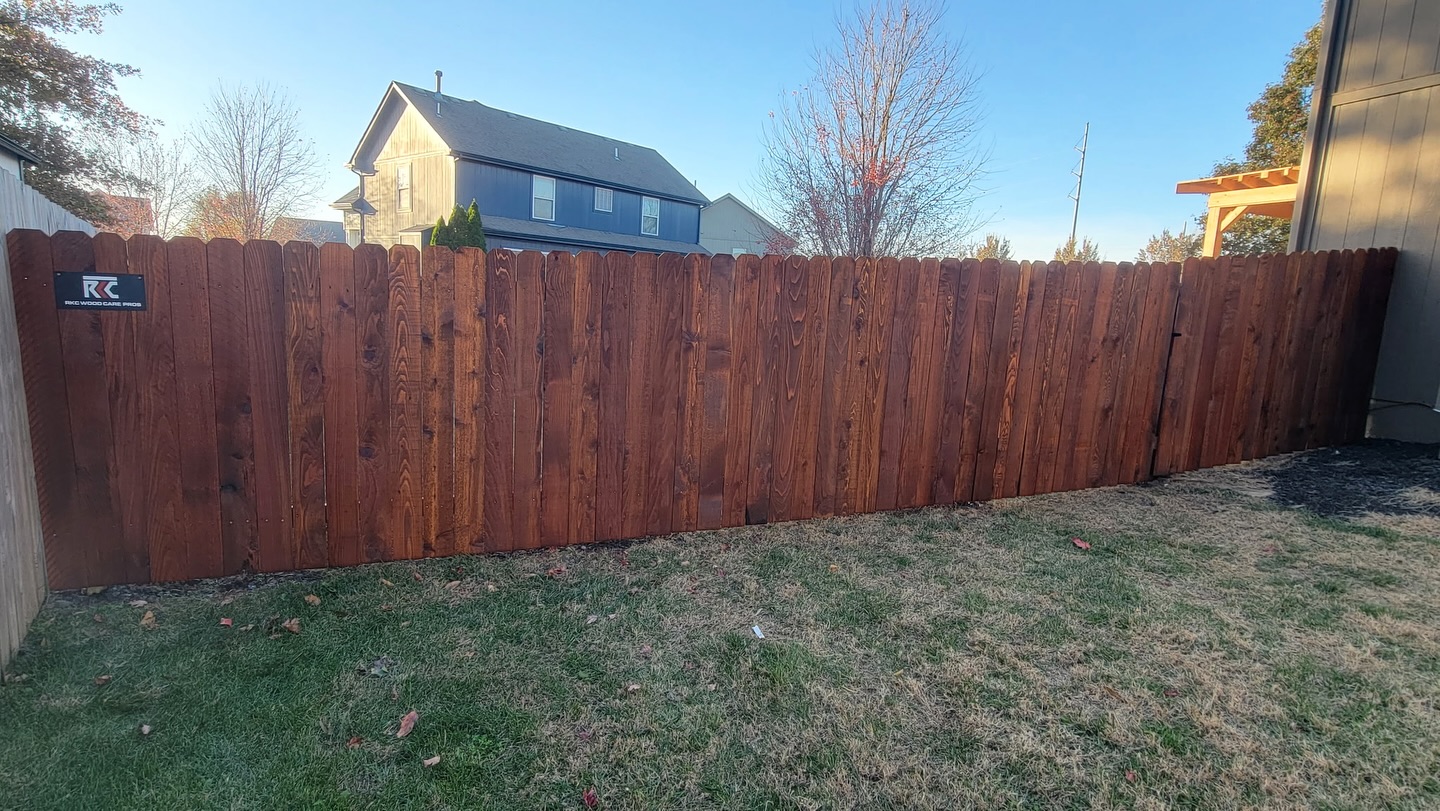
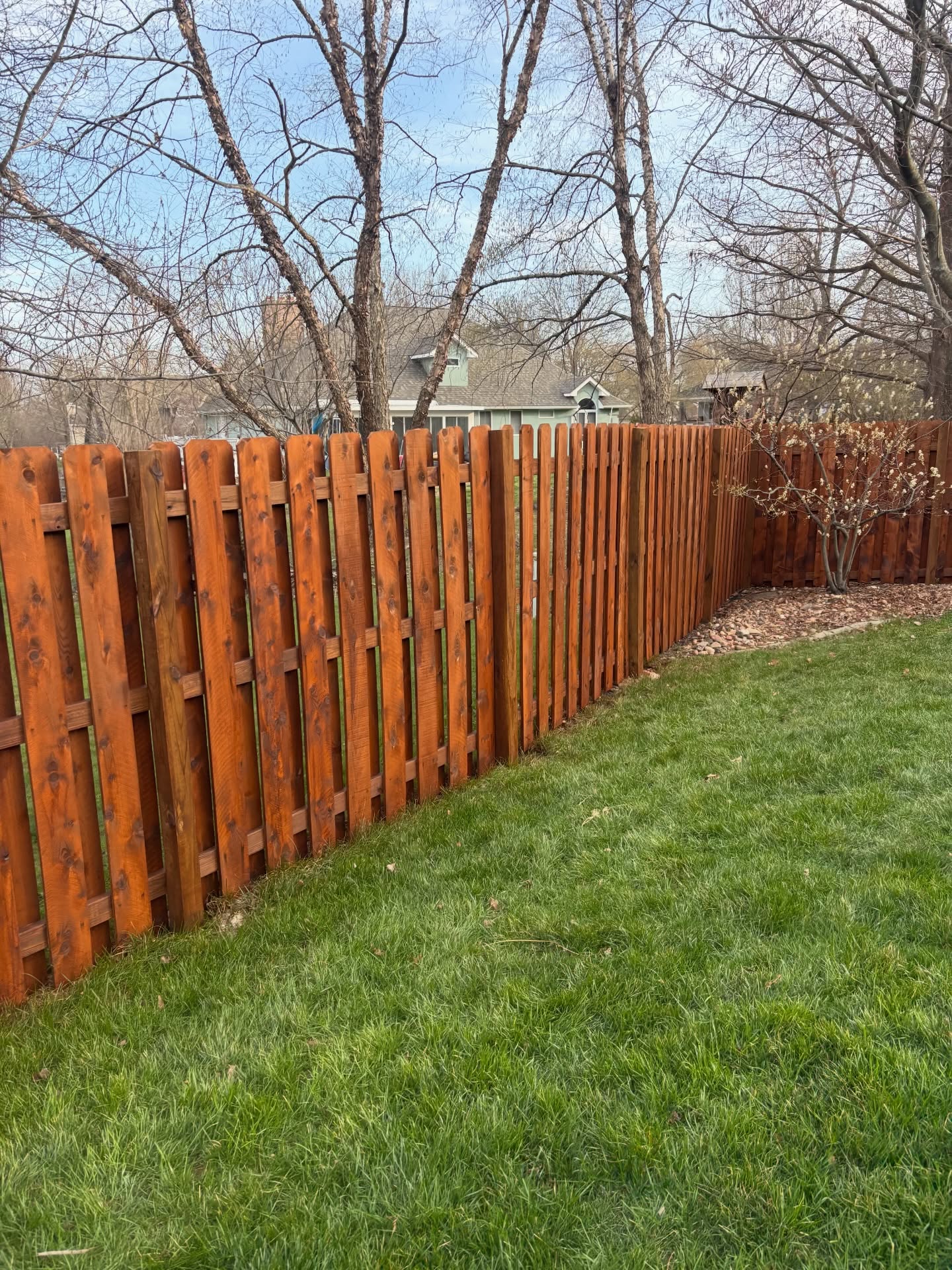
Mahogany semi-transparent stain on a cedar fence in Raymore, MO by RKC Wood Care Pros
Semi-Transparent · Raymore
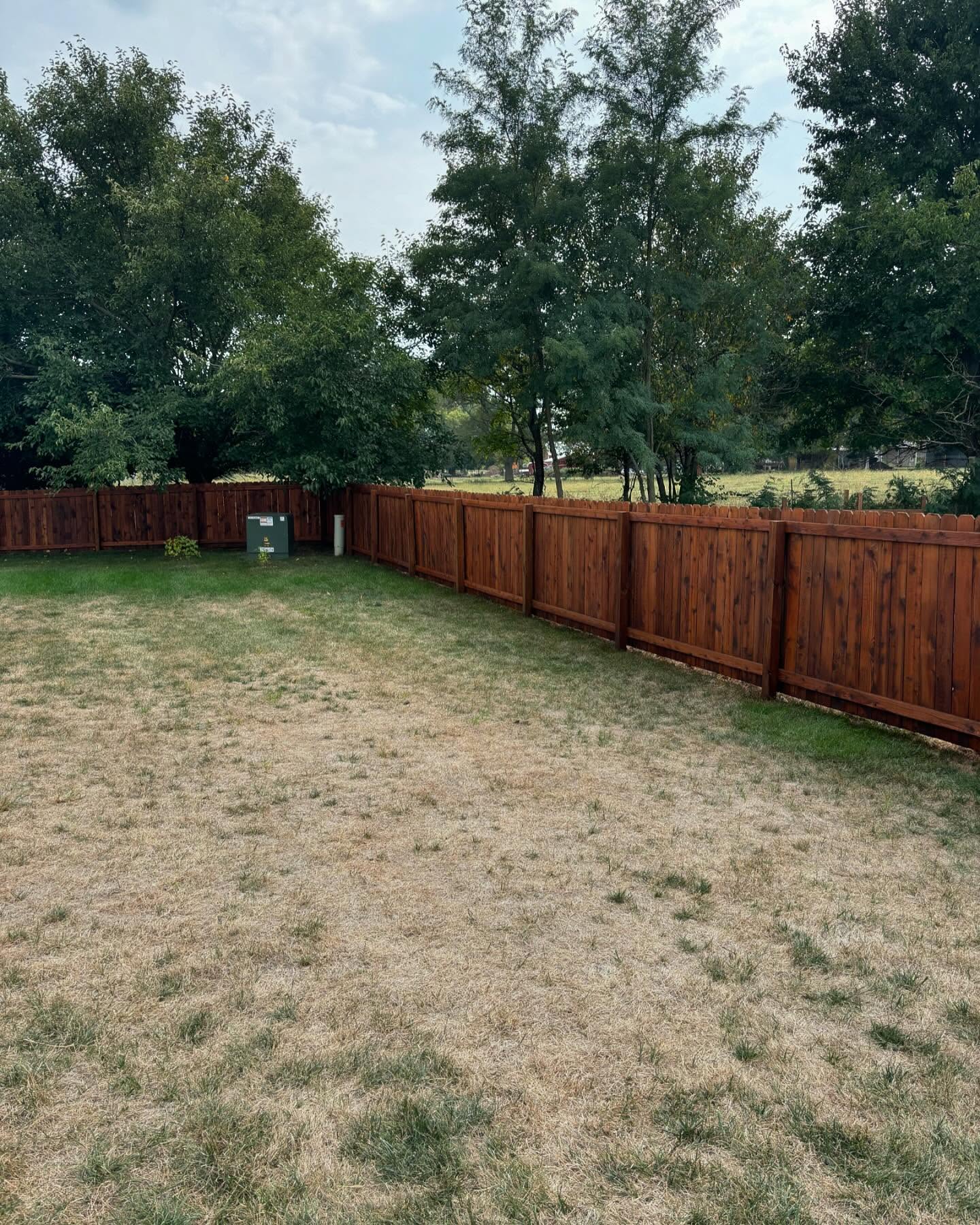
Dark semi-solid stain finish on a cedar fence in Raymore, MO
Semi-Solid · Raymore
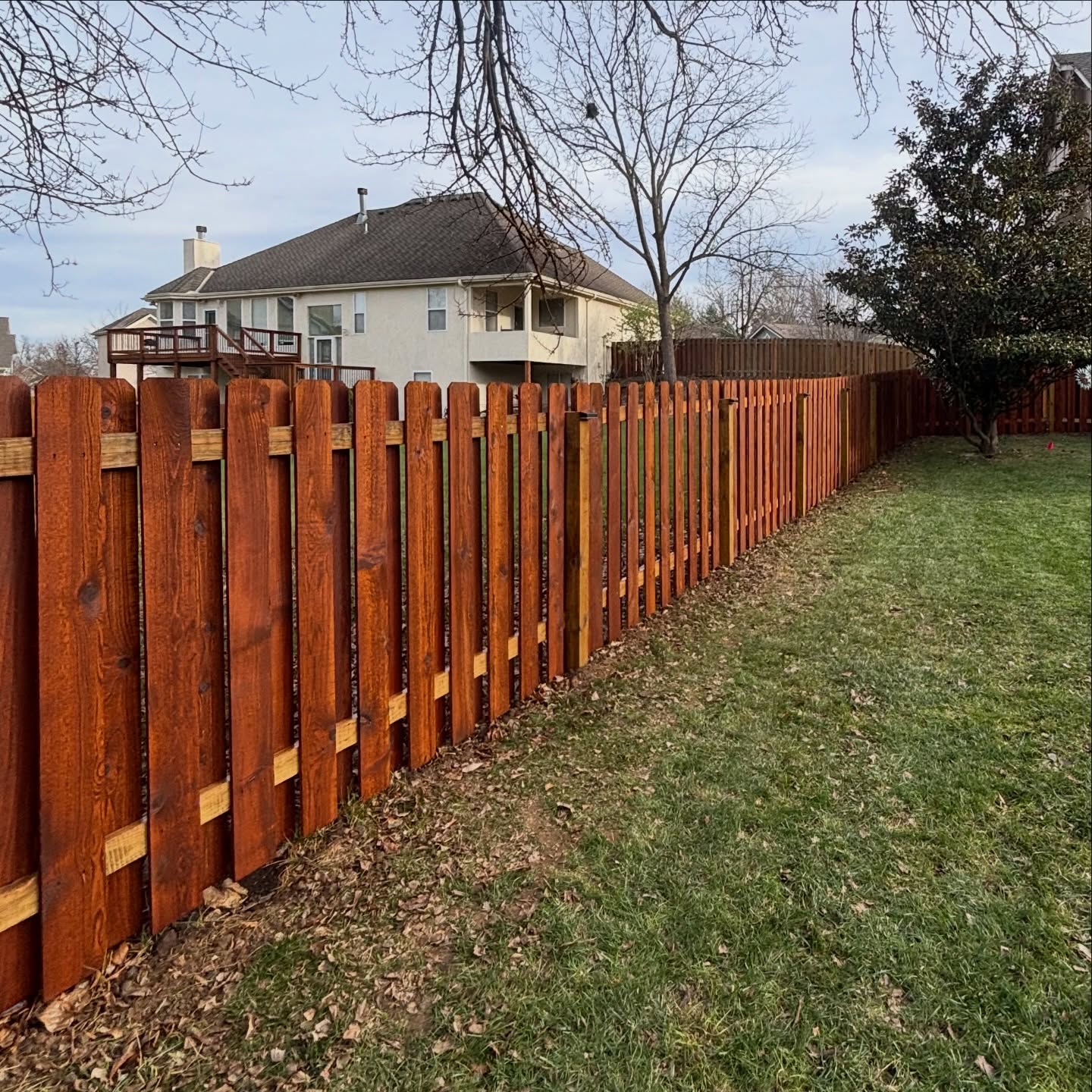
Golden-honey stain on new cedar in Raymore, MO
New-Cedar Coat · Raymore
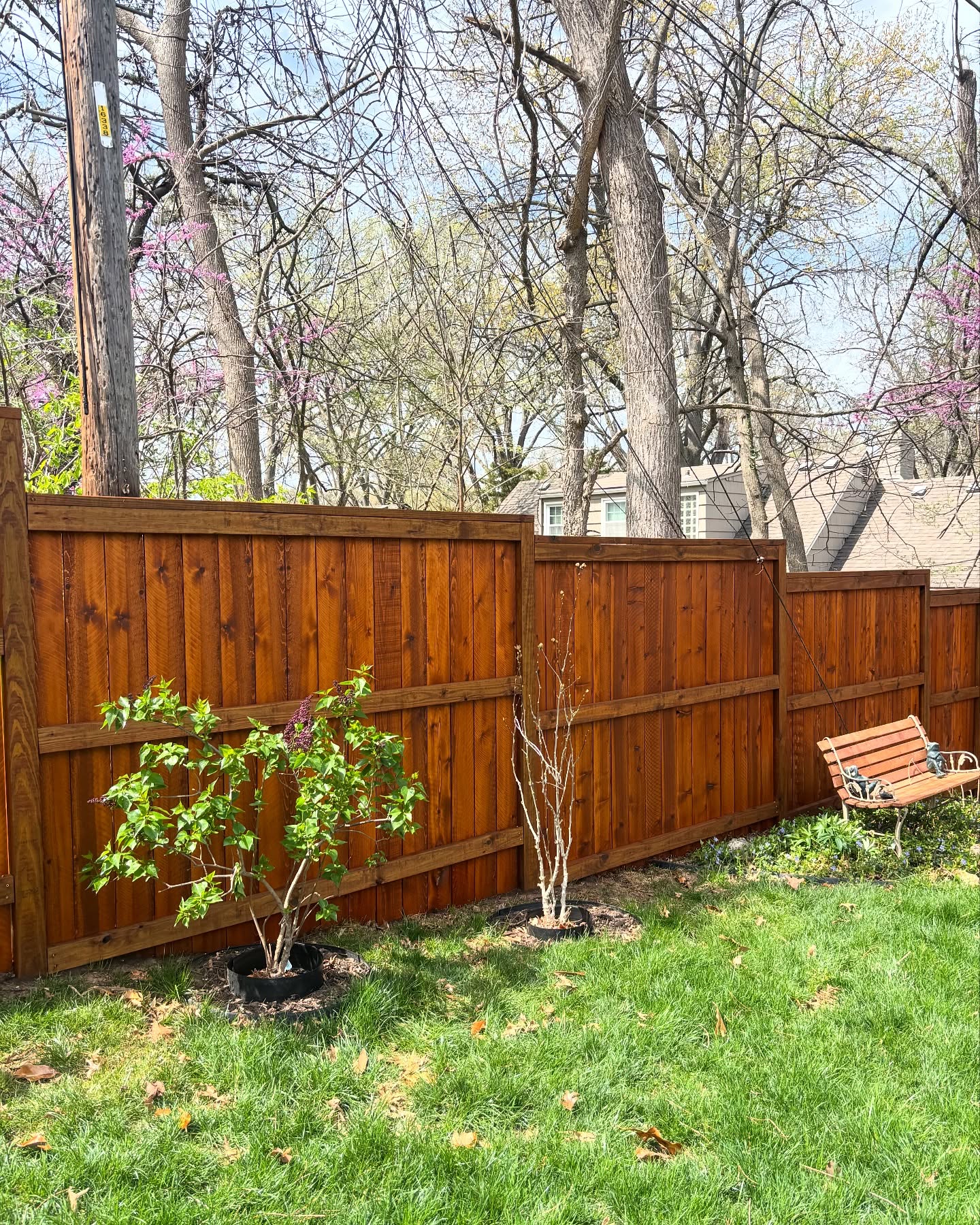
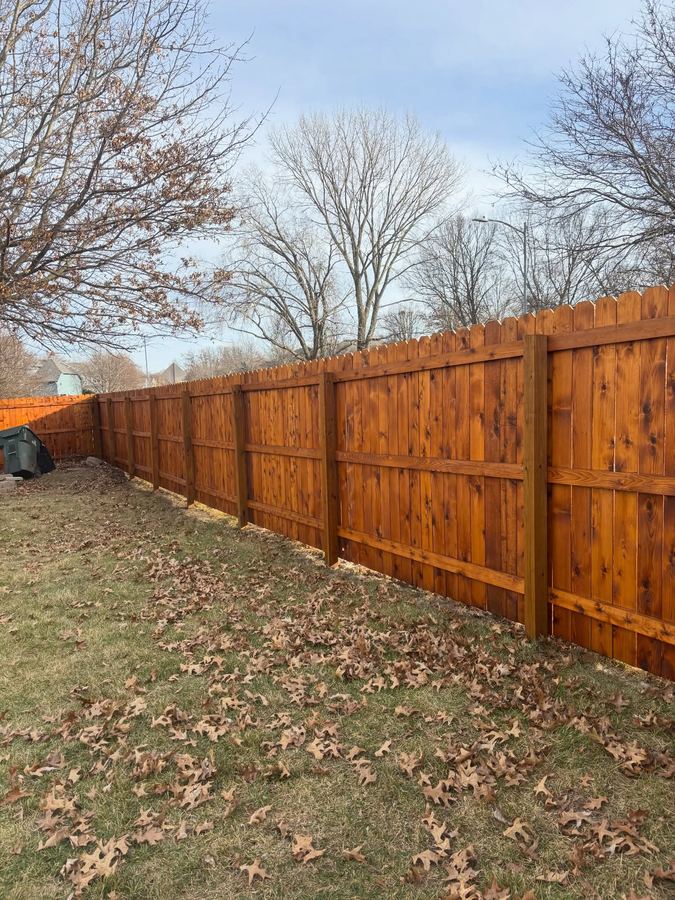
Freshly stained cedar fence on an open Raymore, MO lot
Sun-Faced Run · Raymore

REVIEWS

What Kansas City Homeowners Say About RKC

4.9 ★ · 85 Google reviews

Every review is on our Google Business Profile — read them there, unedited.

Read all 85 reviews on Google

RAYMORE STAIN QUESTIONS

Stain Questions Raymore Homeowners Ask Most

Three questions decide most Raymore stain jobs: which opacity and tone to run, what the open sun does to the finish over time, and whether a new or silvered cedar run should be coated now. These are the ones Raymore homeowners raise at the estimate — sorted by topic, each answer tied to the opacity ladder, the match-the-house tone work, and the open-lot exposure. Don't see yours? Call (913) 286-1091 and ask.

Raymore, MO fence staining by RKC Wood Care Pros

Opacity & Tone

What's the difference between semi-transparent and semi-solid stain?
It's how much pigment the finish carries, which decides how much of the wood grain still shows and how long the coat lasts. A semi-transparent is sheer — the grain and the picture-frame detailing read right through the color, which is why it's the Raymore standard on cedar meant to be seen. It holds about two years. A semi-solid carries more pigment, so it mutes the grain into one cleaner tone and blocks more UV, stretching the cycle to three or four years. The opacity ladder above lays out the full range from a clear sealer to an opaque solid. On a match-the-house cedar fence we usually land on semi-transparent; on a sun-hammered or older run we step up to semi-solid for uniformity and a longer life.
Can you match the stain to my brick and stone?
Yes — that's most of what we do in Raymore. This is an earth-tone market, and the point of the finish here is to make the fence look like it belongs to the house, so we pull the tone toward your brick, stone, or trim rather than picking from a generic chart. We brush a sample on a hidden section of the fence first so you judge the actual color on your own wood, in your own light, before we commit the whole run. Once you approve it we log the exact product and tone, which is what lets the re-coat two years out match board for board instead of drifting.
My cedar looks blotchy where I stained it myself — why?
Almost always it's a too-sheer finish over boards that weren't at one tone. A semi-transparent or a toner shows everything underneath it, so if some boards were more weathered or more sun-bleached than others, the color drinks in unevenly and reads blotchy. The fix is either to brighten the whole run back to one true tone first so a sheer finish sits even, or to step up the opacity to a semi-solid that carries enough pigment to level the variation out. We read the boards before we quote and tell you which route your fence needs — that read is exactly what stops the blotchy result.

Sun & Longevity

My Raymore fence is on an open lot with no shade — what holds up best?
On a fully open new-development lot the sun is the enemy, and the answer is pigment. A clear sealer or a light toner will silver within a year out there because there's not enough pigment to block the UV. A semi-transparent holds a couple of years; a semi-solid, with its heavier pigment load, blocks more sun and stretches the cycle to three or four. We'll also carry a touch more pigment onto the west and south faces that take the worst of the afternoon sun, so the whole fence reaches its next coat at one even tone. On an exposed lot, choosing a grade up the opacity ladder is one of the biggest levers you have on how long the coat lasts.
How often will a Raymore cedar fence need re-staining?
It depends on the opacity you sit on. A semi-transparent runs about every two years; a semi-solid, three to four; a solid, four to five but with a peel risk if it ever traps moisture. Open, sun-exposed Raymore lots favor the shorter end of each range because the unbroken sun weathers a finish faster than a shaded suburban run. Whatever grade you choose, your next date goes on the invoice and we're the ones who circle back when it's due — so the fence gets re-coated while it's still holding color, before it drifts to silver and needs a brighten first.

New Cedar & Restoration

I just had a new cedar fence built in Raymore — when and how should I stain it?
Give fresh Western Red Cedar about 30 days first so its internal moisture falls far enough that a penetrating finish keys into the grain instead of beading off. Then it's an opacity decision: most Raymore move-up buyers want an earth-toned semi-transparent that keeps the grain showing while sealing the wood against the open sun. Many choose a factory pre-stain instead — the boards sealed on all four sides before they go up — so the fence starts protected from day one. Either way we time the coat to the cure, key the tone to your house, and log it so the re-coat matches. On our own installs the first coat is often folded into the package.
My older picture-frame fence has gone gray — is it worth staining?
Usually yes. That silver is almost always a thin weathered skin over sound wood, not a spent fence — and a well-built picture-frame or shadowbox run is worth bringing back rather than replacing. We strip any failed finish, brighten the whole run to one true tone, wash and hard-dry it, then lay a fresh coat at the opacity the wood's age calls for — often a semi-solid on older boards so they read uniform again instead of blotchy. On Raymore's open lots we probe the posts first, since the rolling grade and open-ground frost can heave one loose; where a post has moved we reset it before finishing, so the coat you pay for gets its full life.

OTHER RAYMORE FENCE SERVICES

More Fence Services Available in Raymore

Each link below keeps you in Raymore — its own page, with pricing, conditions, and recent job photos tied to this city rather than the metro at large. Weighing a fresh install, a repair, a gate, or one specific material alongside the staining? Here's where each of those picks up.

Ready when you are

Get a free estimate — we usually respond the same day.

Call (913) 286-1091