Skip to content
Fence Staining & Sealing in Oak Grove, MO — A Coat Built for a Used Fence

Fence Staining & Sealing in Oak Grove, MO — A Coat Built for a Used Fence

Oak Grove is a hard-use sports town — kids, dogs, and play mean the fence gets used, not just looked at. So the coat here has to survive the wear points as much as the sun: the mower line, the dog-run board, the ball-impact face, the gate that's slammed daily. RKC Wood Care Pros maps those wear points and finishes for them — a tougher semi-solid with deeper pigment that hides scuffs where the yard works the wood, oil on the value pine, deeper pigment on the I-70 sun faces. A finish built for a fence a family actually uses, every coat logged. 4.9 stars from 85 Google reviews. Call (913) 286-1091 for a free walk and quote.

★★★★★
4.9
from 85 reviews
Licensed
& Insured · KS + MO
400+
fences installed
A+ BBB Rated Kansas City Fence Contractor Finished for the Wear Points 2-Year Cedar / 3-Year Pine Cycle
View stain options in our catalog ↓

WHY OAK GROVE HOMEOWNERS STAIN WITH RKC

A Coat for a Fence That Gets Used

Oak Grove fences get used, not just looked at — kids, dogs, mowers, and a gate that's slammed daily. So a good coat here has to survive physical wear as much as sun and rain, and that means finishing for the wear points where a family yard actually beats up the wood. We map those spots and coat them tougher — a semi-solid with deeper pigment that hides scuffs at the base, the dog board, the impact face, and the gate — with oil on the value pine and deeper pigment on the I-70 sun faces. A penetrating finish that fades instead of peeling, every coat logged so the next one matches.

1

Tougher where the yard works it

A sheer coat rubs off fast at the wear points — the mower line, the dog board, the ball-impact face. So we lay a tougher semi-solid there, with deeper pigment that hides scuffs, and can carry an even harder grade on just the side that takes the play. It's a finish weighted for use, not the same coat everywhere regardless of how the yard actually beats on it.

2

The gate gets its own attention

The gate is the most-used part of any fence — handled, swung, and slammed daily — so it wears at the latch and edge first. We give it a hard-wearing coat and hand-detail the high-touch spots, and can put it on its own faster cycle if it takes heavy use, so the most-used part doesn't look tired while the run still holds its color.

3

The right product for the wood

Oak Grove yards mix pine, cedar, and composite, and each takes hard use differently. Pine needs an oil to penetrate its dense fiber and hold at the wear points; cedar takes a semi-solid at the use spots; composite never needs a coat. We match the product to both the wood and the wear, and tell you straight which sections to skip.

4

Sealed base beats the dog-run rot

Where physical wear and ground moisture meet — a scuffed, bare bottom board near damp soil — is where a hard-used fence rots. We probe the base first, replace any soft board, then seal the end grain and bottom board hardest so a scuffed base still sheds water instead of drinking it. Sealing the wear-and-moisture zone is what keeps use from turning into rot.

OAK GROVE LOCAL CONDITIONS

Why Staining in Oak Grove Is About the Wear Points

Three local factors shape stain work in Oak Grove: a hard-use sports town that wears its fences as much as weathers them, a value mix of pine, cedar, and composite that each take the wear differently, and the I-70 high ground that piles sun and wind onto the same use points. This is a family, kids-and-dogs kind of place where the fence gets worked. Same crew, same standard: map the wear points, match the product to the wood and the wear, coat it tougher where the yard beats on it, and log the schedule.

1

A hard-use town wears the fence, not just weathers it

Oak Grove is a sports town — a family, kids-and-dogs, built-to-take-a-beating kind of place — and its fences get used, not just looked at. That changes the staining conversation from most cities: here the coat has to survive physical wear as much as sun and rain. A ball knocks the finish off the mid-panel, a dog scratches the bottom board bare, a mower and trimmer gouge the base, a gate gets slammed daily. Those wear points fail long before the weather would take an untouched fence, so the finish and the build have to answer them — a tougher coat where the yard actually gets worked, not the same sheer coat everywhere.

2

A value mix of pine, cedar, and composite

Oak Grove yards run a practical mix — treated pine as the value workhorse, cedar as the upgrade, composite for the no-maintenance runs — and each takes the hard-use finish differently. Pine is dense and stands up to abuse but needs an oil-based stain to penetrate; cedar takes a semi-transparent or a tougher semi-solid at the wear points; composite never needs a coat at all. So part of the job here is matching the product to both the wood and the wear: an oil on the pine base a dog paces, a semi-solid on the cedar face the kids' ball hits, and an honest 'leave it alone' on any composite section. We read the yard and the wood together.

3

I-70 high ground adds sun and wind to the wear

Oak Grove sits on high ground near I-70, open to the southern sun and wind, so the weather piles onto the physical wear at the same spots. The mid-panel that takes the ball also takes the UV; the base a mower scuffs also wicks ground moisture; the gate that gets slammed also bakes in the afternoon sun. That combination is why the wear points need more than a standard coat — they're hit from two directions at once. We weight deeper pigment onto the sun-and-wind faces and a tougher grade onto the use points, so the fence holds up to the family and the weather both, and reaches its next coat evenly.

The Oak Grove fences we've coated and brought back run across the family subdivisions and the larger practice-yard lots that give the town its hard-use, sports-minded character — cedar and treated-pine dog-ear runs worked by kids and dogs, gates slammed daily, and fences scuffed at the base and grayed up top. Each one gets its wear points mapped up front, the base and gate scuff-sanded and sealed, a tougher grade laid where the yard works the wood, and the bottom boards probed where use and moisture meet. A fence another company built earns the identical wear-point treatment — a durable coat has only ever cared how hard the yard uses it.

WHERE A USED FENCE WEARS

The Wear-Point Map — Where the Yard Beats on the Wood

On a hard-use Oak Grove yard the finish doesn't fail evenly — it wears out first at the spots where the family actually works the fence, long before the weather would take an untouched run. Here's the wear-point map we finish against: each high-wear spot, what wears it, how the coat and build handle it, and how we fix it if it's already worn. The through-line — a tougher coat and a sealed base at the use points, so the fence holds up to the yard as well as the weather.

Wear point What wears it How we handle it The fix if it's worn
The mower & string-trimmer line The bottom few inches take repeated hits from the mower deck and trimmer string, scuffing and gouging the finish off A tougher semi-solid at the base resists the scuffing, and a mow strip or gravel line keeps the equipment off the wood We scuff-sand the gouged spots, spot-seal the bare wood, and re-coat the base so it isn't left drinking water
The dog-run bottom board Dogs pace, scratch, and dig the fence line, wearing the finish off the bottom board and the ground contact A rot-resistant bottom board sealed hard, with deeper pigment that hides scuffs, over a gravel-drained base We seal or replace the worn bottom board and re-coat it heavier, since it takes the most abuse on a dog yard
The play & ball-impact face Kids' balls, bikes, and play knock the finish off the mid-panel on the yard side, worst near the goal or hoop A semi-solid takes impact scuffing better than a sheer finish, and holds color where a toner would show every mark We re-coat the impact face heavier, and can carry a tougher grade just on the side that takes the play
The gate — swing, latch & handle The most-used part of any fence — handled, swung, and slammed daily, so the finish wears at the latch and edge first The gate gets a hard-wearing coat and hand-detailed edges, since it's touched more than the whole rest of the run We re-coat the gate on its own faster cycle if needed, so it doesn't look tired while the run still holds
The high-touch mid-panel Hands, hoses, and leaning wear the finish thin at the heights people actually reach and touch A penetrating finish that bonds into the grain wears by fading at the touch points rather than rubbing off in patches A wash and re-coat evens the touch-worn zones back into the rest of the panel
The ground line (use + moisture) Where physical wear and ground moisture meet — scuffed bare wood at the base then wicks water and rots We seal the end grain and bottom board hardest, so a scuffed base still sheds water instead of drinking it A probe checks the base for soft wood before re-coating; we replace a rotted bottom board first

The line that runs down the map: a used fence wears out at the spots the yard works, not evenly across the run — so the coat gets weighted where the family actually beats on the wood. Want us to map your fence's wear points? A free staining walk does exactly that, or pair it with Oak Grove fence repair so a rotted dog-run board gets replaced before the durable coat goes on.

STAIN SERVICES

Durable Coats & Restoration — Every Oak Grove Scenario

The scope your Oak Grove fence lands in comes straight out of the wear read — a durable hard-use coat on a worked family yard, a cedar re-stain checked at the wear points, an oil re-coat on value pine, or a brighten-and-restore on a scuffed, grayed run. Below are the four we run across Oak Grove, what each one suits, and honest per-foot numbers. Colors are yours to choose; what stays fixed is that the coat is weighted for use — a tougher grade and a sealed base where the yard works the wood, all by our own crew.

Hard-Use Durable Coat by RKC Wood Care Pros in Oak Grove, MO

Hard-Use Durable Coat

The Oak Grove specialty · built to take the beating

Oak Grove is a hard-use sports town — kids, dogs, and play mean the fence takes physical contact, not just weather. So the coat here has to survive the wear points as much as the sun: the mower line at the base, the dog-run bottom board, the ball-impact face, the gate that gets slammed daily. We lay a tougher semi-solid at those high-wear spots, with deeper pigment that hides scuffs, and can carry an even harder grade on just the side that takes the play. It's a finish chosen for a fence that gets used, not just looked at — built to hold up where a family yard actually wears it.

  • Price: $5–9 / LF · typically $750–1,350 per 150 LF
  • Typical use: Family and dog yards, high-contact runs, play areas, gates that take daily use

Cedar Re-Stain by RKC Wood Care Pros in Oak Grove, MO

Cedar Re-Stain

The 2-year cycle · scuff-checked at the wear points

A cedar fence in Oak Grove wants a re-coat about every two years, and on a used family yard we check the wear points on every one — the mower line, the dog board, the impact face, the gate — for scuffs and bare wood that need spot-sealing before the full coat. On the day it's a soft wash to lift oxidation, a scuff-sand and spot-seal on the gouged areas, a meter check, then the matched color driven into both faces with a heavier hand at the spots that take the abuse. We log your product and color so the re-coat matches, and put the next date on the invoice.

  • Price: $4–8 / LF · typically $600–1,200 per 150 LF
  • Typical use: Cedar dog-ear and privacy runs on a family yard, wear-point-checked re-stains
Pressure-Treated Pine Re-Stain by RKC Wood Care Pros in Oak Grove, MO

Pressure-Treated Pine Re-Stain

The value workhorse · oil for the dense fiber

Treated pine is the value workhorse on a lot of Oak Grove yards, and it stands up to hard use well — but it needs the right product. The dense treated fiber wants an oil-based semi-transparent to penetrate; a waterborne skins over and wears off fast at the very wear points a family yard punishes. It also runs on a longer clock: the factory treatment has to cure, about three months from a new install, before an oil stain will soak in. Any board still tinged green gets a brightener first. We meter it, won't rush a coat onto pine that isn't ready, and seal the base and dog-run boards hard.

  • Price: $3–7 / LF · typically $450–1,050 per 150 LF
  • Typical use: Treated-pine family fences, value runs, high-use yards on a budget
Scuffed & Gray Restoration by RKC Wood Care Pros in Oak Grove, MO

Scuffed & Gray Restoration

Bringing a worked-hard Oak Grove run back

A hard-used fence that's gone a while without a coat shows it two ways: the sun grays the upper run while use scuffs the finish off the bottom boards, the gate, and the play face. That's still usually a thin skin over sound wood. We strip any failed finish, scuff-sand and brighten the run to one tone, wash and hard-dry, then lay a durable coat weighted at the wear points so it holds up to the use again. Because a dog yard and the ground moisture together can rot a bottom board, we probe the base first and replace any soft board before finishing — no return on coating rotted wood.

  • Price: $6–12 / LF · typically $900–1,800 per 150 LF
  • Typical use: Scuffed, grayed, worked-hard family fences, homes just changed hands, worn dog yards
Durable hard-use cedar and pine fence stain pricing — Oak Grove, MO — RKC Wood Care Pros

OAK GROVE STAIN PRICING

What Fence Staining Costs in Oak Grove

What an Oak Grove job costs rides on the wood and the wear — a routine re-stain on a lightly-used cedar run is one number, a heavily-worked yard that needs scuff-sanding, a durable grade at the wear points, and a base board check runs more. Each quote folds in the wear-point map, the wash, the scuff-sand and spot-seal, the metered dry window, the matched penetrating family weighted at the use points with the right product for pine or cedar, the spray-and-back-brush pass by our own two-person crew, and a written next date. The three setups we price most often for Oak Grove homes are below.

Cedar Re-Stain

$4–8 / LF

wash + penetrating stain

The 2-year coat, wear-point-checked — scuff-sand and spot-seal the gouged base and gate, matched color into both faces heavier at the use points, next date in writing. Most 150 LF Oak Grove cedar runs land at $600–1,200.

Hard-Use / Pine Coat

$3–9 / LF

durable semi-solid or pine oil

A tougher semi-solid at the wear points runs $5–9; an oil re-stain on value pine runs $3–7. The wood and the wear set the number. A 150 LF Oak Grove run generally lands at $450–1,350.

Scuffed / Gray Restoration

$6–12 / LF

strip · brighten · durable coat

Failed finish stripped, scuffs sanded, brightened to one tone, washes, a dog-yard base check, then a durable coat weighted at the wear points. A worked-hard 150 LF run is usually $900–1,800.

A number comes only after an on-site look at how hard the yard has worked the fence and whether the base or a dog-run board has rotted — that check is what stops you paying hard-use rates on a lightly-used run, or coating over a soft board. Every Oak Grove estimate is free, written, and itemized — call (913) 286-1091 or set up a walk. While the crew's on site they can flag any Oak Grove fence repair — a scuffed-and-rotted bottom board or worn gate — that should be handled before a durable coat protects the run — one trip, same hands.

OUR STAIN PROCESS

How an Oak Grove Stain Job Comes Together

Four steps from the phone call to the final walk. Most Oak Grove stain jobs span 2 to 4 days — and mapping the wear points, done first, is what the durable coat is built around. The coat itself is usually a single day on site for a standard run. The rest of the clock is the wear read, the wash-and-scuff-sand cycle, and the metered dry window the mixed woods complicate. Here's what each step looks like on an Oak Grove fence.

1

Walk it and map the wear points

Step one on an Oak Grove fence is a wear read most companies skip: where the yard actually works the fence. Josh or a lead measures the footage, identifies the wood — often more than one on a value mix — takes a moisture reading, and walks the run for the wear points: the mower and trimmer line at the base, the dog-run bottom board, the ball-impact face, the gate. On any older fence we probe the base where use and moisture together can rot a bottom board. That map is what the coat is built around, because on a family yard the finish has to hold up where it gets used, not just where the sun hits. The estimate's free, itemized, and sampled on a hidden board.

2

Wash, scuff-sand the wear, and meter dry

Before the coat, the wood has to be clean, sound, and dry. A run due on schedule gets a soft wash to lift oxidation; the wear points get a scuff-sand and spot-seal where use has gouged the finish off to bare wood, so those spots don't drink water or show through the new coat. A grayed run takes an oxalic brightener to one tone; any failed film gets stripped. Then the meter goes on the wood — pine and cedar read differently, and a scuffed base can hold moisture — and we wait for a true dry reading through the board before finishing. Prepping the wear points is what makes a hard-use coat actually last where it's needed.

3

Coat it, heavier where the yard works it

Surface clean, sound, and dry, we lay the matched finish sprayed and back-brushed into both faces. The difference on an Oak Grove fence is the weighting: a tougher semi-solid or a heavier hand at the wear points — the base a mower scuffs, the bottom board a dog paces, the face a ball hits, the gate that's slammed daily — since those take the abuse a sheer coat wouldn't survive. On the pine we use an oil that penetrates the dense fiber; on the cedar a durable grade at the use points. Deeper pigment on the I-70 sun faces too, so the fence holds up to the family and the weather at once and ages even.

4

Walk it together, then log the schedule

Last is your eyes alongside ours — a full pass checking that the wear points are sealed and the run reads even, any scuffed spot or thin edge touched in before we sign off. Then the finish lands on your file: the date, the wood or woods, the product, the exact color, the footage, the wear-point notes, and when the next coat is due — about two years, sooner on a heavily-used gate or dog run if you want it kept sharp. That record is why your re-coat matches and why the reminder comes from us. On a fence a family actually uses, tracking the wear points is how we keep the whole run holding up between coats.

RECENT OAK GROVE STAIN JOBS

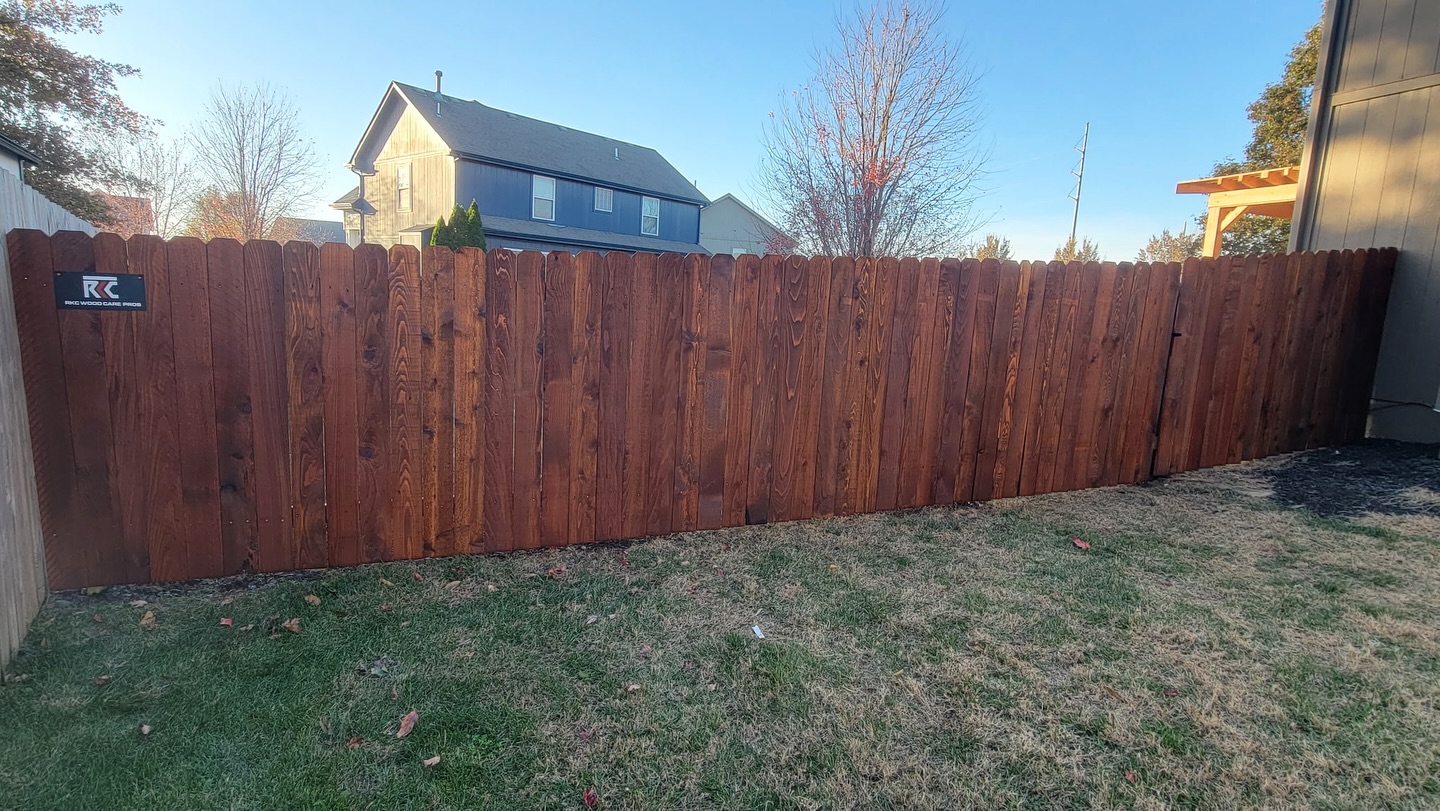
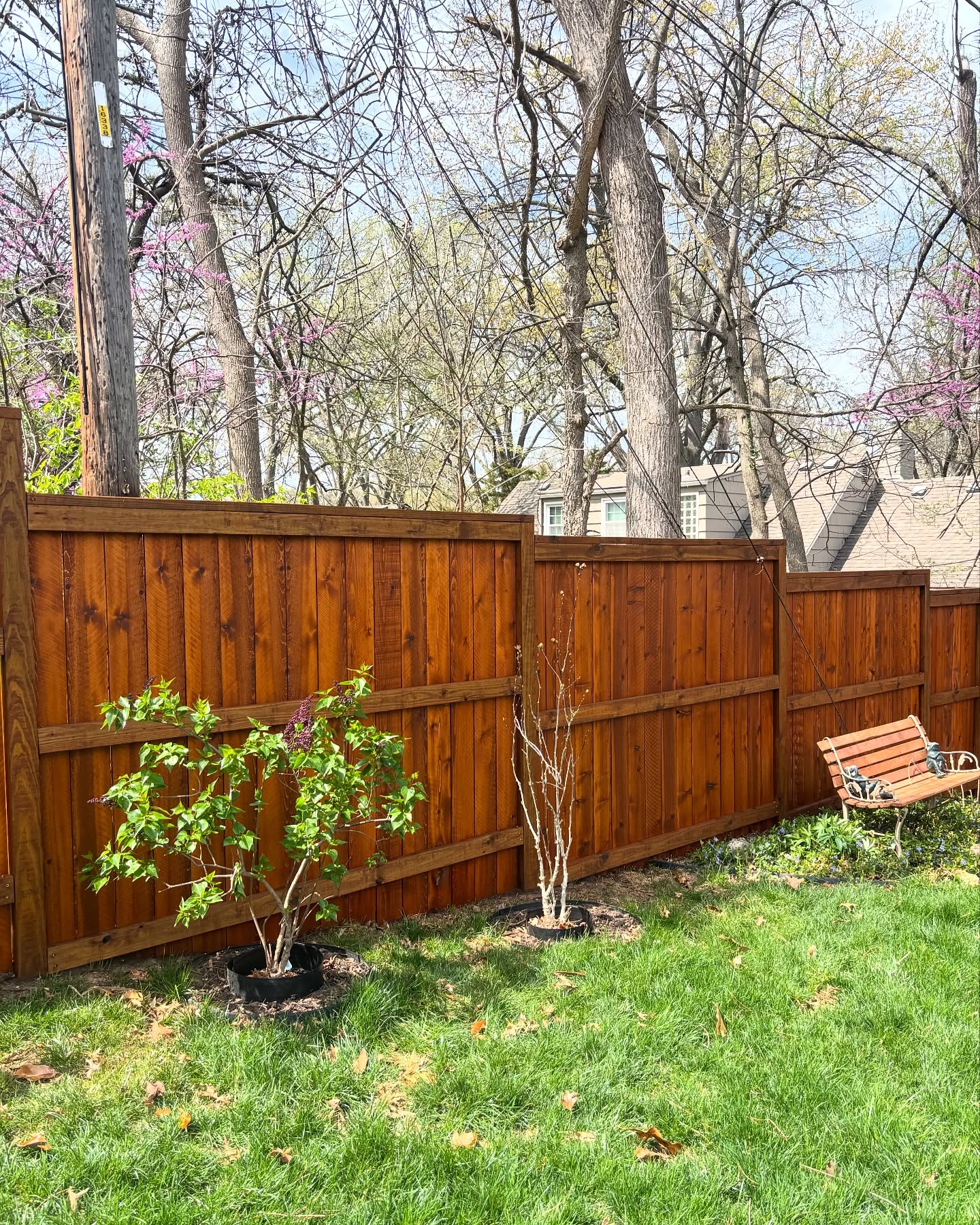
Rich mahogany durable stain on a dog-ear cedar fence in Oak Grove, MO by RKC Wood Care Pros
Hard-Use Coat · Oak Grove
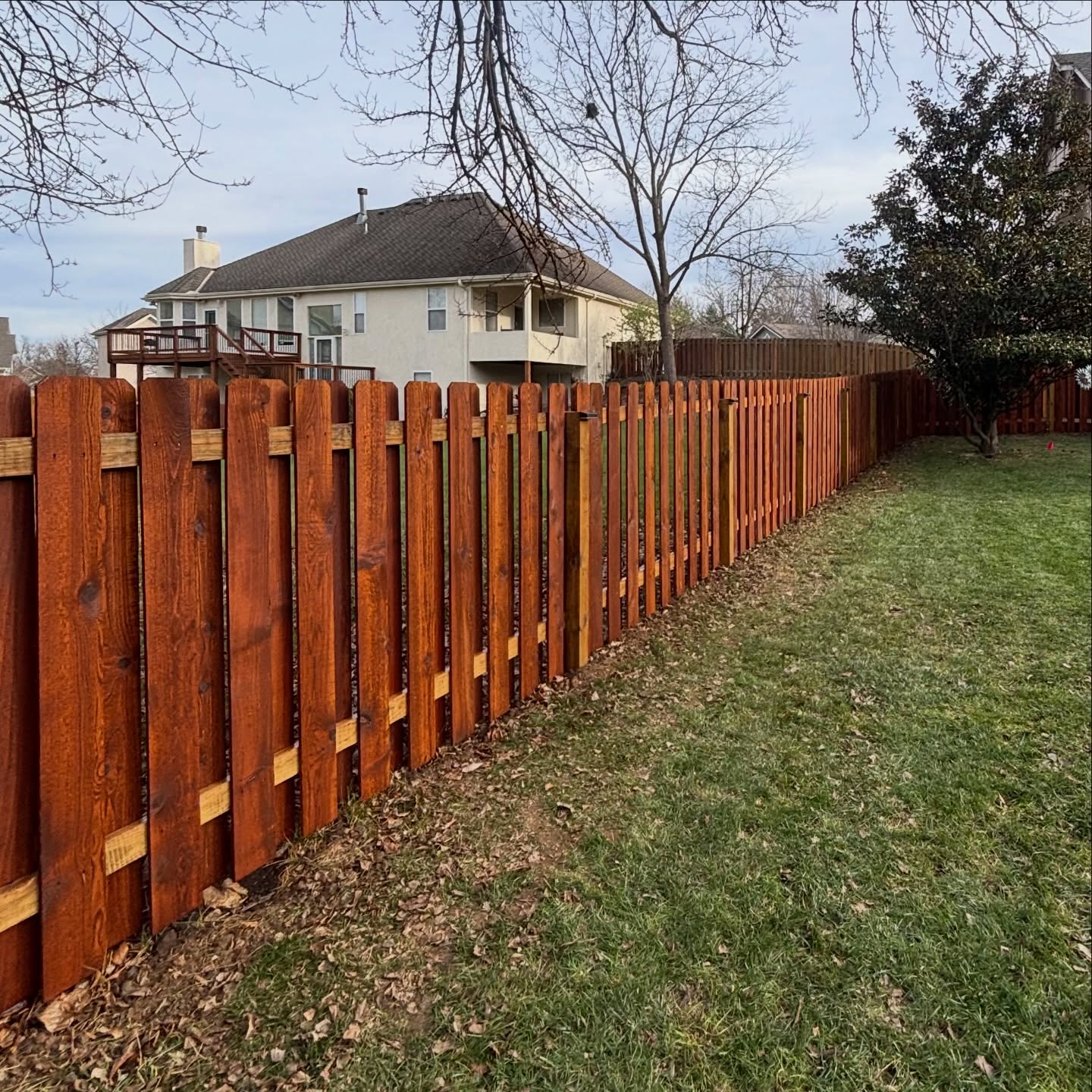
Golden honey stain on a cedar fence in Oak Grove, MO
Cedar Re-Stain · Oak Grove
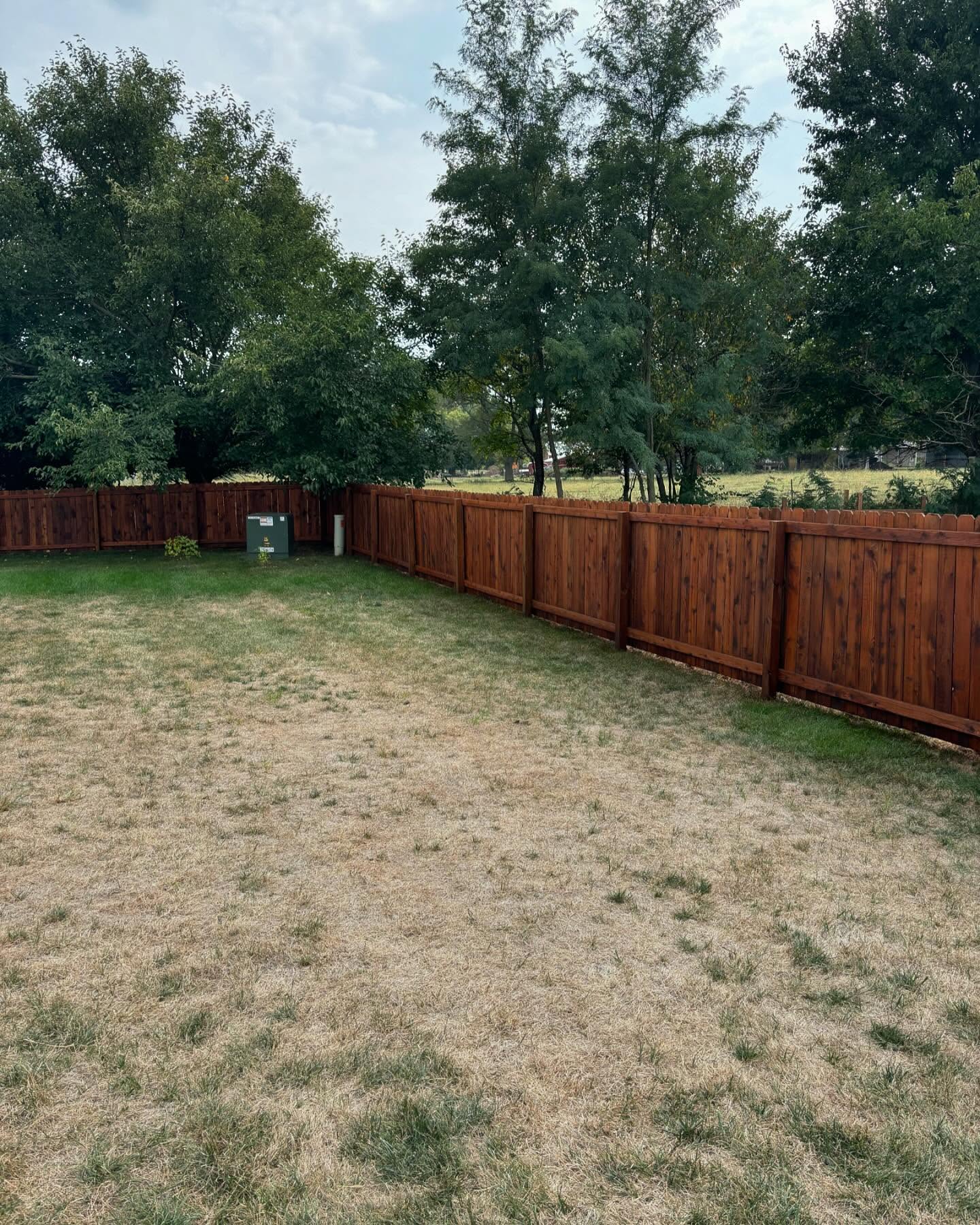
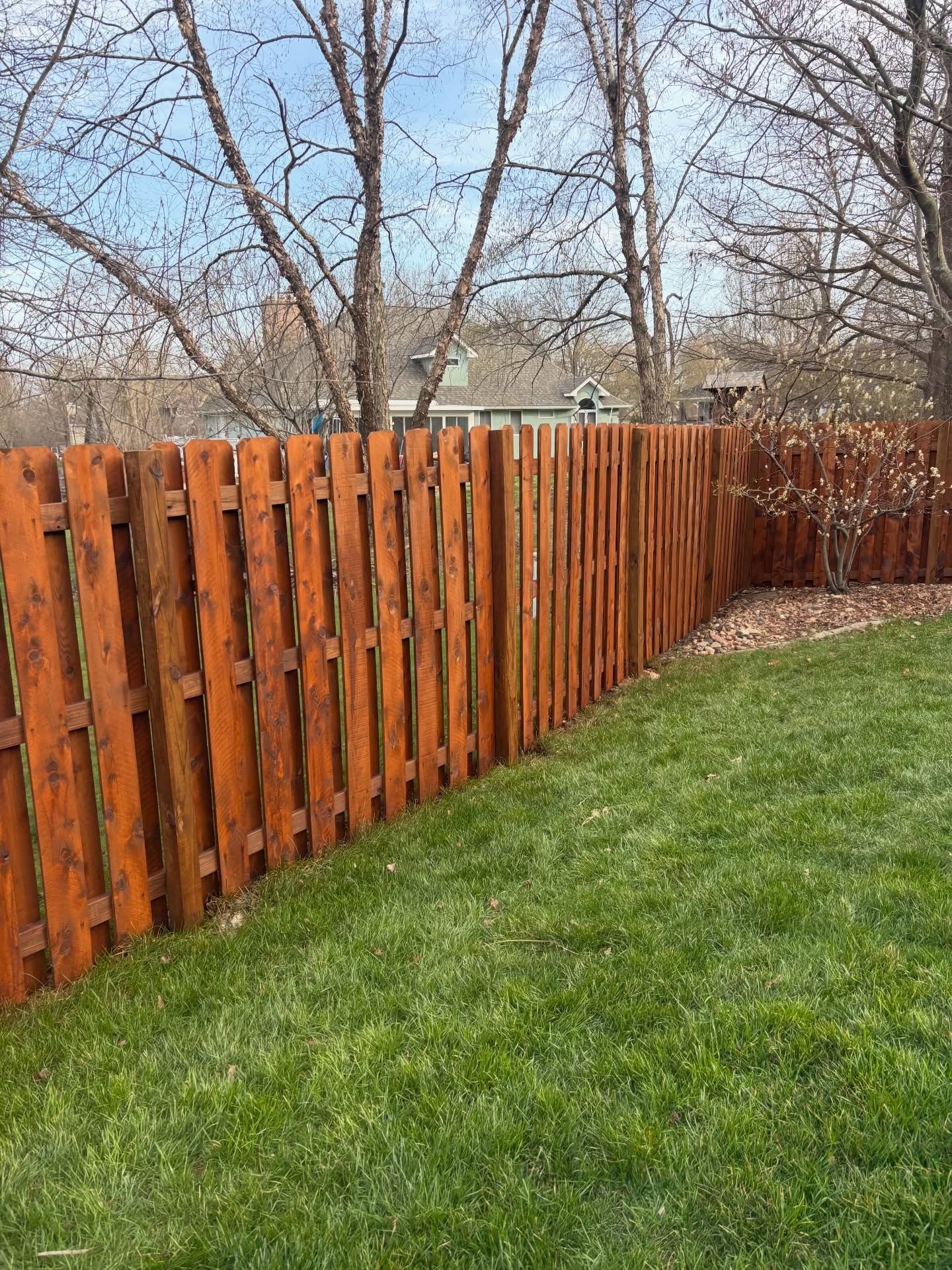
Dark walnut re-stain on a hard-used wood fence in Oak Grove, MO
Pine Re-Stain · Oak Grove
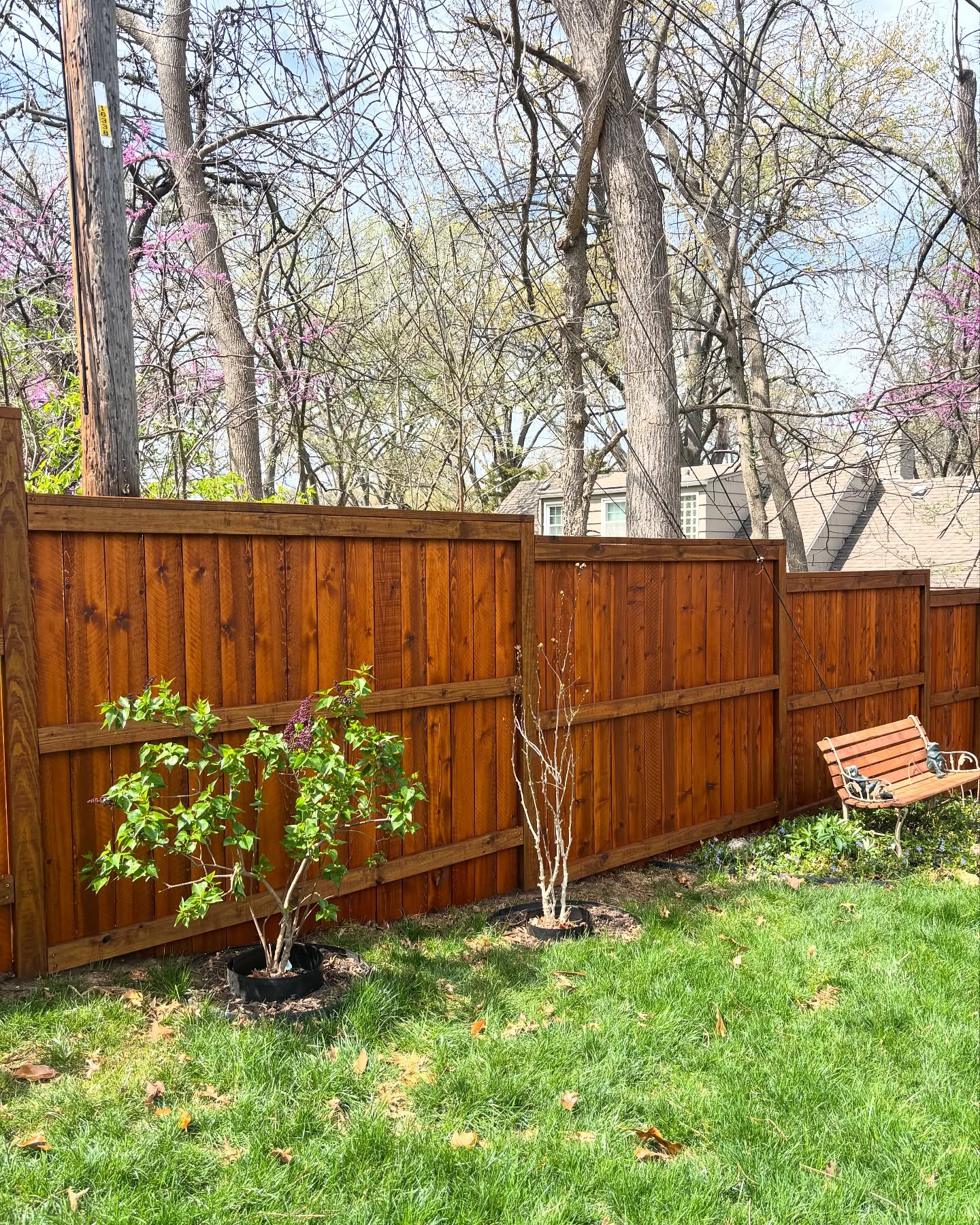
Completed durable fence stain project on a family yard in Oak Grove, MO
Family Yard · Oak Grove

REVIEWS

What Kansas City Homeowners Say About RKC

4.9 ★ · 85 Google reviews

Every review is on our Google Business Profile — read them there, unedited.

Read all 85 reviews on Google

OAK GROVE STAIN QUESTIONS

Stain Questions Oak Grove Homeowners Ask Most

Three questions decide most Oak Grove stain jobs: whether a coat will hold up to hard family use, how pine and cedar and composite each take the wear, and whether a scuffed, grayed run can be brought back. These are the ones Oak Grove homeowners raise at the estimate — sorted by topic, each answer tied to the wear-point map, the material mix, and the re-coat schedule. Don't see yours? Call (913) 286-1091 and ask.

Oak Grove, MO fence staining by RKC Wood Care Pros

Hard Use & Wear Points

My dogs and kids beat up the fence — will a stain hold up to that?
It will if it's the right coat, weighted at the wear points — and on an Oak Grove family yard that's exactly how we finish. Physical use wears a fence differently than weather: dogs scratch and pace the bottom board, kids' balls knock the finish off the mid-panel, mowers and trimmers gouge the base, and the gate gets slammed daily. A sheer coat rubs off fast at those spots. So we lay a tougher semi-solid — with deeper pigment that hides scuffs — at the wear points, and can carry an even harder grade on just the side that takes the play. The wear-point map above shows each spot and how we handle it. It's a finish built for a fence that gets used, not just looked at.
The bottom of my fence is scratched bare where the dog runs — what do you do about it?
We treat it as its own wear point, because it takes the most abuse on a dog yard. First we check the wood — a scuffed, bare bottom board that's also near damp ground can wick water and start to rot, so we probe it before anything else and replace it if it's soft. If it's sound, we scuff-sand the bare spots, spot-seal them so they aren't left drinking water, then re-coat the bottom board heavier than the rest of the run, often with a deeper pigment that hides the scratches. Sealing that board hard, over a gravel-drained base where we've installed, is what keeps the dog wear from turning into rot at the ground line.
Can you make the gate hold up better? It always looks worn first.
Yes — the gate is the single most-used part of any fence, handled, swung, and slammed every day, so it wears at the latch and edge long before the rest of the run. We give it a hard-wearing coat and hand-detail the edges and the high-touch latch area, since it gets touched more than the whole rest of the fence combined. If it takes really heavy use, we can put it on its own faster re-coat cycle so it doesn't look tired while the run still holds its color. Treating the gate as a distinct wear point — not just another section of fence — is what keeps the most-used part looking as good as the rest.

Pine, Cedar & Composite

My fence is treated pine — does it need a different stain for hard use?
Yes, it needs an oil-based stain, and that matters more on a high-use yard. Treated pine is dense and stands up to abuse well, but its dense fiber only takes an oil-based semi-transparent — a waterborne skins over the surface and wears off fast at exactly the wear points a family yard punishes. There's also a timing catch: the factory treatment has to cure, about three months from a new install, before an oil stain will penetrate, and any board still tinged green gets a brightener first. We meter it, use the right oil product, and seal the base and dog-run boards hard. Done right, a treated-pine fence holds up to hard use as well as cedar for less money.
Part of my fence is composite — should that be stained too?
No — and it's a nice bonus on a hard-use yard. Composite doesn't take stain and doesn't need it; it shrugs off scratches, dog wear, and weather without a coat, so a wash when it looks dull is all it asks. If your yard mixes composite with wood — say composite on the dog run and cedar elsewhere — we stain the wood, weight it at its wear points, and leave the composite alone. We're a wood crew first, and part of that is telling you straight which sections to coat and which to skip, so you're not paying to stain something that can't hold a finish and doesn't need one anyway.

Schedule & Restoration

How often will a hard-used Oak Grove fence need re-staining?
About every two years for cedar and three for pine on the main run — but the wear points can want attention sooner. A gate that's slammed daily or a dog-run board that's paced constantly may scuff before the two-year mark, so if you want those kept sharp we can touch them up on a faster cycle while the rest of the run holds. The I-70 sun exposure also favors the shorter end. We log your next date and note the wear points, and reach out before it's due, so the fence gets re-coated while it's still protecting the wood rather than after use and sun together have taken it to bare and gray.
My fence is scuffed at the bottom and gray up top — can it be brought back?
Almost always. That two-way wear — grayed on top from the sun, scuffed at the base from use — is the classic look of a hard-worked Oak Grove fence, and it's usually a thin skin over sound wood, not a spent fence. We strip any failed finish, scuff-sand and brighten the run to one tone so the top and bottom match again, wash and hard-dry it, then lay a durable coat weighted at the wear points so it stands up to the use going forward. The one thing we check first is the base — a scuffed, damp bottom board can rot, so we probe it and replace any soft board before finishing, so the coat you pay for gets its full life.

OTHER OAK GROVE FENCE SERVICES

More Fence Services Available in Oak Grove

Each link below keeps you in Oak Grove — its own page, with pricing, conditions, and recent job photos tied to this city rather than the metro at large. Weighing a fresh install, a repair, a gate, or one specific material alongside the staining? Here's where each of those picks up.

Ready when you are

Get a free estimate — we usually respond the same day.

Call (913) 286-1091