Skip to content
Fence Staining & Sealing in Grain Valley, MO — Finished to the Fence Type

Fence Staining & Sealing in Grain Valley, MO — Finished to the Fence Type

Grain Valley runs the widest range of fence types in one town — 6-ft cedar privacy on the new lots, shadowbox and picket in the yards, split-rail and ranch-rail on the acreage edges, vinyl in the planned areas. Each one takes a different finish approach. RKC Wood Care Pros matches the coat to the structure: full both-faces UV block on a solid privacy run, every edge on a picket, a light rustic hand on a rail fence — and honest "don't stain it" on vinyl. Deeper pigment on the open-prairie sun faces, sealed in-house, every coat logged. 4.9 stars from 85 Google reviews. Call (913) 286-1091 for a free walk and quote.

★★★★★
4.9
from 85 reviews
Licensed
& Insured · KS + MO
400+
fences installed
A+ BBB Rated Kansas City Fence Contractor Finished to the Fence Type Sealed In-House, Logged & Scheduled
View stain options in our catalog ↓

WHY GRAIN VALLEY HOMEOWNERS STAIN WITH RKC

A Finish Matched to the Fence

Grain Valley has more fence types than most towns — solid cedar privacy on the new lots, shadowbox and picket in the yards, split-rail out on the acreage. Staining them the same way doesn't work, because each structure takes a different finish approach. A solid privacy face wants full UV block on both sides; a picket wants every edge reached; a rail fence wants a light rustic hand or none; vinyl wants no coat at all. We match the method to the fence in front of us — a penetrating finish that fades instead of peeling, every coat logged so the re-coat matches.

1

The privacy run gets full protection

Six-foot cedar dog-ear is the Grain Valley standard, and on a big solid face out on an open lot the finish has to block the full prairie sun and seal the wood against the wind. We spray a pigmented semi-transparent, back-brush it into both faces, carry deeper pigment on the sun side, and seal the ground line — the full-coverage approach a solid run needs.
2

The picket gets every edge

A shadowbox or spaced picket has far more surface and edges per foot than a flat board, and both faces show. Skip an edge or a picket top and it wicks water and grays early. We coat these from both sides with a back-brush behind, working the finish into the gaps, the alternating edges, and the tops — the coverage is the whole craft on these styles.

3

The rail fence gets a light hand

Out on the rural east, split-rail and ranch-rail fences are meant to look rustic, so the honest choice is a light penetrating tone or a clear-plus-UV seal that slows graying while keeping the natural rail look — or just sealing the posts and letting the rails silver. We don't drown a rail fence in pigment it was never meant to carry.

4

Vinyl gets an honest no

Not every fence should be stained, and we'll say so. Vinyl and composite don't take a finish — a coat just sits on the surface and peels — so if you've got a vinyl run we'll tell you a wash is the right call, not a stain. Being a wood crew first means being straight about which fences to leave alone, so you don't pay for a coat that can't hold.

GRAIN VALLEY LOCAL CONDITIONS

Why Staining in Grain Valley Depends on the Fence

Three local factors shape stain work in Grain Valley: the widest range of fence types in one town, the bare open lots that wear a finish faster, and the streets of new cedar going up all at once as the subdivisions fill. This is a gateway town between filling-in subdivisions and the rural east, so no single method fits every fence. Same crew, same standard: match the plan to the fence type, weight pigment onto the open-lot sun faces, and log the schedule so each type stays on the right cycle.

1

The widest range of fence types in one town

Grain Valley is a gateway between filling-in subdivisions and the rural east, and its fences show that split. Six-foot cedar dog-ear is king on the new lots, but the town also runs shadowbox and spaced-picket yard fences, split-rail and ranch-rail lines out on the acreage edges, welded wire on the timber posts, and vinyl in the newer planned areas. That range is why staining here isn't one method — each fence type takes a different finish approach. A solid privacy run wants full UV block on both faces; a split-rail wants a light hand or none; vinyl wants no coat at all. We match the approach to the structure in front of us.

2

Bare, open lots wear a finish faster

Grain Valley's expansion-frontier subdivisions are carved from open farmland with no mature trees to break the sun or the prairie wind, so a fence takes full exposure from day one. That's hard on any finish, and it wears differently by type: a big solid privacy face is a target for UV and needs deeper pigment, while an open split-rail has less surface to bleach but its posts take the wind. On the bare lots we favor the shorter end of the re-coat cycle, weight pigment onto the sun faces, and seal the ground line — because on an open lot the coat is doing more work than it would in a sheltered, tree-shaded yard.

3

A town of new cedar going up all at once

Grain Valley is a first-time-buyer expansion market, so whole streets of new 6-foot cedar go up together as the subdivisions fill. That makes new-fence timing a common question — fresh cedar needs about a month to cure before a penetrating finish keys in instead of beading off. It also means the first coat is where the fence-type approach starts: a new privacy run gets both faces and a sealed ground line, a new picket run gets every edge, and a new split-rail line gets the light-touch conversation. We time the first coat to the cure and lay it the way the structure calls for, then log it so the re-coat matches.

The Grain Valley fences we've stained and brought back run from the filling-in subdivisions around Rosewood, Greystone, and Creekside to the acreage lots out on the rural eastern edge toward Buckner and the I-70 and Valley Speedway corridor — 6-foot cedar privacy, shadowbox and picket yards, split-rail and welded-wire acreage lines, and bare-lot runs gone silver in the open sun. Each one gets its type identified up front, the finish matched to the structure, deeper pigment on the sun faces, and the posts checked where the prairie wind can lean them. A fence another company built earns the identical treatment — the finish has only ever cared what the fence is, not whose truck showed up.

FINISH BY FENCE TYPE

The Finish Each Fence Type Wants — Privacy to Split-Rail

In a town with this many fence types, the biggest staining variable isn't the color — it's the structure. Each type takes a different finish approach, and treating them all the same is why a lot of coats fail. Here's the guide we use across Grain Valley: each common fence type, what it needs from a finish, how we coat it, and a note on cadence or cost. The short version — solid runs want full both-faces UV block, open styles want every edge reached, rail fences want a light hand, and vinyl wants no coat at all.

Fence type What the finish has to do How we coat it Cadence / note
6-ft solid privacy (dog-ear / board) Full UV block on a big flat face that takes the open-prairie sun, plus a sealed ground line A pigmented semi-transparent sprayed and back-brushed into both faces, deeper on the sun side, end-grain sealed at the bottom The Grain Valley standard · re-coat roughly every 2 years
Shadowbox (alternating boards) Both faces coated evenly since both are visible, and the air gaps reached, not skipped Sprayed from both sides with a back-brush behind, working the finish into the gaps and the alternating board edges Takes more time than a flat run · same 2-year cadence
Spaced picket / ranch-yard picket Every face and edge of a narrow, high-surface-area board hit, including the tops that shed water Coated by spray with a hand back-brushing each picket, tops and both faces, so nothing's left bare to wick water More edges per foot · a tone-forward job on a visible yard fence
Split-rail / ranch-rail (rural east) Weather protection without a heavy look — many owners want it to stay rustic, not glossy A light penetrating tone or a clear-plus-UV sealer that slows graying while keeping the natural, weathered rail look Lower cost per foot · owner chooses seal-it or let-it-silver
Welded-wire on wood posts The wood posts and rails protected; the wire left alone We coat only the wood members, masking or working around the wire, so the timber lasts while the mesh does its job Common on the acreage edges · posts are what fail, so posts get sealed
Vinyl or composite Nothing — these don't take stain and shouldn't be coated We don't stain them; if a vinyl or composite run is dirty or chalky we'll tell you a wash is the right call, not a coat The honest 'don't' · staining vinyl only traps and peels

The line that runs down the guide: the fence's structure decides the finish — full coverage on a solid face, every edge on an open style, a light hand on a rail, and nothing on vinyl. Want us to match the plan to your fence? A free staining walk reads the type and lays out the approach, or start with a new Grain Valley wood fence from the same crew that will coat it the way its structure calls for.

STAIN SERVICES

Coats for Every Style — Every Grain Valley Fence

The scope your Grain Valley fence lands in comes straight out of its type — a full both-faces coat on a solid privacy run, an every-edge coat on shadowbox or picket, a light rustic finish on a split-rail line, or a brighten-and-restore on a bare, silvered run. Below are the four we run across Grain Valley, what each one suits, and honest per-foot numbers. Colors are yours to choose; what stays fixed is that the method matches the structure — full coverage where it's needed, a light hand where it isn't, all by our own crew.

Privacy & Dog-Ear Coat by RKC Wood Care Pros in Grain Valley, MO

Privacy & Dog-Ear Coat

The Grain Valley standard · new and existing 6-ft cedar

Six-foot cedar dog-ear is king in Grain Valley — the default on the new subdivision lots and the type most of our stain work covers. On a big solid face out on an open, treeless expansion-frontier lot, the finish has one job: block the full prairie sun and seal the wood against the wind that dries it. We spray a pigmented semi-transparent and back-brush it into both faces, carry deeper pigment on the sun side, and seal the end grain at the ground line. New cedar gets its first coat timed to the cure; existing runs come back on the 2-year cycle. Logged so the re-coat matches.

  • Price: $4–8 / LF · typically $600–1,200 per 150 LF
  • Typical use: 6-ft cedar privacy and dog-ear runs across the new subdivisions, first coats and re-stains
Shadowbox & Picket Coat by RKC Wood Care Pros in Grain Valley, MO

Shadowbox & Picket Coat

Both-faces and open styles · every edge reached

Shadowbox and spaced-picket fences look great and are common on Grain Valley's yards, but they take more time to finish than a flat run — both faces are visible, the air gaps and board edges have to be reached, and a picket has far more surface area per foot than a solid board. We coat these by spraying from both sides with a hand back-brushing right behind, working the finish into the gaps, the alternating edges, and the picket tops that shed water. Skip an edge and it wicks water and grays early, so on these styles the care is in the coverage.

  • Price: $5–9 / LF · typically $750–1,350 per 150 LF
  • Typical use: Shadowbox runs and spaced-picket yard fences, both-faces coverage, tone-forward finishes
Split-Rail & Ranch-Rail Finish by RKC Wood Care Pros in Grain Valley, MO

Split-Rail & Ranch-Rail Finish

The rural-east styles · seal it or let it silver

Out on Grain Valley's rural eastern edge, split-rail and ranch-rail fences run the acreage lots, and they're a different finish conversation. Many owners want them to stay rustic — weathered and natural — so the choice is honest: a light penetrating tone or a clear-plus-UV sealer that slows the graying while keeping the rail look, or leaving it to silver on purpose and just sealing the posts. Where a run has welded wire, we coat only the wood posts and rails and work around the mesh. It's lower cost per foot than a solid run, and the right call depends on the look you're after.

  • Price: $2–5 / LF · typically $300–750 per 150 LF
  • Typical use: Split-rail, ranch-rail, and welded-wire lines on the acreage edges, rustic or lightly sealed
Gray-Fence Restoration by RKC Wood Care Pros in Grain Valley, MO

Gray-Fence Restoration

Bringing a bare, weathered Grain Valley run back

On Grain Valley's open lots a fence left unsealed goes silver fast — the full sun and prairie wind weather bare wood in a hurry. That gray is usually a thin skin over sound wood, not a spent fence. We strip any failed finish, brighten the run to one tone with an oxalic treatment, wash and hard-dry it, then lay one penetrating coat matched to the fence type. Because the open expansion-frontier lots wear finishes fast, we also check the posts — bare-lot wind can lean a shallow-set one — and reset any that have moved before the coat goes on.

  • Price: $6–12 / LF · typically $900–1,800 per 150 LF
  • Typical use: Silvered cedar on open new-subdivision lots, homes just changed hands, fences never sealed
Cedar and rail fence stain pricing by type — Grain Valley, MO — RKC Wood Care Pros

GRAIN VALLEY STAIN PRICING

What Fence Staining Costs in Grain Valley

What a Grain Valley job costs rides mostly on the fence type and the coverage it needs — a light rustic seal on a split-rail is one number, a full both-faces coat on a shadowbox or a strip-and-restore on a bare, silvered privacy run is another. Each quote folds in the type read, the wash, the brighten where needed, the metered dry window, the matched penetrating family with deeper pigment on the sun faces, the spray-and-back-brush pass by our own two-person crew, and a written next date. The three setups we price most often for Grain Valley homes are below.

Privacy / Dog-Ear Coat

$4–8 / LF

wash + penetrating stain

The Grain Valley standard on 6-ft cedar — soft wash, meter check, both faces coated with deeper pigment on the sun side and a sealed ground line, next date in writing. Most 150 LF runs land at $600–1,200.

Shadowbox / Picket Coat

$5–9 / LF

both-faces + every-edge coverage

The higher-coverage styles — both faces, the air gaps, and every picket edge and top reached. More surface per foot than a flat run. A 150 LF shadowbox or picket run generally lands at $750–1,350.

Split-Rail / Restoration

$2–12 / LF

light seal · or strip-brighten-stain

A light rustic seal on rail fences runs $2–5 a foot; a full strip-brighten-restore on a bare, silvered solid run runs $6–12. The type and how far the sun has taken it set the number.

A number comes only after an on-site look at the fence type, the coverage it needs, and whether the bare-lot wind has leaned any posts — that check is what stops you paying full-coverage rates on a rail fence, or coating a run whose posts are about to move. Every Grain Valley estimate is free, written, and itemized — call (913) 286-1091 or set up a walk. While the crew's on site they can flag any Grain Valley fence repair — a wind-leaned or shallow-set post — that should be handled before staining protects the run — one trip, same hands.

OUR STAIN PROCESS

How a Grain Valley Stain Job Comes Together

Four steps from the phone call to the final walk. Most Grain Valley stain jobs span 2 to 4 days — and identifying the fence type, done first, is what sets the whole approach. The coat itself is usually a single day on site for a standard run. The rest of the clock is the type read, the wash-brighten cycle, and the metered dry window the open lots and wind complicate. Here's what each step looks like on a Grain Valley fence.

1

Walk it and match the plan to the fence type

Step one on a Grain Valley fence is identifying what we're actually finishing — because the plan for a solid 6-foot privacy run is not the plan for a split-rail or a picket. Josh or a lead measures the footage, identifies the wood and the fence type, takes a moisture reading, checks how open the lot is to the sun and wind, and on older runs probes the posts the bare-lot wind can lean. Then we lay out the approach for your specific style: full both-faces UV block on a privacy run, every edge on a picket, a light rustic hand or none on a rail fence. The estimate's free, itemized, and sampled on a hidden board.

2

Wash, brighten, and meter the dry window

Whatever the type, the wood has to be clean and dry before a coat. A run due on schedule gets a soft wash to lift oxidation and mildew; a sun-silvered bare-lot run takes an oxalic brightener back to one tone; any failed film gets stripped. Then the meter goes on the wood, because Grain Valley's open lots and prairie wind dry the surface faster than the core — a board can read dry on top while it still holds water inside. We wait for a true dry reading through the board before the finish goes on, so it keys in instead of beading off. On rail fences this step is lighter; on solid runs it's the whole foundation of the coat.

3

Coat it the way the structure calls for

Surface clean and dry, we finish it to match the type. A solid privacy run gets sprayed and back-brushed into both faces with deeper pigment on the sun side and the ground line sealed. A shadowbox or picket run gets both faces, the air gaps, and every edge and top reached. A split-rail line gets the light rustic tone the owner chose — or just its posts sealed. On the open expansion-frontier lots we carry more pigment onto the sun faces across every solid type, so the run reaches its next coat at one tone instead of the exposed side bleaching ahead. The method changes with the fence; the standard doesn't.

4

Walk it together, then log the schedule

Last is your eyes alongside ours — a full pass catching any edge, gap, or picket top that reads thin or skipped, touched in before we sign off. Then the finish lands on your file: the date, the wood, the fence type, the product, the exact color, the footage, and when the next coat is due — about two years for a solid cedar run, longer for a lightly-sealed rail fence. That record is why your re-coat matches and why the reminder comes from us. On a town with this many fence types, the log is how we keep each one on the right cycle for what it is.

RECENT GRAIN VALLEY STAIN JOBS

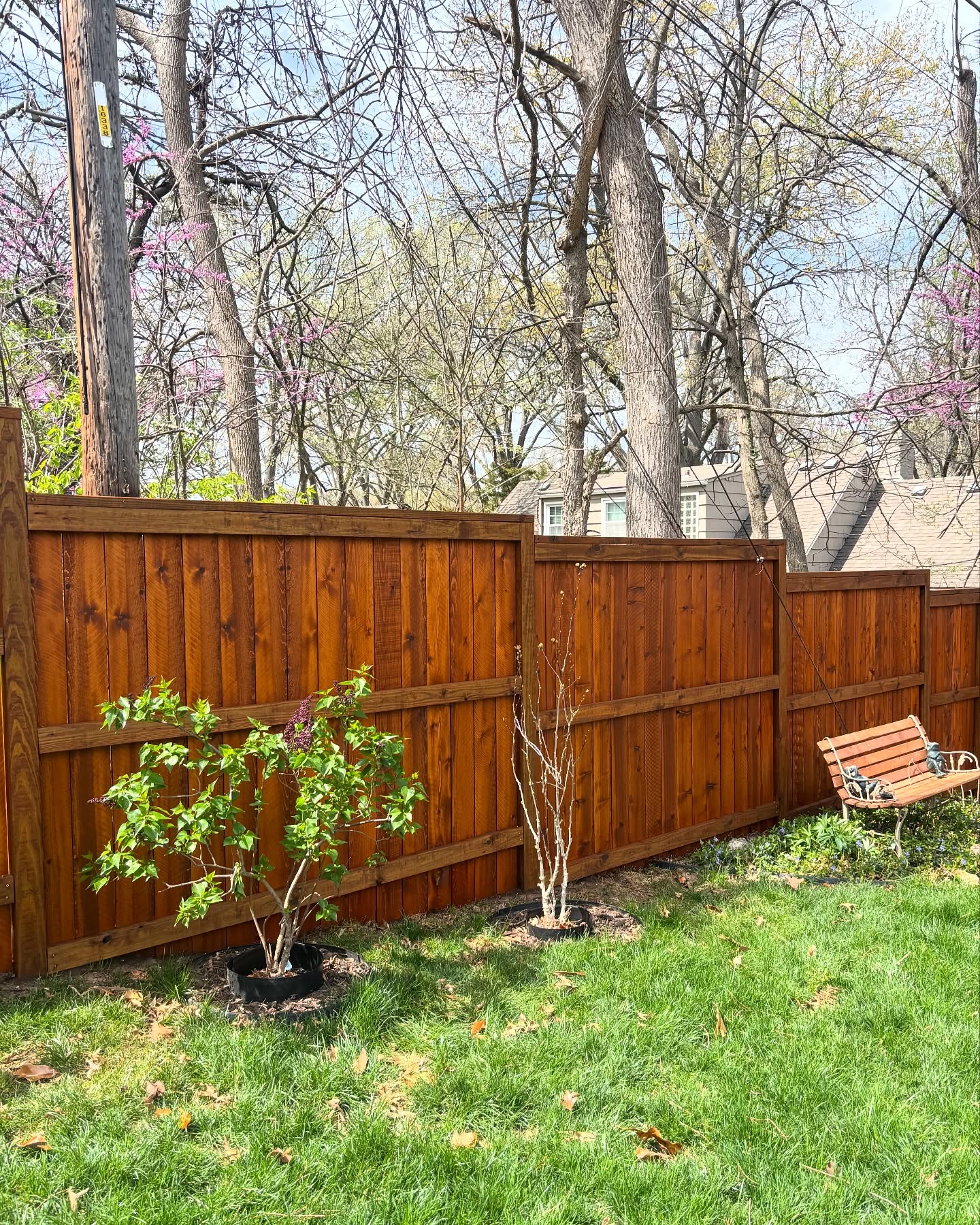
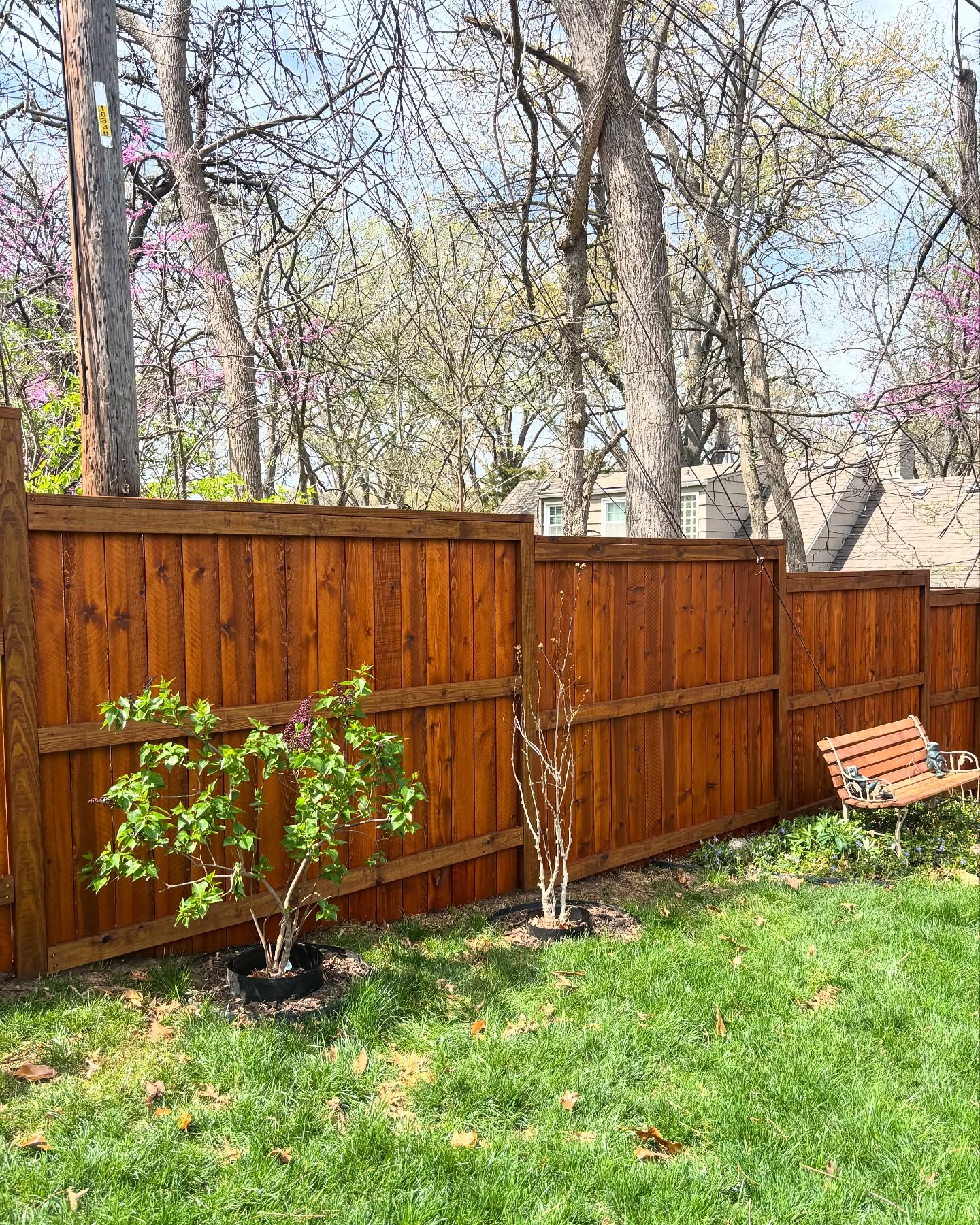
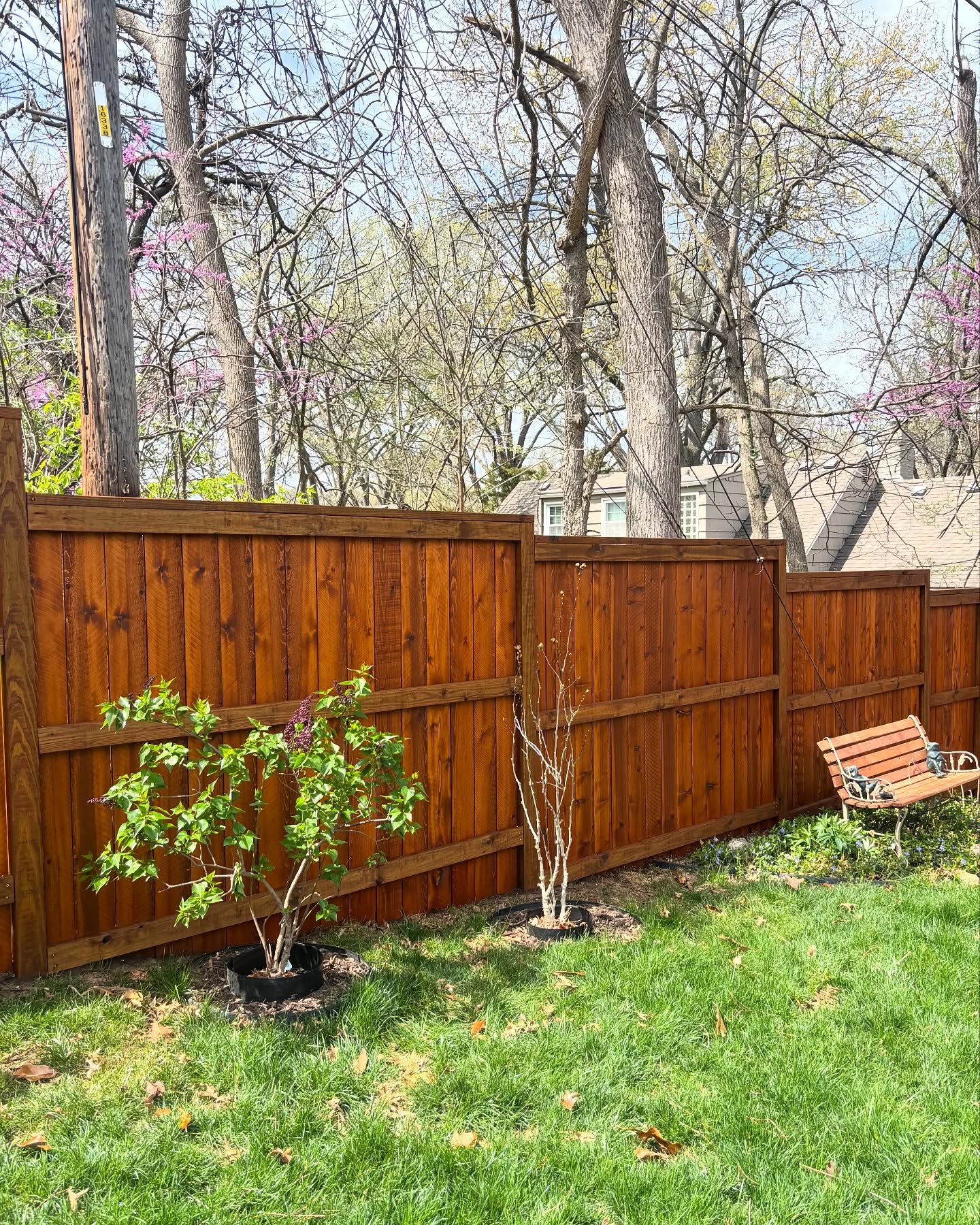
Brown-finish stain on a cedar privacy fence in Grain Valley, MO by RKC Wood Care Pros
Privacy Coat · Grain Valley
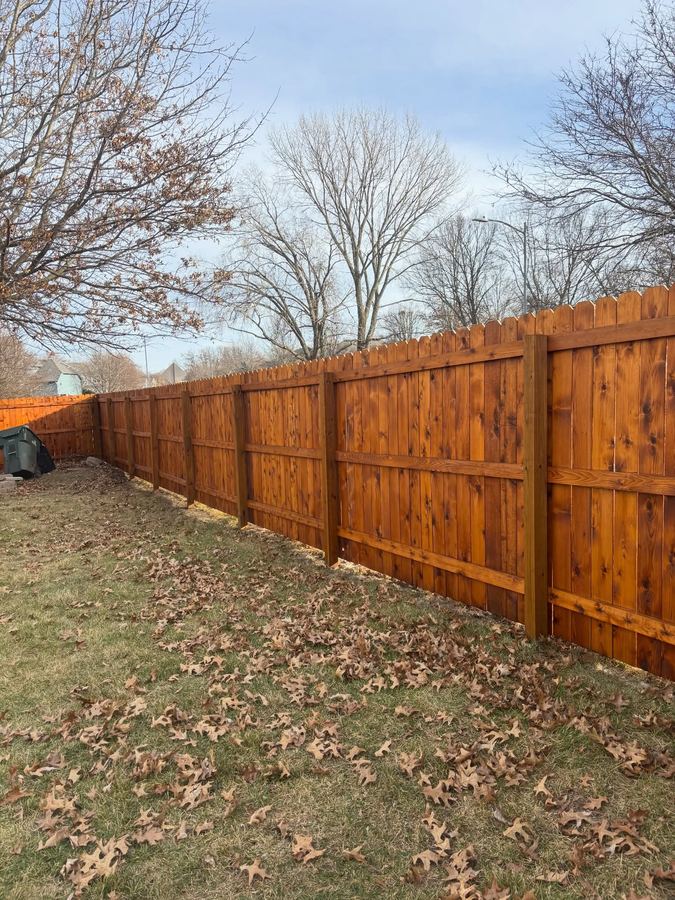
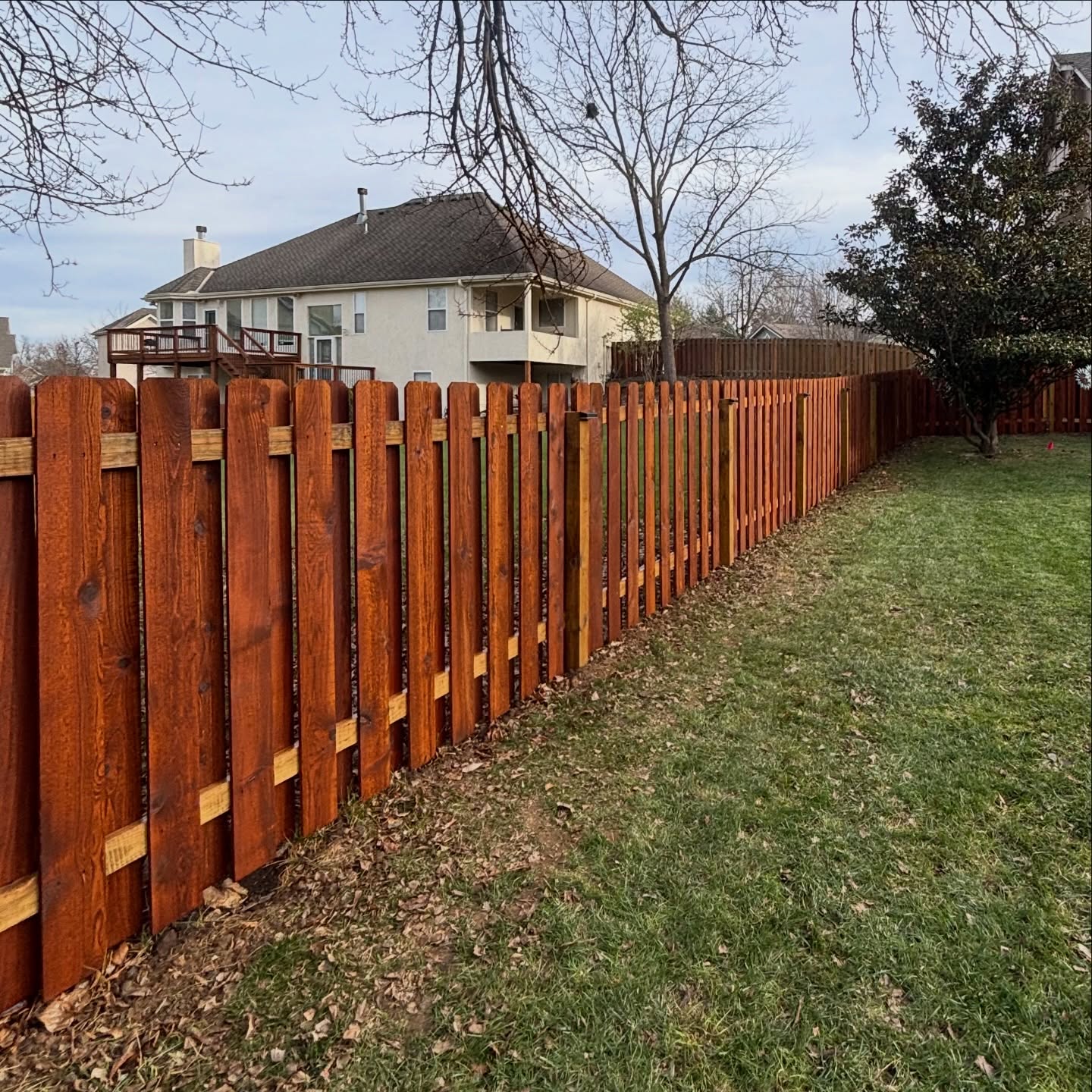
Golden finish on a spaced-picket cedar fence in Grain Valley, MO
Picket Coat · Grain Valley
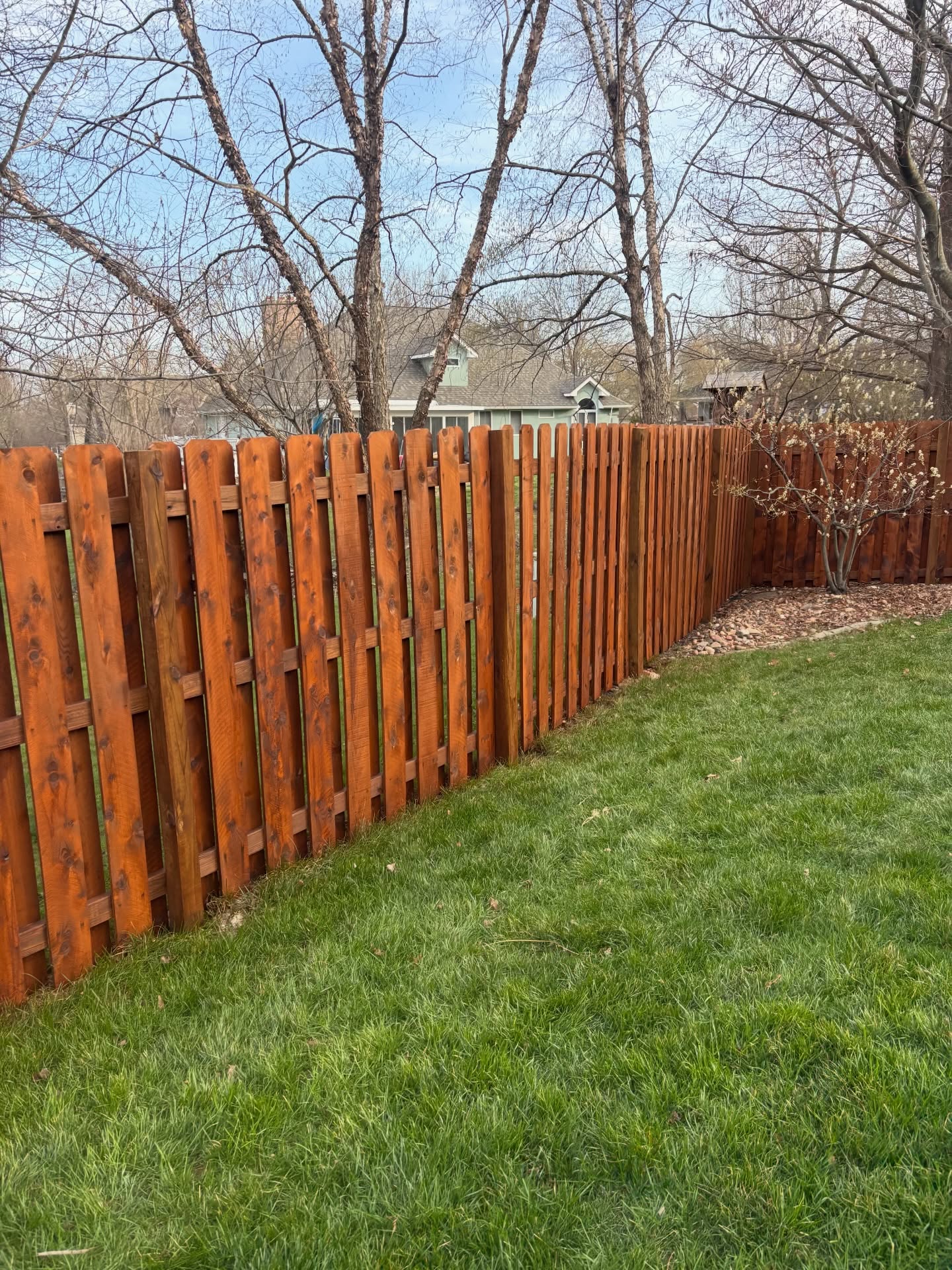
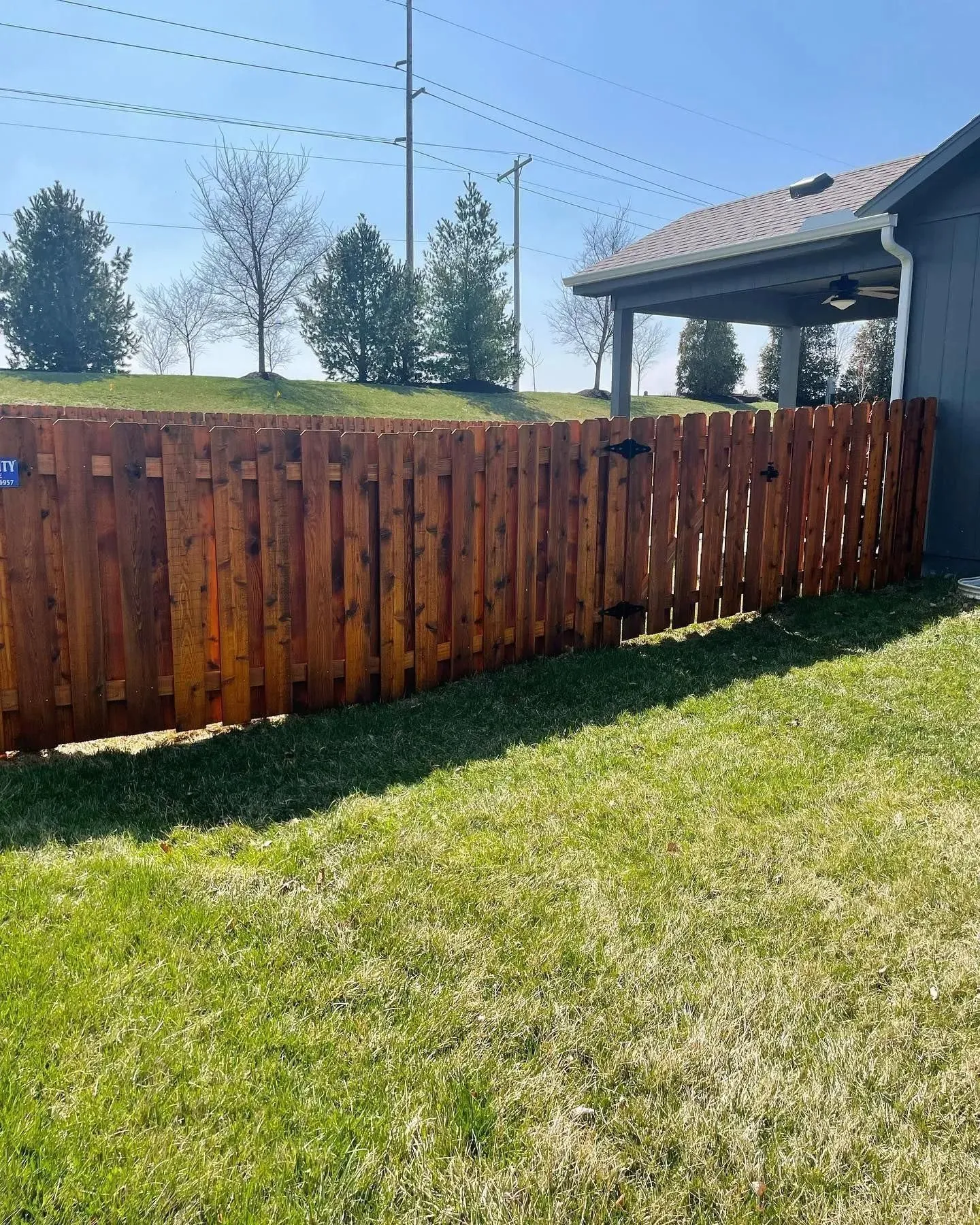
Final coat of stain on a wood fence in Grain Valley, MO
Final Coat · Grain Valley
Wood fence after staining on an open Grain Valley, MO lot
Open-Lot Run · Grain Valley

REVIEWS

What Kansas City Homeowners Say About RKC

4.9 ★ · 85 Google reviews

Every review is on our Google Business Profile — read them there, unedited.

Read all 85 reviews on Google

GRAIN VALLEY STAIN QUESTIONS

Stain Questions Grain Valley Homeowners Ask Most

Three questions decide most Grain Valley stain jobs: how the finish differs by fence type, what the bare open lots do to a coat, and how to keep each style on the right re-coat cycle. These are the ones Grain Valley homeowners raise at the estimate — sorted by topic, each answer tied to the finish-by-type approach, the open-lot exposure, and the honest cadence for each style. Don't see yours? Call (913) 286-1091 and ask.

Grain Valley, MO fence staining by RKC Wood Care Pros

By Fence Type

Does staining a split-rail fence work differently than a privacy fence?
Yes, quite a bit — and Grain Valley has both, so it comes up often. A 6-foot solid privacy run is a big flat face that takes the full prairie sun, so it wants a pigmented semi-transparent on both faces with deeper pigment on the sun side and a sealed ground line — full protection. A split-rail or ranch-rail fence is a different animal: many owners want it to stay rustic and weathered, so the honest choice is a light penetrating tone or a clear-plus-UV sealer that slows graying while keeping the natural look, or just sealing the posts and letting the rails silver. The finish-by-type guide above lays out the approach for each style we run here.
My fence is shadowbox — is it harder to stain?
Not harder, but more work per foot, so it costs a little more. A shadowbox alternates boards so both faces are visible and there are air gaps between the boards — which means we coat it from both sides, working the finish into the gaps and the alternating board edges rather than just rolling one flat face. A spaced picket is similar: far more edges and tops per foot than a solid board, and every one has to be reached or it wicks water and grays early. We spray with a back-brush behind on both, so nothing's left bare. The coverage is the craft on these styles, which is why they run $5–9 a foot versus $4–8 for a flat run.
Should I stain my vinyl fence?
No — and we'll tell you that straight rather than sell you a coat you don't need. Vinyl and composite don't take stain; a coat just sits on the surface and eventually peels or traps dirt, because there's no grain for it to penetrate. If your vinyl run looks dirty, chalky, or dull, the right fix is a proper wash, not a finish. We're a wood-staining crew first, and part of that is being honest about which fences shouldn't be stained at all. If you've got a mixed property — vinyl in front, cedar in back — we'll stain the cedar and leave the vinyl alone.

Open Lots & New Cedar

My Grain Valley lot is wide open with no trees — how does that affect staining?
The open exposure is the biggest factor out here, and it's why we lean on deeper pigment and a shorter re-coat cycle. With no mature trees to break the sun or the prairie wind, a fence takes full UV and constant drying from day one, which weathers a finish faster than a sheltered, tree-shaded yard. On solid runs we carry more pigment onto the west and south faces that catch the worst of it, seal the ground line, and favor the shorter end of the 2-year cycle. The wind also matters at application — we meter through the board rather than trusting a surface that the wind dried fast. On an open lot the coat is simply doing more work.
I just had a new cedar fence put up in Grain Valley — when should I stain it?
Give new cedar about 30 days first, so its internal moisture falls far enough that a penetrating finish keys into the grain instead of beading off. Since whole streets of new cedar go up together as the subdivisions fill, this is one of the most common questions we get here. The first coat is also where the fence-type approach starts: a new privacy run gets both faces and a sealed ground line, a new picket gets every edge, a new split-rail gets the light-touch conversation. We time it to the cure, lay it the way your structure calls for, seal it against the open sun and wind, and log it. On our own installs the first coat is often folded into the price.

Cadence & Restoration

How often will each type of fence need re-staining out here?
It varies by type and by how exposed the lot is. A solid cedar privacy or shadowbox run on an open Grain Valley lot runs about every 2 years, favoring the shorter end because the full sun and wind weather it fast. A spaced picket is similar. A lightly-sealed split-rail or ranch-rail fence goes longer between touch-ups, especially if the owner is fine with it weathering naturally. Vinyl never needs staining at all. Whatever your fence is, we log its type and next date and circle back when it's due, so each one stays on the right cycle for what it is rather than all getting treated the same.
My bare-lot fence has gone completely gray — is it too late to stain it?
Almost never too late. On Grain Valley's open lots bare wood silvers fast, but that gray is usually a thin weathered skin over sound wood, not a spent fence. We strip any failed finish, brighten the run to one tone with an oxalic treatment, wash and hard-dry it, then lay a penetrating coat matched to the fence type. The one thing we check first is the posts — the bare-lot prairie wind can lean a shallow-set post before the wood ever wears out, and there's no return on staining a run that's about to move. Where a post has leaned, we reset it before finishing so the coat gets its full life.

OTHER GRAIN VALLEY FENCE SERVICES

More Fence Services Available in Grain Valley

Each link below keeps you in Grain Valley — its own page, with pricing, conditions, and recent job photos tied to this city rather than the metro at large. Weighing a fresh install, a repair, a gate, or one specific material alongside the staining? Here's where each of those picks up.

Ready when you are

Get a free estimate — we usually respond the same day.

Call (913) 286-1091